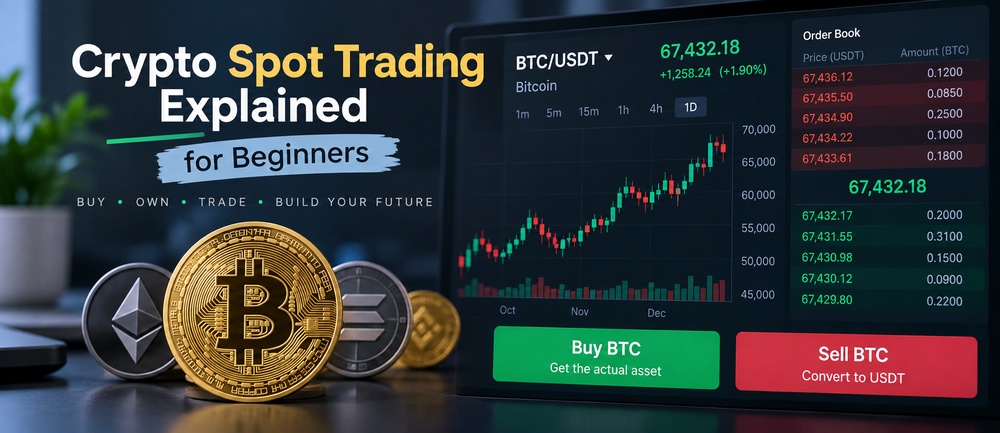
Crypto spot trading is one of the simplest ways to buy and sell cryptocurrency.
Instead of trading a futures contract, borrowing money, or using leverage, a spot trader exchanges one asset for another at the current market price and receives the actual cryptocurrency purchased.
For example, if you buy Bitcoin using USDT on the BTC/USDT spot market, you exchange USDT for BTC. The Bitcoin then appears in your exchange account or wallet, depending on the platform and how you choose to hold it.
That simplicity is one reason spot trading is often the first type of cryptocurrency trading beginners encounter.
However, simple does not mean risk-free.
A beginner still needs to understand trading pairs, market and limit orders, spreads, slippage, trading fees, liquidity, custody, and proper risk management before placing a trade.
This guide explains crypto spot trading for beginners, how the spot market works, how to buy and sell cryptocurrency, and how spot trading differs from margin and futures trading.
Important: This article is for educational purposes only and does not constitute financial, investment, tax, or trading advice. Cryptocurrency prices can be highly volatile, and you can lose part or all of the money committed to a trade.
What Is Crypto Spot Trading?
Crypto spot trading is the direct buying and selling of cryptocurrency in the spot market.
When you make a conventional spot purchase, you are buying the underlying crypto asset rather than a derivative contract that tracks its price.
For example:
- You have 1,000 USDT.
- Bitcoin is trading at $100,000.
- You use 500 USDT to buy BTC.
- Ignoring fees, you receive approximately 0.005 BTC.
You now own the BTC purchased through that transaction.
If Bitcoin later rises to $110,000, the approximate market value of your 0.005 BTC becomes:
$110,000 × 0.005 = $550
If you sell the BTC at that price, your gross gain before trading costs would be approximately:
$550 − $500 = $50
If Bitcoin instead falls to $90,000, the position would be worth approximately:
$90,000 × 0.005 = $450
That would represent an unrealized loss of approximately $50 until you sell.
The key idea is straightforward:
Spot trading exchanges assets you already have for assets you want to buy at prices available in the current market.
Binance Academy describes spot trading as the direct buying and selling of assets at current market prices, normally without the borrowing and leverage mechanics associated with margin or futures products.
What Does “Spot” Mean in Crypto?
The word spot refers to trading an asset for delivery at or around the current market price.
In cryptocurrency markets, spot transactions generally settle quickly inside the trading platform.
Suppose the BTC/USDT market currently shows:
BTC price: 100,000 USDT
If you place a market buy order for BTC, your order attempts to execute against available sell orders in the order book.
Once filled, your account balance changes.
You have:
Less USDT
and:
More BTC
Unlike a futures trader, you do not simply hold a contract representing exposure to Bitcoin’s price.
You have purchased the underlying BTC within the platform’s custody system.
How Crypto Spot Trading Works
Most spot markets operate through trading pairs.
A trading pair shows which asset you are buying or selling and which asset is being used to price it.
Examples include:
- BTC/USDT
- ETH/USDT
- SOL/USDT
- ETH/BTC
- BTC/USD
Consider:
BTC/USDT
BTC is the base asset.
USDT is the quote asset.
If BTC/USDT trades at:
100,000
that means approximately:
1 BTC = 100,000 USDT
Buying BTC/USDT
When you buy BTC/USDT, you are using USDT to acquire BTC.
Selling BTC/USDT
When you sell BTC/USDT, you are exchanging BTC back into USDT.
Understanding which asset is the base and which is the quote currency helps prevent order-entry mistakes.
Simple Crypto Spot Trading Example
Suppose you deposit:
2,000 USDT
into a cryptocurrency exchange.
Bitcoin is trading at:
100,000 USDT per BTC
You decide to buy:
0.01 BTC
The approximate purchase value is:
0.01 × 100,000
= 1,000 USDT
Ignoring fees, after the purchase you would have approximately:
- 0.01 BTC
- 1,000 USDT remaining
Now assume Bitcoin rises to:
105,000 USDT
The BTC position is now worth:
0.01 × 105,000
= 1,050 USDT
Gross unrealized profit:
1,050 − 1,000
= 50 USDT
If you sell the 0.01 BTC at approximately that price, the profit becomes realized.
Your true net result will be slightly different after applicable trading fees, spread, and slippage.
For a detailed explanation of the calculation, see our How to Calculate Crypto Profit and Loss guide.
Spot Trading Does Not Automatically Mean You Control the Private Keys
Buying cryptocurrency in the spot market gives you an economic interest in the underlying asset, but there is an important custody distinction.
If the crypto remains on a centralized exchange, the exchange typically controls the private keys associated with the blockchain wallets holding customer assets.
If you withdraw the cryptocurrency to a self-custody wallet, you control the private keys or seed phrase.
Investor.gov explains in its crypto asset custody guidance that crypto custody concerns how and where crypto assets are held and accessed and that private keys are critical to controlling access.
Beginners should therefore distinguish between:
Owning a spot position on an exchange
and:
Personally controlling the private keys to the asset
These are not necessarily the same thing.
What Is a Crypto Spot Market?
A crypto spot market is a marketplace where cryptocurrencies are exchanged at current market prices.
Spot markets can exist on:
- Centralized exchanges
- Decentralized exchanges
- Over-the-counter markets
For most beginners, centralized exchanges are the most familiar form.
A centralized exchange typically provides:
- Trading interface
- Order book
- Trade matching
- Account balances
- Deposits and withdrawals
- Market and limit orders
- Custody services
A decentralized exchange may instead use smart contracts and blockchain transactions to allow users to trade from compatible wallets.
The mechanics and risks can differ significantly, so beginners should understand the platform being used rather than assuming all spot markets work identically.
What Is a Crypto Trading Pair?
A trading pair represents two assets that can be exchanged for one another.
Consider:
ETH/USDT
If ETH/USDT is trading at:
4,000
then approximately:
1 ETH = 4,000 USDT
If you buy the pair:
You exchange USDT for ETH.
If you sell the pair:
You exchange ETH for USDT.
Some pairs use fiat currencies such as:
- BTC/USD
- BTC/EUR
Others use stablecoins:
- BTC/USDT
- ETH/USDT
- SOL/USDC
And some trade one cryptocurrency directly against another:
- ETH/BTC
Before entering a trade, always confirm which asset you are paying with and which asset you will receive.
Market Orders vs Limit Orders in Spot Trading
Two of the most common order types beginners encounter are market orders and limit orders.
Market Order
A market order attempts to buy or sell immediately at the best available prices in the order book.
For example, if BTC is trading around:
100,000 USDT
and you submit a market buy order, the exchange fills the order against available sellers.
The advantage is speed.
The disadvantage is that the exact average execution price is not guaranteed.
Large orders or thin markets may experience slippage.
Limit Order
A limit order tells the exchange the maximum price you are willing to pay when buying or the minimum price you are willing to accept when selling.
For example:
Current BTC price:
100,000 USDT
You place a limit buy at:
98,000 USDT
The order will normally remain open unless the market reaches your specified price and sufficient liquidity is available to fill it.
A limit order gives greater price control.
But execution is not guaranteed.
Price may never reach your limit.
What Is an Order Book?
An order book displays outstanding buy and sell orders on an exchange.
The buy side is commonly called:
Bids
The sell side is commonly called:
Asks
The highest current bid represents one of the best prices buyers are offering.
The lowest current ask represents one of the best prices sellers are offering.
The difference between them is the:
Bid-ask spread
Example:
Highest bid:
99,990
Lowest ask:
100,010
Spread:
100,010 − 99,990
= 20 USDT
A highly liquid market typically has:
- More orders
- Greater trading volume
- Tighter spreads
- Better ability to absorb larger orders
A less-liquid coin may have wider spreads and greater slippage.
What Is Slippage in Crypto Spot Trading?
Slippage is the difference between the price you expect and the actual average price at which your order executes.
Suppose BTC shows:
100,000 USDT
You place a large market buy order.
There may not be enough BTC available at exactly 100,000 to fill the entire order.
Part of the order may fill at:
- 100,000
- 100,010
- 100,030
- 100,050
Your average execution price could therefore be above the price you initially saw.
This difference is slippage.
Slippage can become more significant when:
- Liquidity is low
- Volatility is high
- Order size is large
- Markets move rapidly
- You use market orders
A planned trade should therefore consider execution quality, not just the chart price.
Crypto Spot Trading Fees
Spot trading usually involves transaction costs.
These may include:
- Maker fees
- Taker fees
- Bid-ask spread
- Conversion fees
- Withdrawal fees
- Blockchain network fees
- Deposit or payment-method charges
A trade that appears profitable before costs can produce a smaller net result after those costs are included.
For example:
Gross trading profit:
$25
Total entry and exit trading costs:
$8
Approximate net result:
$25 − $8
= $17
This becomes especially important for frequent traders or traders targeting relatively small price movements.
Our dedicated Crypto Trading Fees Explained guide covers maker fees, taker fees, spreads, slippage, withdrawal costs, and other transaction expenses in greater detail.
Crypto Spot Trading vs Futures Trading
Spot trading and futures trading are not the same.
| Feature | Spot Trading | Futures Trading |
|---|---|---|
| Underlying asset | Usually purchased directly | Trade is based on a derivatives contract |
| Leverage | Conventional spot trading normally does not require leverage | Often available |
| Liquidation | No leverage-based liquidation in a standard fully paid spot purchase | Leveraged positions can be liquidated |
| Funding payments | Generally not applicable to ordinary spot holdings | May apply to perpetual futures |
| Expiration | No contract expiration for the purchased asset | Depends on contract; perpetuals do not expire |
| Short selling | Normally requires another mechanism | Commonly available through derivatives |
| Complexity | Relatively straightforward | More complex |
| Risk | Market, custody, liquidity, execution and platform risks | Includes those plus leverage and liquidation risks |
Spot trading still carries substantial risk because the cryptocurrency itself can fall sharply in value.
But conventional fully funded spot trading does not have the same leverage-driven liquidation mechanics found in many futures products.
If you want to understand those mechanics separately, see Crypto Leverage Explained for Beginners and Crypto Margin and Liquidation Explained.
Can You Lose All Your Money in Spot Trading?
Yes.
The absence of leverage does not eliminate market risk.
If you buy a cryptocurrency and its market value falls substantially, the value of your position falls with it.
Suppose you buy:
$1,000 of a cryptocurrency
If its market price falls by:
50%
your position becomes worth approximately:
$500
If the asset were ultimately to become worthless, the economic loss could approach the entire amount invested.
Other risks may include:
- Exchange failure
- Fraud
- Hacking
- Token-specific failure
- Illiquidity
- Stablecoin risk
- Operational mistakes
- Loss of wallet credentials
- Regulatory changes
- Network problems
The CFTC’s customer advisory on virtual currency trading specifically warns that virtual currency markets can be highly volatile and that customers should understand the risks before speculating.
Does Spot Trading Have Liquidation?
A normal fully paid spot position does not have leverage-based liquidation.
If you buy $1,000 worth of BTC using $1,000 of your own funds, the exchange does not normally liquidate that BTC merely because its market price falls.
You still own the BTC unless you sell it, transfer it, or another platform-specific event affects the holding.
This is different from leveraged margin or futures trading.
A leveraged position uses collateral to support a larger market exposure. If losses reduce collateral below the platform’s required maintenance level, the position may be liquidated.
That distinction is one of the most important reasons beginners should know whether they are using:
- Spot
- Margin
- Futures
- Perpetual futures
before submitting an order.
Can You Short Cryptocurrency in Spot Trading?
In a basic spot transaction, you normally sell cryptocurrency that you already own.
For example:
You own:
1 ETH
You sell:
1 ETH
That is a spot sale.
To profit directly from falling prices by opening a short position, traders commonly use:
- Margin borrowing
- Futures
- Perpetual futures
- Other derivative products
Those products introduce additional mechanics and risks.
Therefore, beginners should not assume that a Sell button always means the same thing on every trading interface.
On a spot interface, selling typically means exchanging an asset you already hold.
On a derivatives interface, selling may open or increase a short position.
How to Start Crypto Spot Trading
A beginner can think about the process in several stages.
Step 1: Choose a Platform Carefully
Evaluate factors such as:
- Regulatory status where applicable
- Security practices
- Trading fees
- Supported cryptocurrencies
- Deposit and withdrawal options
- Liquidity
- Custody structure
- Account security
- Withdrawal controls
Do not choose an exchange solely because it advertises many coins or unusually high returns.
Step 2: Secure the Account
Use available security features such as:
- Strong unique password
- Multi-factor authentication
- Withdrawal safeguards
- Anti-phishing features
Never disclose private keys or seed phrases.
Step 3: Deposit Funds
Depending on the platform, you may fund the account using:
- Fiat currency
- Stablecoins
- Existing cryptocurrency
Always confirm the correct blockchain network before making crypto deposits or withdrawals.
Sending an asset through an incompatible network can result in loss of funds.
Step 4: Select the Correct Spot Trading Pair
Suppose you want to buy Bitcoin using USDT.
You would typically select:
BTC/USDT
Confirm that you are on the spot market rather than a futures or margin interface.
Step 5: Choose an Order Type
For beginners, the most common choices are:
- Market order
- Limit order
Understand the difference before submitting the trade.
Step 6: Determine Your Position Size
Do not simply use the maximum amount available in the account.
Decide:
- How much capital you want exposed
- Where your trade idea becomes invalid
- How much money you are prepared to lose
- Whether a stop-loss plan is appropriate
- Whether fees and slippage materially affect the trade
Our Crypto Position Sizing Explained guide explains how to connect account size, stop-loss distance, and acceptable risk.
Step 7: Review the Order Before Confirming
Check:
- Trading pair
- Buy or sell direction
- Order type
- Price
- Quantity
- Estimated value
- Estimated fees
A simple input error can result in an unintended position.
Step 8: Manage the Trade
After entering, decide in advance how you will respond if:
- Price rises
- Price falls
- Volatility increases
- Your trading thesis becomes invalid
A spot position should still have a risk-management plan.
For a broader framework, see Crypto Risk Management for Beginners.
Should You Use a Stop Loss in Spot Trading?
A stop loss can be useful when a spot position is being managed as a trade rather than a long-term holding.
Suppose you buy BTC at:
100,000 USDT
and your trading setup becomes invalid below:
96,000 USDT
You may plan an exit around that level.
The distance is:
100,000 − 96,000
= 4,000 USDT per BTC
If you are trading 0.02 BTC, the theoretical price risk before fees and slippage would be:
4,000 × 0.02
= 80 USDT
A stop order can help execute an exit plan, but it cannot guarantee the exact fill price during fast markets.
Our Crypto Stop Loss Explained guide covers stop placement, stop-market versus stop-limit orders, and the relationship between stop distance and position size.
Spot Trading and Position Sizing
Many beginners make the mistake of asking:
How much crypto can I afford to buy?
A better trading question is:
How much am I prepared to lose if this trade is wrong?
Suppose your account contains:
$10,000
You decide that the maximum planned loss for one trade is:
$100
If your planned stop distance represents:
5% of the asset price
then a simplified position-size estimate is:
$100 ÷ 5%
= $2,000 position value
The fact that your account contains $10,000 does not mean you need to put all $10,000 into one spot trade.
Position size should be connected to risk.
Common Crypto Spot Trading Mistakes
1. Buying Without Understanding the Trading Pair
Always confirm what you are buying and what asset you are spending.
2. Using Market Orders Without Considering Slippage
Market orders prioritize execution rather than a guaranteed price.
3. Ignoring Trading Fees
Fees reduce the net result of every completed trade.
4. Putting Too Much Capital Into One Coin
Concentration increases exposure to one asset’s price and project-specific risks.
5. Assuming Spot Trading Is Safe Because There Is No Leverage
Spot trading removes some leverage-related risks, but market and custody risks remain.
6. Leaving Large Balances on an Exchange Without Understanding Custody
Understand who controls the private keys and what happens if the platform experiences operational or financial problems.
7. Chasing Rapid Price Moves
Entering after a sudden rally without a defined plan can lead to poor execution and emotional decision-making.
8. Trading Illiquid Coins
Low-liquidity assets may have large spreads and severe slippage.
9. Entering Without an Exit Plan
Know in advance what would cause you to:
- Take profit
- Reduce the position
- Exit at a loss
- Reassess the trade
10. Confusing Spot With Margin or Futures
Always confirm which product you are trading before submitting an order.
Is Crypto Spot Trading Good for Beginners?
Spot trading is generally easier to understand than leveraged derivatives because the basic transaction is direct:
Use one asset → Buy another asset → Hold or sell it later
There is normally no need to calculate:
- Leverage
- Maintenance margin
- Liquidation price
- Funding rate
for a conventional fully paid spot trade.
However, that does not mean every beginner should trade cryptocurrency or that spot trading is inherently safe.
A beginner still needs to understand:
- Volatility
- Position sizing
- Stop-loss planning
- Fees
- Slippage
- Custody
- Exchange risk
- Security
- Emotional decision-making
The simpler product structure only removes some layers of complexity.
It does not remove investment or trading risk.
Crypto Spot Trading vs Holding
Spot trading and long-term holding can involve the same underlying cryptocurrency, but the decision-making process may differ.
A spot trader may focus on:
- Entry price
- Stop loss
- Profit target
- Shorter holding period
- Technical setup
- Trade-by-trade risk
A long-term holder may focus more on:
- Multi-year thesis
- Asset fundamentals
- Portfolio allocation
- Custody
- Long-term volatility tolerance
The transaction used to acquire the asset may still be a spot purchase.
The difference is often the strategy used after the purchase.
Frequently Asked Questions
What is crypto spot trading?
Crypto spot trading is the direct buying and selling of cryptocurrency in the current market. A conventional spot purchase gives the buyer the underlying crypto asset rather than a futures or derivatives contract.
What does spot mean in cryptocurrency?
Spot refers to buying or selling an asset at current market prices for prompt settlement rather than trading a contract for future or derivative exposure.
Is spot trading the same as buying crypto?
Buying cryptocurrency directly on a spot market is a form of spot trading. However, platforms may also offer instant-conversion products with different pricing or fee structures.
Can you use leverage in spot trading?
Conventional spot trading is generally fully funded and does not require leverage. Some platforms offer separate margin products that allow borrowing against spot markets, but that introduces leverage and should not be confused with ordinary unleveraged spot trading.
Can you get liquidated in spot trading?
A standard fully paid spot position is not normally subject to leverage-based liquidation. The asset can still lose substantial value, including potentially most or all of its market value.
Is spot trading safer than futures?
Spot trading avoids certain futures risks such as leverage-driven liquidation and perpetual funding mechanics. However, it still carries market, custody, liquidity, platform, cybersecurity, and execution risks. “Lower complexity” should not be interpreted as “safe.”
What is the difference between spot and futures crypto?
Spot trading exchanges the underlying crypto asset. Futures trading uses a derivatives contract whose value is linked to the cryptocurrency. Futures frequently support leverage and may involve liquidation, margin requirements, and funding or expiry mechanics.
Can I make money with crypto spot trading?
A trader can profit if the asset is sold at a sufficiently higher price than the total purchase cost, after fees and other trading costs. Losses occur when price moves unfavorably or other risks materialize. No trading method guarantees profit.
Do I need a stop loss for spot trading?
Not every investor or strategy uses stop-loss orders, but active traders should have a defined risk and exit plan. A stop loss can help manage downside but cannot guarantee an exact execution price.
What is the best crypto for spot trading?
There is no universally best cryptocurrency. Traders should evaluate liquidity, volatility, spreads, market structure, project risk, platform availability, and their own risk tolerance rather than selecting an asset solely because it recently increased in price.
Final Thoughts
Crypto spot trading is the direct exchange of one asset for another in the current cryptocurrency market.
For beginners, the most important concepts are:
- You are buying the underlying crypto asset.
- Spot markets use trading pairs such as BTC/USDT.
- Market orders prioritize immediate execution.
- Limit orders prioritize price control.
- Spread, slippage, liquidity, and fees affect the true trade result.
- A fully paid spot position does not normally have leverage-based liquidation.
- Spot trading still carries significant market, custody, platform, and security risks.
The simplest way to think about the process is:
Choose the market → Understand the pair → Plan the risk → Choose the order → Check the costs → Execute → Manage the position
Do not confuse a simpler trading product with a low-risk one.
Before placing a spot trade, know how much capital you are exposing and how much you are willing to lose if the market moves against you.
For the next step, review our Crypto Risk Management for Beginners guide and Crypto Position Sizing Explained before increasing your exposure.
Risk Disclaimer: Cryptocurrency trading involves substantial risk and may not be suitable for everyone. Prices can move rapidly, liquidity can deteriorate, and exchanges, wallets, networks, or individual crypto projects can fail. This material is educational only and should not be treated as financial, investment, tax, or legal advice.



This is so interesting and excellent guide for beginners