
Crypto day trading is the practice of opening and closing cryptocurrency trades within the same trading session rather than holding positions for days, weeks, or months.
A day trader may enter Bitcoin, Ethereum, or another cryptocurrency in the morning and close the position a few minutes or several hours later. The goal is to capture relatively short-term price movements while avoiding longer overnight exposure.
Because cryptocurrency markets commonly trade around the clock, however, crypto day trading works differently from day trading traditional stock-market sessions. There is no universal closing bell that automatically defines the end of a crypto trading day. The trader must create a defined trading session and decide when trading stops.
That flexibility can be useful, but it also creates risk.
Crypto markets can move quickly. Frequent entries and exits can increase fees. Leverage can magnify relatively small price movements. And a trader who watches charts for too long can easily move from disciplined trading into overtrading.
This guide explains what crypto day trading is, how it works, what beginners should understand before starting, how to build a basic intraday trading process, and the risks that should never be ignored.
Important: This article is for educational purposes only and does not constitute financial, investment, legal, tax, or trading advice. Cryptocurrency trading can result in substantial losses. Leveraged products can magnify losses and may not be appropriate or available in every jurisdiction.
What Is Crypto Day Trading?
Crypto day trading means buying, selling, going long, or going short on cryptocurrency with the intention of closing the position within the trader’s defined trading session.
The holding period can vary considerably.
A day trade might remain open for:
- A few minutes
- Thirty minutes
- Several hours
- Most of a defined trading session
The key idea is that the trader is trying to profit from short-term market movement rather than holding a long-term investment.
For example, suppose Bitcoin is trading at:
$100,000
A trader identifies a possible intraday breakout and enters at:
$100,500
The trader plans:
- Stop Loss: $99,800
- Take Profit: $101,900
If either exit is reached during the trader’s session, the position is closed.
If neither level is reached, the trader may still close the position before ending the session according to the trading plan.
That is fundamentally different from buying Bitcoin with the intention of holding it for several years.
How Does Crypto Day Trading Work?
A structured crypto day trade generally follows this sequence:
Market Selection → Trading Setup → Entry → Stop Loss → Position Size → Take Profit → Trade Management → Exit → Review
Each stage matters.
A trader who focuses only on the entry signal while ignoring risk, fees, execution, and position size does not have a complete trading process.
1. Choose the Market
A day trader first decides what cryptocurrency or trading pair to monitor.
Common examples include:
- BTC/USD
- BTC/USDT
- ETH/USD
- ETH/USDT
- Other liquid cryptocurrency pairs
Beginners should understand that liquidity matters.
A highly liquid pair generally has more active buyers and sellers than a thinly traded cryptocurrency. Lower liquidity can increase:
- Bid-ask spread
- Slippage
- Irregular price movement
- Difficulty entering or exiting at the expected price
For a beginner, trading a highly volatile but illiquid coin simply because it is moving quickly can create more execution risk than opportunity.
Crypto Day Trading vs Crypto Scalping
Day trading and scalping are related, but they are not identical.
| Feature | Crypto Day Trading | Crypto Scalping |
|---|---|---|
| Typical holding period | Minutes to several hours | Seconds to minutes |
| Number of trades | Usually fewer | Often much higher |
| Profit target | Usually larger per trade | Usually smaller per trade |
| Chart focus | Short-term intraday structure | Very short-term price movement |
| Fee sensitivity | High | Extremely high |
| Screen time | High | Very high |
| Main challenge | Intraday execution and discipline | Speed, costs, execution, and overtrading |
A scalper may take many very short trades during one session.
A day trader may wait much longer for one or two higher-quality setups.
If you want the dedicated explanation of the shorter-term style, see our guide to Crypto Scalping Explained: How It Works, Risks and Strategies.
The important lesson is that trading more frequently does not automatically increase profitability. It increases the number of decisions, transactions, and opportunities for errors.
Crypto Day Trading vs Swing Trading
Swing traders normally hold positions longer than day traders.
A swing trade may remain open for:
- Several days
- One or more weeks
- Occasionally longer
A day trader typically closes positions within the defined intraday session.
That means the two styles often use different:
- Chart timeframes
- Stop-loss distances
- Profit targets
- Position sizes
- Trade frequency
- Market monitoring requirements
Day trading may reduce exposure to longer holding periods, but it creates its own risks through frequent decisions and transaction costs.
Neither style is automatically safer or more profitable.
Spot Day Trading vs Futures Day Trading
Crypto day trading can be performed through different products.
Two common examples are spot trading and futures trading.
Spot Day Trading
In a conventional spot purchase, the trader buys the underlying cryptocurrency.
Suppose you buy BTC using USDT.
You exchange USDT for Bitcoin and receive the purchased BTC in the trading account.
Our guide to Crypto Spot Trading Explained for Beginners explains spot ownership and trading mechanics in more detail.
Spot day traders normally make money from price appreciation when buying first and selling later, although platform features can vary.
Futures Day Trading
Crypto futures are derivative contracts.
A trader may be able to:
- Go long
- Go short
- Use margin
- Use leverage
- Trade without directly owning the underlying cryptocurrency
These features can make futures attractive to active traders, but they also introduce additional risk.
Leverage can magnify losses. Margin requirements apply. Liquidation can occur if a leveraged position moves too far against the trader.
Before considering derivatives, review our guides to Crypto Futures Trading Explained for Beginners and Crypto Margin and Liquidation Explained.
Day trading does not require leverage.
A trader can day trade spot cryptocurrency without using borrowed exposure.
Why Do Traders Day Trade Cryptocurrency?
Crypto attracts day traders for several structural reasons.
24/7 Market Access
Cryptocurrency markets commonly operate continuously rather than following a conventional Monday-to-Friday exchange schedule.
That gives traders access during:
- Weekdays
- Weekends
- Daytime
- Nighttime
But 24/7 availability does not mean a trader should trade 24/7.
A defined session is essential.
Without one, constant market access can encourage fatigue and impulsive trading.
Intraday Volatility
Cryptocurrency prices can experience substantial movement within relatively short periods.
That creates potential trading opportunities.
It also creates larger downside risk.
Investor.gov has repeatedly warned that crypto assets can be highly volatile and speculative and that investors should understand the possibility of substantial loss.
Volatility should therefore be treated as both:
Opportunity and risk
—not as a guarantee of easy profit.
Ability to Trade Different Market Conditions
Depending on the product, day traders may attempt to trade:
- Trends
- Pullbacks
- Breakouts
- Reversals
- Ranges
- Momentum moves
Futures products may also permit short positions.
However, having more ways to trade does not mean every market condition should be traded.
A strategy should define exactly what qualifies as a valid setup.
What Timeframes Do Crypto Day Traders Use?
There is no universal best timeframe.
A trader might use multiple charts for different purposes.
For example:
- 4-hour chart — broader trend or structure
- 1-hour chart — intraday context
- 15-minute chart — setup development
- 5-minute chart — execution
- 1-minute chart — very precise entry work, if the strategy requires it
The mistake is assuming that a lower timeframe automatically creates better opportunities.
Lower timeframes generally contain more market noise and produce more frequent signals.
A practical approach is to separate:
Context timeframe
from:
Entry timeframe
For example, a trader might identify the dominant intraday structure on the 1-hour chart and wait for an entry setup on the 15-minute chart.
Common Crypto Day Trading Setups
A strategy should be tested rather than adopted simply because it appears logical on a chart.
Some common intraday setup categories include the following.
Breakout Trading
A breakout occurs when price moves beyond a recognized support or resistance area.
Example:
Bitcoin repeatedly fails to move above:
$100,000
Price later breaks above that level with strong momentum.
A day trader might wait for confirmation before entering.
The risk is a false breakout.
Price may move briefly above resistance and then reverse sharply.
Break-and-Retest Trading
Instead of entering immediately after the breakout, the trader waits for price to return to the broken level.
The former resistance may act as support.
A possible sequence is:
Resistance Break → Retest → Confirmation → Entry
This can provide a clearer invalidation point, although the retest may never occur.
Trend Pullback
If the market is making:
- Higher highs
- Higher lows
a trader may wait for a pullback rather than buying after an extended upward move.
In a downtrend:
- Lower highs
- Lower lows
a derivatives trader might instead wait for a rally into resistance before considering a short setup.
Range Trading
Some cryptocurrency markets spend periods moving between identifiable support and resistance.
A trader may attempt to buy near support and exit closer to resistance.
The main danger is that the range eventually breaks.
A trade that assumes support will continue holding needs a predefined exit if support fails.
Momentum Trading
Momentum traders look for unusually strong price movement, often accompanied by rising activity or a catalyst.
Momentum can continue longer than expected.
It can also reverse abruptly.
Entering after a large move without a defined invalidation level can create poor risk-to-reward.
Market Orders vs Limit Orders for Day Trading
Execution matters in short-term trading.
A correct directional idea can still produce a poor result if the entry or exit is badly executed.
Market Order
A market order attempts to execute immediately at the best available prices.
The advantage is speed.
The disadvantage is price uncertainty.
During fast movement, the final execution price may differ from the price visible when the order was submitted.
Coinbase’s official explanation of advanced trading order types notes that market orders execute against available liquidity and can fill at multiple prices.
This difference between the expected and actual execution price is called slippage.
Limit Order
A limit order specifies the maximum price you are willing to pay when buying or the minimum price you are willing to accept when selling.
This provides more price control.
But execution is not guaranteed.
Price can touch or approach your limit and move away before the order fills completely.
For a day trader, the decision between market and limit execution should be part of the tested strategy.
Stop Loss Is Essential—but Not Guaranteed
A stop loss defines where you intend to exit when the trade thesis is invalidated.
Suppose:
- BTC entry: $80,000
- Planned stop: $78,800
Stop distance:
$80,000 − $78,800 = $1,200
Percentage stop distance:
$1,200 ÷ $80,000 × 100 = 1.5%
That does not mean you are risking 1.5% of your entire trading account.
Account risk depends on position size.
Our Crypto Stop Loss Explained guide explains how to connect technical invalidation, stop distance, and position sizing.
Also remember that a stop order cannot guarantee the exact final execution price.
During rapid market movement, slippage can increase the realized loss.
How to Calculate Position Size for a Crypto Day Trade
Position size should be calculated from risk.
Not from confidence.
Suppose your trading account is:
$10,000
You decide the maximum planned account risk for one trade is:
1%
Maximum planned risk:
$10,000 × 0.01 = $100
Now suppose your stop is:
2% away from entry
Ignoring fees and slippage for simplicity:
Position Size = Risk Amount ÷ Stop Distance %
Therefore:
$100 ÷ 0.02 = $5,000
Approximate position value:
$5,000
A 2% adverse move in a $5,000 position equals approximately:
$100
This illustrates an important principle:
Stop Distance Determines Position Size
A tighter stop may permit a larger position for the same monetary risk.
A wider stop requires a smaller position.
For the full calculation process, see our Crypto Position Sizing Explained guide.
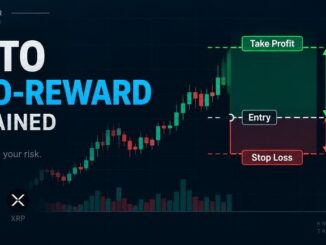
Risk-to-Reward Matters in Day Trading
Day traders take frequent decisions, so the relationship between average winning and losing trades matters greatly.
Suppose a trade has:
- Entry: $100
- Stop: $98
- Target: $104
Potential risk:
$2
Potential reward:
$4
Risk-to-reward:
1:2
But a 1:2 trade is not automatically profitable.
Profitability also depends on:
- Win rate
- Average actual win
- Average actual loss
- Fees
- Spread
- Slippage
- Execution quality
Our Crypto Risk-to-Reward Ratio Explained guide covers the relationship between risk-to-reward, win rate, and expectancy.
Trading Fees Matter More for Active Traders
Day traders may enter and exit frequently.
Every transaction can create costs.
These may include:
- Maker fees
- Taker fees
- Bid-ask spread
- Slippage
- Funding payments
- Borrowing costs
- Other product-specific charges
Suppose a day trader makes five round-trip trades.
That means:
5 entries + 5 exits = 10 transactions
Even relatively small fees can accumulate.
This is why a strategy should be tested using net results after realistic trading costs, not only theoretical chart profit.
For a complete breakdown, see our guide to Crypto Trading Fees Explained.
A Simple Crypto Day Trading Process for Beginners
A disciplined process can be organized into nine steps.
Step 1: Define Your Trading Session
Choose a period when you will actively monitor the market.
Example:
09:00 to 12:00
or:
14:00 to 18:00
The exact session should fit your strategy, market activity, and personal schedule.
When the session ends, stop searching for new trades.
Step 2: Select a Small Watchlist
Beginners do not need to monitor dozens of coins.
A small list of liquid markets is easier to follow consistently.
For example:
- BTC
- ETH
- One or two additional liquid markets
Step 3: Identify the Market Condition
Ask whether the market is:
- Trending
- Ranging
- Breaking out
- Highly volatile
- Illiquid or irregular
Do not force a trend strategy into a range.
Step 4: Wait for a Defined Setup
Your strategy should specify what must happen before you enter.
For example:
Breakout → Retest → Bullish confirmation → Entry
If the setup does not appear, there is no trade.
Step 5: Determine the Invalidation Level
Ask:
At what price is my trade idea wrong?
That level helps define the stop.
Step 6: Calculate Position Size
Determine:
- Account equity
- Maximum planned monetary risk
- Stop distance
- Position size
Do this before entering.
Step 7: Determine the Profit Target
Set a target based on:
- Market structure
- Support or resistance
- Strategy rules
- Expected risk-to-reward
Do not place an unrealistic target simply to make the ratio look better.
Step 8: Execute and Manage the Trade
Once entered, follow the predefined plan.
Avoid changing the rules because of fear, greed, or a single candle.
Step 9: Record the Trade
Track:
- Setup
- Entry
- Stop
- Target
- Position size
- Result
- Fees
- Slippage
- Screenshot
- Whether rules were followed
The trading journal should evaluate the process, not merely whether the trade won.
Example of a Crypto Day Trade
Assume a hypothetical BTC trade.
Account equity:
$10,000
Maximum planned risk:
0.5%
Risk amount:
$50
BTC entry:
$100,000
Stop:
$99,000
Stop distance:
1%
Approximate position value:
$50 ÷ 0.01 = $5,000
At $100,000 BTC:
$5,000 ÷ $100,000 = 0.05 BTC
Suppose the target is:
$102,000
Potential price reward:
2%
Approximate gross potential profit:
$5,000 × 0.02 = $100
Approximate planned risk:
$50
The theoretical risk-to-reward is:
1:2
But actual results can differ because of:
- Fees
- Spread
- Slippage
- Partial fills
- Execution delay
That is why a trading plan should include realistic transaction costs.
How Much Money Do You Need to Day Trade Crypto?
There is no universal minimum account size for crypto day trading.
Minimum requirements depend on:
- Exchange
- Trading pair
- Minimum order size
- Product
- Fees
- Strategy
- Stop distance
- Risk per trade
The important question is not:
“How much do I need to make large profits?”
It is:
“Can this account size support my strategy while keeping monetary risk acceptably small?”
An account that is too small relative to fees, minimum order sizes, and the trader’s expected income target can encourage excessive leverage.
That is dangerous.
The account should determine the realistic position size.
The desired profit should not determine how much risk is forced onto the account.
Is Leverage Necessary for Crypto Day Trading?
No.
Leverage is not required to day trade cryptocurrency.
It simply increases market exposure relative to the capital used as margin.
Suppose you have:
$1,000 margin
and use:
10× leverage
You may control approximately:
$10,000 of market exposure
A 1% adverse move in a $10,000 position represents approximately:
$100
Relative to $1,000 of margin, that is already:
10%
before considering fees or other costs.
Leverage can therefore turn an ordinary intraday movement into a large account loss.
Before using leveraged products, understand Crypto Leverage Explained for Beginners.
Common Crypto Day Trading Mistakes
1. Trading Without a Defined Setup
Entering because “Bitcoin looks like it is going up” is not a complete strategy.
Define the exact conditions required for entry.
2. Risking Too Much Per Trade
A few oversized losses can damage the account quickly.
Risk should be determined before entry.
3. Overtrading
More trades do not automatically mean more profit.
Each additional trade creates another opportunity for:
- Fees
- Slippage
- Execution errors
- Emotional decisions
4. Chasing Price
Entering after a large candle because of fear of missing out often produces poor entry location.
If the planned setup has already passed, wait for another opportunity.
5. Moving the Stop Loss Farther Away
If a planned $50 loss is allowed to become $150 simply because the trader does not want to be wrong, the original risk model has been abandoned.
6. Ignoring Trading Costs
A strategy can look profitable before fees and unprofitable afterward.
Active traders must calculate net results.
7. Using Excessive Leverage
Leverage changes exposure.
It does not improve the quality of the setup.
8. Trading Illiquid Coins
Fast percentage movement can look attractive, but thin liquidity can produce severe slippage and poor exits.
9. Trading All Day Because Crypto Is Always Open
A 24/7 market can encourage fatigue.
Fatigue reduces decision quality.
Define a session.
10. Changing Strategy After Every Loss
Every strategy experiences losing trades.
One loss does not prove the strategy is invalid.
Evaluate a meaningful sample of trades under consistent rules.
Why a Trading Journal Matters
A journal allows a trader to move from opinions to data.
After 50 or 100 trades, you can measure:
- Win rate
- Average win
- Average loss
- Average risk-to-reward
- Net profitability
- Fees
- Maximum losing streak
- Drawdown
- Best-performing setup
- Worst-performing setup
- Best trading hours
- Rule violations
Without records, a trader may remember dramatic winners and forget repeated small losses.
A journal creates accountability.
Crypto Day Trading Risk Management
Day trading should sit inside a broader account-risk framework.
At minimum, consider defining:
- Maximum risk per trade
- Maximum daily loss
- Maximum number of trades
- Maximum simultaneous exposure
- Maximum leverage
- Trading-session hours
- Conditions that require stopping
For example, a trader might have a rule such as:
Stop trading after three consecutive losses or after reaching the predefined daily loss limit.
The exact rule depends on the tested strategy.
The principle is more important:
There must be a point where trading stops.
Our Crypto Risk Management for Beginners guide covers account-level risk controls in more detail.
Platform and Custody Risk Still Matter
Day traders often focus almost entirely on price risk.
But crypto trading can also involve platform and custody risk.
Investor.gov’s crypto asset custody guidance recommends carefully researching third-party custodians and protecting account credentials, private keys, and seed phrases.
A trader should consider:
- Exchange security
- Withdrawal policies
- Regulatory status
- Account protection
- Two-factor authentication
- Counterparty risk
- Custody arrangements
A profitable trading strategy cannot protect capital if the trading platform itself fails or account security is compromised.
Can You Make Money Day Trading Crypto?
It is possible for a trading strategy to produce profits.
But there is no guarantee that day trading will be profitable.
The result depends on whether the trader actually has a repeatable positive-expectancy process after costs.
A simplified expectancy formula is:
Expectancy = (Win Rate × Average Win) − (Loss Rate × Average Loss)
Suppose:
- Win rate: 45%
- Average win: $120
- Loss rate: 55%
- Average loss: $70
Calculation:
(0.45 × $120) − (0.55 × $70)
$54 − $38.50 = +$15.50
The theoretical expectancy is:
+$15.50 per trade before additional costs
Now subtract:
- Fees
- Spread
- Slippage
- Funding where applicable
A strategy should be evaluated based on its real net performance.
Not screenshots of individual winning trades.
Is Crypto Day Trading Good for Beginners?
Day trading is demanding.
A beginner must make decisions about:
- Market selection
- Setup quality
- Entry
- Stop placement
- Position size
- Profit targets
- Fees
- Execution
- Trade management
- Emotional control
That creates a steep learning curve.
A beginner does not need to start by risking real money.
A more disciplined progression is:
Learn → Define Rules → Study Historical Charts → Backtest → Paper Trade or Simulate → Review Results → Use Small Risk Only If Appropriate
The objective is to validate the process before increasing financial exposure.
Frequently Asked Questions
What is crypto day trading?
Crypto day trading means opening and closing cryptocurrency trades within a defined intraday trading session to attempt to capture short-term price movements.
Is crypto day trading the same as scalping?
No. Scalping is generally a faster trading style involving shorter holding periods and often more trades. Day trading can involve positions held for minutes or several hours.
Can you day trade Bitcoin?
Yes. Bitcoin is widely traded in spot and derivatives markets. The exact product, trading rules, fees, leverage, and availability depend on the platform and jurisdiction.
Do crypto day traders hold positions overnight?
A strict day-trading approach generally closes positions before the trader’s defined session ends. Because crypto trades 24/7, the trader must personally define what constitutes the end of the session.
What is the best timeframe for crypto day trading?
There is no universal best timeframe. Traders commonly combine a broader context chart with a lower execution timeframe. The appropriate combination depends on the tested strategy.
Do you need leverage to day trade crypto?
No. Leverage is optional and increases exposure and risk. Spot cryptocurrency can be day traded without leverage.
How many trades should a crypto day trader take per day?
There is no required number. A strategy should determine trade frequency. Forcing trades to meet a daily target can lead to overtrading.
Is crypto day trading profitable?
It can be profitable for some strategies and traders, but there is no guaranteed profit. Net results depend on win rate, average win, average loss, risk management, trading costs, execution, and discipline.
What cryptocurrencies are best for day trading?
Rather than searching for a universal “best” coin, beginners should evaluate liquidity, spread, volatility, market depth, trading costs, and whether the market fits their tested strategy.
Is crypto day trading risky?
Yes. Risks include volatility, leverage, liquidation, slippage, fees, platform failure, custody problems, technical outages, and emotional overtrading.
Final Thoughts
Crypto day trading is not simply buying a coin and hoping it rises before the end of the day.
A disciplined day-trading process requires:
Defined Session → Clear Setup → Logical Stop → Risk-Based Position Size → Realistic Target → Controlled Execution → Trade Journal
Short-term cryptocurrency trading can create frequent opportunities, but it also creates frequent opportunities to make mistakes.
The fact that crypto markets are open 24/7 does not mean you should trade continuously.
The fact that leverage is available does not mean you should use it.
And the fact that a cryptocurrency is volatile does not mean the movement can be predicted consistently.
For beginners, the priority should be building a repeatable process rather than maximizing trade frequency.
Understand the market.
Define the setup.
Calculate the risk.
Control the position size.
Track the results.
Only then can you determine whether a day-trading strategy has a genuine edge after fees, slippage, and losses are included.
Risk Disclaimer: Cryptocurrency trading involves substantial risk and may not be suitable for everyone. Prices can move rapidly, leveraged positions can be liquidated, and stop orders may execute at prices different from the intended level. Trading platforms can also experience outages, security incidents, withdrawal restrictions, or failure. Never interpret historical or hypothetical results as a guarantee of future performance. This material is provided solely for educational purposes.


Be the first to comment