If you trade Bitcoin through a broker, CFD platform, MetaTrader account, or crypto-derivatives exchange, you may eventually face a simple question:
What BTCUSD lot size should I trade?
The answer is not simply “0.01 lot,” “0.10 lot,” or whatever your broker allows.
A proper Bitcoin lot size should be based on:
- Your account equity
- The percentage of your account you are prepared to risk
- Your BTCUSD entry price
- Your stop-loss price
- The BTCUSD contract size used by your broker or platform
- The platform’s minimum volume and volume step
- Trading costs, slippage, and leverage
The most important principle is:
Calculate the amount of money you are willing to lose first. Then convert that risk into the correct BTCUSD trade size.
This guide explains what Bitcoin lot size means, how BTCUSD position sizing works, how to convert BTC quantity into lots, and why you should never assume that every broker uses the same Bitcoin contract specification.
Important: This article is for educational purposes only and does not constitute financial, investment, or trading advice. Bitcoin and leveraged cryptocurrency products are highly volatile. Actual losses can exceed planned losses because of slippage, gaps, fees, liquidation, execution conditions, and other market risks.
What Is Bitcoin Lot Size?
Bitcoin lot size is the trading volume used to represent the size of a BTCUSD position on a broker or trading platform.
In traditional forex trading, traders commonly think in standardized lot sizes such as:
- 1.00 lot
- 0.10 lot
- 0.01 lot
BTCUSD can also be quoted in lots on CFD and MetaTrader platforms.
However, there is an important difference:
The amount of Bitcoin represented by one lot is determined by the contract specification of the broker or trading product.
For example, some BTCUSD CFD products define:
1.00 lot = 1 BTC
Under that contract specification:
- 1.00 lot = 1 BTC
- 0.10 lot = 0.10 BTC
- 0.01 lot = 0.01 BTC
But you should never assume that this relationship applies everywhere.
Crypto exchanges may express order quantities directly in BTC or use different contract structures. Even within one exchange, specifications can differ between spot, USD-margined futures, coin-margined futures, and other derivatives.
For this reason, always verify the instrument specification before calculating your BTCUSD lot size.
As one real-world example, HF Markets’ BTCUSD cost disclosure shows a product where 1 lot equals 1 Bitcoin. Binance, meanwhile, publishes product-specific minimum trade amounts and contract rules for its futures products, illustrating why traders should not assume that every platform uses one universal Bitcoin lot convention.
Bitcoin Lot Size vs. Bitcoin Position Size
These terms are related, but they are not always identical.
Bitcoin Lot Size
Lot size is the number entered into the platform’s trading-volume field.
Example:
0.04 lot BTCUSD
Bitcoin Position Size
Position size describes the actual exposure created by the trade.
It may be expressed as:
- BTC quantity
- Dollar position value
- Number of contracts
- Lots, depending on the platform
Suppose your broker specifies:
1 lot = 1 BTC
If you trade:
0.04 lot
your Bitcoin quantity is:
0.04 BTC
If Bitcoin is trading at:
$85,000
your approximate position value is:
0.04 × $85,000 = $3,400
Therefore:
- Lot size = 0.04 lot
- BTC quantity = 0.04 BTC
- Position value = approximately $3,400
But none of those numbers tells you your actual risk per trade until your stop-loss distance is known.
For the broader risk framework behind this calculation, read our Crypto Position Sizing Explained guide.
Position Value Is Not the Same as Money at Risk
This distinction is critical.
Suppose you open:
0.04 BTC
at:
$85,000
Your position value is:
0.04 × $85,000 = $3,400
Now suppose your stop loss is placed at:
$82,500
The price distance from entry to stop is:
$85,000 − $82,500 = $2,500
A 0.04 BTC position losing $2,500 per Bitcoin would theoretically lose:
0.04 × $2,500 = $100
So the trade has:
| Item | Amount |
|---|---|
| BTC quantity | 0.04 BTC |
| Position value | $3,400 |
| Stop distance | $2,500 per BTC |
| Planned price loss | $100 |
The position is worth approximately $3,400, but the planned price risk is approximately $100.
That is why choosing a BTCUSD lot size based only on how much margin is available can be dangerous.
The BTCUSD Position Sizing Formula
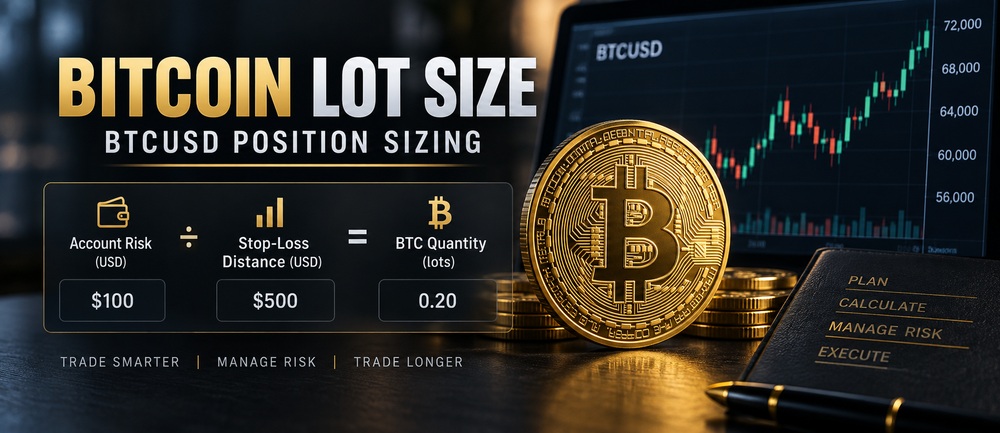
For a linear BTCUSD product quoted in U.S. dollars, a useful risk-based formula is:
BTC Position Size = Maximum Money at Risk ÷ Stop-Loss Distance in USD
Where:
Maximum Money at Risk = Account Equity × Risk Percentage
and:
Stop-Loss Distance = |Entry Price − Stop-Loss Price|
The absolute value means we use the positive distance whether the position is long or short.
Once the required BTC quantity is calculated, convert it into lots using the broker’s contract size.
BTCUSD Lot Size Formula
Lot Size = Required BTC Quantity ÷ BTC Represented by 1 Lot
If your broker defines:
1 lot = 1 BTC
then:
Lot Size = Required BTC Quantity
If your broker uses a different contract size, the lot conversion will change.
This is why the contract specification must be checked before placing the trade.
The underlying risk-first approach is consistent with Binance Academy’s position-sizing framework, which calculates position size from account size, account risk, and the distance to the trade’s invalidation point.
BTCUSD Lot Size Example: $10,000 Account
Suppose you have:
- Account equity: $10,000
- Maximum risk per trade: 1%
- BTCUSD entry: $85,000
- Stop loss: $82,500
- Broker contract size: 1 lot = 1 BTC
Step 1: Calculate the Maximum Risk Amount
$10,000 × 1% = $100
Your planned maximum price risk is:
$100
Step 2: Calculate the Stop-Loss Distance
$85,000 − $82,500 = $2,500
Your risk per full Bitcoin is:
$2,500
Step 3: Calculate the Required BTC Quantity
$100 ÷ $2,500 = 0.04 BTC
The calculated Bitcoin position size is:
0.04 BTC
Step 4: Convert BTC Quantity Into Lots
If:
1 lot = 1 BTC
then:
0.04 BTC ÷ 1 BTC per lot = 0.04 lot
Therefore, the calculated BTCUSD lot size is:
0.04 lot
Step 5: Check the Position Value
0.04 × $85,000 = $3,400
Approximate position value:
$3,400
Step 6: Verify the Planned Loss
If price moves from $85,000 to $82,500:
$2,500 × 0.04 BTC = $100
The theoretical planned loss is:
$100
which equals:
1% of the $10,000 account
before fees, spread, slippage, and other costs.
BTCUSD Position Sizing Example Table
Using the same $10,000 account and $85,000 BTC entry:
| Account Risk | Risk Amount | Stop Distance | BTC Quantity | Lot Size if 1 Lot = 1 BTC |
|---|---|---|---|---|
| 0.5% | $50 | $2,500 | 0.02 BTC | 0.02 lot |
| 1.0% | $100 | $2,500 | 0.04 BTC | 0.04 lot |
| 1.5% | $150 | $2,500 | 0.06 BTC | 0.06 lot |
| 2.0% | $200 | $2,500 | 0.08 BTC | 0.08 lot |
The table shows a direct relationship:
More account risk = larger BTCUSD position
But increasing risk also increases the damage caused by losing trades and losing streaks.
There is no universal risk percentage that is safe for every trader.
For a broader framework covering trade risk, correlation, drawdown, leverage, and loss limits, see our Crypto Risk Management for Beginners.
What Does 0.01 Lot Mean in BTCUSD?
This is one of the most common Bitcoin lot-size questions.
The correct answer depends on the broker’s contract specification.
If your broker defines:
1.00 lot = 1 BTC
then:
0.01 lot = 0.01 BTC
If BTC is trading at $85,000:
0.01 × $85,000 = $850
So 0.01 lot would represent approximately:
$850 of BTCUSD exposure
However, that does not mean your risk is $850.
Suppose your stop is $1,500 away from your entry.
Planned price loss:
0.01 BTC × $1,500 = $15
Your position value may be approximately $850 while your planned stop-loss risk is only approximately $15.
Again:
Position value and money at risk are different.
How Much Is 0.10 Lot of Bitcoin?
If your broker uses:
1 lot = 1 BTC
then:
0.10 lot = 0.10 BTC
At a hypothetical Bitcoin price of:
$85,000
the approximate notional position value is:
0.10 × $85,000 = $8,500
If Bitcoin moves by:
$1,000
the gross change in the position would be approximately:
0.10 × $1,000 = $100
before spread, fees, swaps, funding, slippage, and other costs.
This simple relationship is useful when the product uses a linear 1-BTC-per-lot contract.
But always check your broker specification first.
Wider Stop Loss = Smaller BTCUSD Lot Size
Assume:
- Account equity: $10,000
- Risk per trade: 1%
- Maximum risk: $100
- Contract size: 1 lot = 1 BTC
Now compare several stop distances.
| Stop Distance | BTC Quantity | Lot Size |
|---|---|---|
| $1,000 | 0.10 BTC | 0.10 lot |
| $2,000 | 0.05 BTC | 0.05 lot |
| $2,500 | 0.04 BTC | 0.04 lot |
| $5,000 | 0.02 BTC | 0.02 lot |
The account risk remains approximately:
$100
What changes is the position size.
This produces one of the most important BTCUSD position-sizing rules:
Wider stop = smaller lot size
and:
Tighter stop = larger calculated lot size
However, a trader should not artificially tighten the stop simply to obtain a larger Bitcoin position.
The stop should normally reflect where the trading setup becomes invalid.
Then the lot size should adapt to that stop.
How to Calculate BTCUSD Lot Size From a Percentage Stop
Sometimes you know the stop-loss percentage rather than the dollar distance.
Suppose:
- Account equity: $10,000
- Risk: 1%
- Risk amount: $100
- Stop distance: 4%
Use:
Position Value = Risk Amount ÷ Stop-Loss Percentage
Calculation:
$100 ÷ 0.04 = $2,500
Your approximate position value is:
$2,500
If BTC is trading at:
$100,000
the Bitcoin quantity is:
$2,500 ÷ $100,000 = 0.025 BTC
If:
1 lot = 1 BTC
then:
BTCUSD lot size = 0.025 lot
If your broker only permits volume steps of 0.01 lot, you cannot necessarily enter 0.025 exactly.
You would need to adjust the order to an allowed volume while ensuring the final trade remains within your risk limit.
Check Minimum Lot Size and Volume Step
A mathematically correct position may still be impossible to enter exactly.
Your broker or exchange can impose:
- Minimum trade volume
- Maximum trade volume
- Volume step
- Minimum notional value
- Tick size
- Margin requirement
- Position limits
Suppose your calculated position is:
0.037 BTC
but your broker only allows:
0.01-lot increments
If 1 lot = 1 BTC, your available choices might include:
- 0.03 lot
- 0.04 lot
If 0.04 lot would exceed your intended monetary risk, the more conservative choice may be to round down rather than up.
The exact trading rules depend on the platform.
For example, Binance’s BTCUSD1 perpetual-contract announcement lists a product-specific minimum trade amount and states that contract specifications may be adjusted as market conditions change.
The practical lesson is simple:
Never calculate BTCUSD lot size from assumptions when the actual instrument specification is available.
BTCUSD Lot Size and Leverage Are Not the Same Thing
A common beginner mistake is choosing lot size based on available leverage.
For example:
- Account: $10,000
- Broker offers: 10× leverage
A trader might think:
“I can control $100,000, so I should trade the maximum position.”
That reverses the correct risk-management process.
A better sequence is:
Account Equity → Risk Amount → Stop Distance → BTC Position Size → Lot Size → Leverage
Suppose your calculated position value is:
$3,400
Using 5× leverage may reduce the approximate margin required to support that position.
But leverage does not change the fact that your market exposure is still approximately:
$3,400
If you are not yet comfortable with this distinction, read our Crypto Leverage Explained for Beginners before increasing BTCUSD exposure.
Example: Same BTCUSD Position, Different Leverage
Assume:
- Position value: $4,000
- Planned stop-loss risk: $100
At 1× Leverage
Approximate margin requirement:
$4,000
At 2× Leverage
Approximate margin requirement:
$2,000
At 5× Leverage
Approximate margin requirement:
$800
At 10× Leverage
Approximate margin requirement:
$400
The position exposure remains:
$4,000
The planned price risk remains approximately:
$100
What changes is the amount of margin required to support the position.
This is why margin should never be confused with risk.
Our guide to Crypto Margin and Liquidation explains this relationship in more detail.
BTCUSD CFD Lots vs. Crypto Exchange Quantity
BTCUSD trading can look different depending on where the trade is executed.
BTCUSD CFD or MetaTrader Broker
The platform may ask for:
Volume in lots
Example:
0.05 lot
You need the contract specification to determine how much BTC exposure that lot represents.
Crypto Exchange Spot Market
The platform may ask directly for:
BTC quantity
Example:
0.05 BTC
There may be no forex-style lot field.
Crypto Futures or Perpetual Contract
The exchange may use:
- BTC quantity
- Contracts
- Notional value
- Product-specific minimum quantity
- Product-specific margin rules
Binance, for example, distinguishes between different futures contract types and publishes separate contract specifications for each product. See its futures trading-pair documentation for an example of how USD-margined and coin-margined products are differentiated.
The risk principle remains similar, but the final order-entry unit may differ.
How to Check BTCUSD Contract Size Before Trading
Before entering a BTCUSD order, confirm at least the following:
- What does 1 lot represent?
- What is the minimum lot size?
- What is the volume step?
- What is the maximum volume?
- What leverage applies?
- What margin is required?
- What are the trading hours?
- What spread or commission applies?
- Are there overnight, swap, or funding charges?
- Is the product a CFD, futures contract, perpetual contract, or spot instrument?
On MetaTrader-based brokers, these details are normally available through the symbol or contract specification provided by the broker.
Do not copy another trader’s BTCUSD lot size unless you have verified that:
- You use the same account size
- You use the same risk percentage
- You use the same entry and stop
- You trade the same contract specification
- You use the same platform conditions
Even two traders entering Bitcoin at the same price may require completely different lot sizes.
BTCUSD Long Position Example
Suppose:
- Account equity: $5,000
- Risk: 1%
- Maximum risk: $50
- BTCUSD long entry: $90,000
- Stop loss: $88,000
- Contract size: 1 lot = 1 BTC
Stop distance:
$90,000 − $88,000 = $2,000
BTC position:
$50 ÷ $2,000 = 0.025 BTC
Lot size:
0.025 lot
Position value:
0.025 × $90,000 = $2,250
If the stop is filled near $88,000:
0.025 × $2,000 = $50
Approximate planned price loss:
$50
BTCUSD Short Position Example
The same calculation works for a short position.
Suppose:
- Account equity: $8,000
- Risk: 0.75%
- BTCUSD short entry: $95,000
- Stop loss: $98,000
- Contract size: 1 lot = 1 BTC
Step 1: Risk Amount
$8,000 × 0.75% = $60
Step 2: Stop Distance
$98,000 − $95,000 = $3,000
Step 3: BTC Position Size
$60 ÷ $3,000 = 0.02 BTC
Step 4: Lot Size
If 1 lot = 1 BTC:
0.02 lot
The direction changes, but the sizing principle does not.
Why Bitcoin Volatility Makes Lot Size Important
Bitcoin can experience large price swings over relatively short periods.
A fixed lot size that seems reasonable during calm conditions can create much larger monetary fluctuations when volatility expands.
That is why disciplined BTCUSD traders generally should not think:
“I always trade 0.10 lot.”
A better process is:
“I calculate the lot size for each trade from my current equity, planned risk, and stop distance.”
If the stop must be wider because volatility has expanded, maintaining the same monetary risk generally requires a smaller position.
This is one reason position sizing should be dynamic rather than emotional.
Include Spread, Fees, Funding, and Slippage
The simplified BTCUSD formula assumes the only loss is the difference between entry and stop.
Real trading may also include:
- Bid-ask spread
- Commission
- Funding fees
- Overnight financing
- Swap charges
- Slippage
- Conversion fees
- Liquidation-related costs
Suppose your maximum acceptable loss is:
$100
and you estimate:
$8
of transaction and execution costs.
A conservative trader might reserve part of the risk budget for those costs instead of allocating the entire $100 to the price movement.
For example:
$100 − $8 = $92
Then the price-risk calculation would use:
$92
rather than the full $100.
This does not guarantee the final loss will remain under $100, but it reduces the risk of ignoring predictable trading costs.
Do Not Assume a Stop Loss Guarantees the Exact Loss
A stop loss is a risk-management tool, not a guaranteed execution price.
During fast Bitcoin markets, the actual fill can differ from the requested stop level because of:
- Slippage
- Market gaps
- Thin liquidity
- Exchange outages
- Liquidation cascades
- Sudden news
- Extreme volatility
Therefore, a calculated $100 risk should be understood as a planned risk estimate, not a guaranteed maximum loss.
That is also why oversizing a BTCUSD position simply because a stop is present can be dangerous.
Common Bitcoin Lot Size Mistakes
1. Assuming 1 Lot Always Equals 1 BTC
Some products use that specification.
Others do not.
Always verify the contract size.
2. Copying Another Trader’s Lot Size
A 0.10-lot trade may be reasonable for one account and excessive for another.
3. Using the Maximum Lot the Broker Allows
Maximum permitted volume is a platform limit, not a risk recommendation.
4. Choosing Lot Size Before Setting the Stop
The stop distance directly affects how large the BTCUSD position should be.
5. Confusing Margin With Position Risk
A small margin requirement can still control a large Bitcoin position.
6. Ignoring Volume Step
Your exact calculated lot size may not be accepted by the platform.
7. Rounding Up Automatically
Rounding upward can push the trade above your intended risk.
8. Ignoring Fees and Slippage
The actual loss can exceed the theoretical price-loss calculation.
9. Using the Same Lot Size in Every Market Condition
Bitcoin volatility changes.
Your trade size may need to change with it.
10. Increasing BTCUSD Lot Size After a Loss
Increasing size in an attempt to recover quickly can turn a normal losing streak into a severe drawdown.
A Simple BTCUSD Position-Sizing Checklist
Before entering a Bitcoin trade, confirm:
- What is my current account equity?
- What percentage am I prepared to risk?
- What is my maximum monetary risk?
- What is my BTCUSD entry price?
- Where is my logical stop loss?
- What is the dollar distance between entry and stop?
- How many BTC should I trade?
- What does 1 lot represent on this specific product?
- What lot size matches the required BTC quantity?
- Does the broker permit that volume?
- Am I using leverage?
- How much margin will the trade require?
- Where is the liquidation level?
- Have I allowed for spread, fees, funding, and slippage?
- Does the new position keep my total account exposure within my risk limits?
For a detailed step-by-step calculation applicable across cryptocurrencies, continue with How to Calculate Crypto Position Size.
Frequently Asked Questions
What is Bitcoin lot size?
Bitcoin lot size is the trading volume used to represent the size of a BTCUSD position. The amount of Bitcoin represented by one lot depends on the broker or product specification.
Is 1 BTCUSD lot equal to 1 Bitcoin?
It can be, but not universally.
Some BTCUSD CFD products define 1 lot as 1 BTC. Other platforms or derivatives may use different contract structures.
Always check the product specification.
What does 0.01 lot mean in Bitcoin?
If your broker defines 1 lot as 1 BTC, then 0.01 lot equals 0.01 BTC.
At $85,000 per BTC, that would represent approximately $850 of notional exposure.
How do I calculate BTCUSD lot size?
First calculate your monetary risk:
Risk Amount = Account Equity × Risk %
Then calculate BTC quantity:
BTC Quantity = Risk Amount ÷ |Entry − Stop|
Finally convert BTC into lots:
Lot Size = BTC Quantity ÷ BTC per Lot
What is the correct lot size for a $1,000 Bitcoin trading account?
There is no universal lot size for a $1,000 account.
The correct size depends on:
- Your risk percentage
- Entry price
- Stop-loss distance
- Contract size
- Broker volume step
- Fees
- Slippage
- Other open exposure
Is 0.01 lot safe for BTCUSD?
Not automatically.
A 0.01-lot position can create very different account risk depending on the stop distance, contract specification, Bitcoin price, and account size.
Does leverage change the correct BTCUSD lot size?
Leverage should not determine the risk-based lot size.
Risk and stop distance should determine the position first.
Leverage mainly changes how much margin is required to support that position.
Should I round my Bitcoin lot size up or down?
If your exact calculated volume is unavailable, rounding down is generally more conservative because rounding up can exceed your planned monetary risk.
You should still recalculate the final risk after adjusting the volume.
Can I use the same BTCUSD lot size every day?
You can technically use a fixed lot size, but the monetary risk may change whenever your account equity, entry price, stop distance, volatility, or broker conditions change.
Risk-based sizing recalculates the position for each setup.
Is BTCUSD lot size the same on every broker?
No.
Contract sizes, minimum volumes, volume steps, leverage, spreads, margin requirements, and trading conditions can differ.
Always verify the exact BTCUSD specification of the product you are trading.
Final Thoughts
Bitcoin lot size should never be chosen simply because a broker offers a particular minimum volume or because another trader uses the same number.
The correct BTCUSD position starts with risk.
The practical sequence is:
Account Equity → Risk Percentage → Risk Amount → Entry and Stop → BTC Quantity → Contract Size → Lot Size
If your broker defines 1 lot as 1 BTC, the conversion is straightforward.
But the formula only works correctly when the contract specification is verified first.
Most importantly, remember that lot size controls how strongly Bitcoin price movement affects your account.
A disciplined trader should therefore calculate BTCUSD size from the amount that can reasonably be lost—not from the amount the broker is willing to lend.
Continue building the foundation with our Crypto Risk Management for Beginners and How to Calculate Crypto Position Size guides before increasing leverage or trade volume.
Risk Disclaimer: Cryptocurrency and leveraged derivatives involve substantial risk. Position-sizing calculations are estimates and cannot guarantee the maximum loss on a trade. Slippage, volatility, fees, funding, liquidity conditions, gaps, liquidation, platform failures, and other factors can cause actual results to differ materially from theoretical calculations.



Be the first to comment