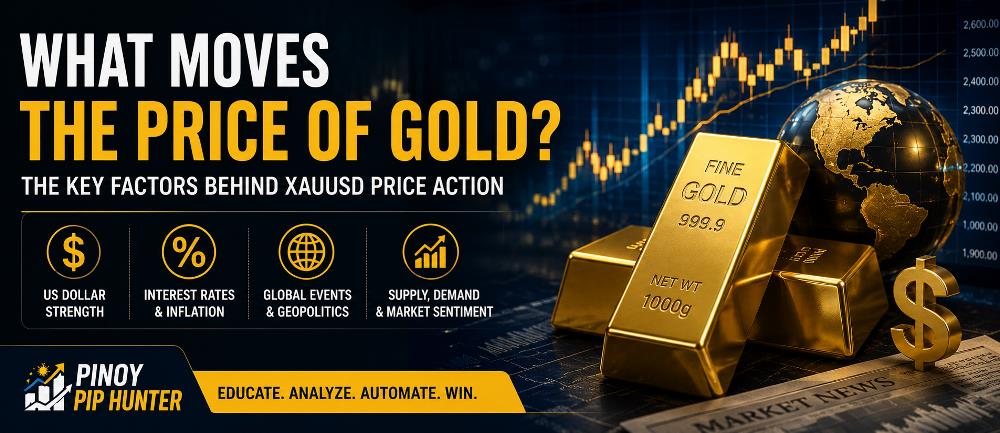
Gold is one of the most actively traded markets in the world, and its price can move dramatically within minutes.
For XAUUSD traders, understanding what moves the price of gold is just as important as understanding charts, trading sessions, support and resistance, or technical indicators.
Gold does not rise or fall because of one single factor. Its price is influenced by a combination of:
- The U.S. dollar
- Interest rates
- Inflation expectations
- U.S. economic data
- Federal Reserve policy
- Geopolitical uncertainty
- Central-bank buying
- Investment flows
- Physical supply and demand
- Market sentiment and momentum
Some of these factors can push gold in the same direction, while others may conflict with each other.
That is why XAUUSD sometimes reacts differently from what traders initially expect.
In this guide, we will explain the major forces that influence gold prices and how traders can use this information when analyzing XAUUSD.
Why Does the Gold Price Move?
Gold is both a commodity and a financial asset.
Unlike many commodities, gold is not consumed primarily for industrial purposes. Investors, governments, central banks, financial institutions, jewellery buyers, and traders all participate in the gold market for different reasons.
The World Gold Council tracks global gold demand across investment, central banks, jewellery, technology, mining supply, and recycling. These different sources of demand and supply can influence gold over both short and long time horizons.
For XAUUSD traders, this means gold can respond to developments across several financial markets simultaneously.
Understanding these relationships can help explain why gold suddenly becomes volatile.
1. The U.S. Dollar
One of the most important factors affecting gold is the U.S. dollar.
Gold is internationally quoted primarily in U.S. dollars, which creates an important relationship between gold and the value of the dollar.
As a general tendency:
U.S. dollar strengthens → Gold may face downward pressure
U.S. dollar weakens → Gold may receive upward support
Why?
If the dollar becomes stronger, gold becomes relatively more expensive for buyers using other currencies.
When the dollar weakens, gold becomes relatively cheaper for those buyers.
However, traders should not treat this relationship as an absolute rule.
Gold and the dollar can occasionally rise together, particularly during periods of severe financial or geopolitical uncertainty.
What XAUUSD Traders Should Watch
Gold traders commonly monitor:
- U.S. Dollar Index movements
- EURUSD
- U.S. Treasury yields
- Federal Reserve expectations
- Major U.S. economic releases
A sharp dollar movement can quickly translate into increased XAUUSD volatility.
If you are still learning the mechanics of the gold market itself, our guide on XAUUSD trading hours and the best time to trade gold explains when global market participation and volatility typically increase.
2. Interest Rates and Bond Yields
Interest rates are another major driver of gold.
Gold does not pay interest.
This means investors often compare holding gold against interest-bearing assets such as:
- Government bonds
- Treasury bills
- Bank deposits
- Money-market instruments
When interest rates or real bond yields rise significantly, the opportunity cost of holding gold may increase.
As a simplified relationship:
Higher real yields → Potential pressure on gold
Lower real yields → Potential support for gold
Research from the World Gold Council regularly considers interest rates and opportunity cost among the important forces affecting gold performance.
However, the relationship is not perfect.
Periods of unusually high geopolitical risk, strong central-bank buying, or financial instability can support gold even while interest rates remain relatively high.
This is why gold traders should avoid making trading decisions from one indicator alone.
3. Federal Reserve Monetary Policy
Because gold is quoted against the U.S. dollar, decisions by the U.S. Federal Reserve are particularly important for XAUUSD.
The Federal Reserve influences:
- U.S. interest rates
- Dollar expectations
- Treasury yields
- Economic growth expectations
- Inflation expectations
- Global financial conditions
Important Federal Reserve events include:
- FOMC interest-rate decisions
- Federal Reserve statements
- Economic projections
- Fed Chair press conferences
- Speeches by Federal Reserve officials
- Changes in expectations for future rate cuts or hikes
Traders can follow monetary-policy announcements directly from the official Federal Reserve FOMC page.
Why Expectations Matter
Markets usually do not wait for an actual interest-rate decision.
Gold can begin moving days or weeks earlier as traders adjust their expectations.
For example, if markets suddenly believe the Federal Reserve will cut rates sooner or more aggressively than previously expected, Treasury yields and the dollar may react.
Gold may then begin rising before the rate cut actually occurs.
This illustrates an important market principle:
Financial markets often react to changing expectations before the actual event occurs.
4. Inflation
Gold is widely viewed as a potential store of value during periods of inflation.
This is one reason inflation reports can strongly affect XAUUSD.
Important inflation indicators include:
- Consumer Price Index (CPI)
- Core CPI
- Producer Price Index (PPI)
- Personal Consumption Expenditures Price Index (PCE)
- Inflation expectations
The official U.S. Consumer Price Index data is published by the U.S. Bureau of Labor Statistics and is one of the most closely watched economic releases among gold traders.
The Federal Reserve also pays close attention to inflation measured through the PCE price indexes published by the U.S. Bureau of Economic Analysis.
However, the relationship between inflation and gold is more complicated than:
Higher inflation = higher gold.
Why?
Because traders must also consider how central banks are likely to respond.
Suppose U.S. inflation unexpectedly rises.
Two competing effects may appear:
- Investors may become more interested in gold because inflation concerns are increasing.
- Traders may expect the Federal Reserve to keep interest rates higher for longer, potentially strengthening yields and the U.S. dollar.
The second effect can sometimes outweigh the first.
This explains why gold occasionally falls immediately after a higher-than-expected inflation report.
The reaction depends heavily on how the data changes expectations for monetary policy.
5. U.S. Economic Data
XAUUSD traders should pay close attention to major U.S. economic releases.
Because many of these reports affect expectations for Federal Reserve policy, interest rates, Treasury yields, and the dollar, they can produce very fast movements in gold.
Non-Farm Payrolls
The U.S. employment report is one of the most closely watched monthly economic releases.
The official figures are published by the U.S. Bureau of Labor Statistics.
A significantly stronger-than-expected employment report can sometimes:
- Increase expectations for tighter monetary policy
- Push Treasury yields higher
- Strengthen the dollar
- Put pressure on gold
A much weaker report can produce the opposite reaction.
Consumer Price Index
CPI is one of the most important inflation reports.
Unexpected readings can create very fast XAUUSD movements.
GDP
Gross Domestic Product provides information about economic growth.
Weak economic activity can increase expectations for easier monetary policy and sometimes support safe-haven demand.
Unemployment Data
Rising unemployment may indicate weakening economic conditions and can influence expectations for Federal Reserve policy.
Retail Sales
Strong consumer spending may suggest economic resilience, while weak spending can increase concerns about slowing economic growth.
Because many major U.S. announcements occur during American trading hours, understanding the different market sessions is useful. See our guide to XAUUSD trading hours and the best time to trade gold for a detailed explanation of the Asian, London, and New York periods.
6. Geopolitical Risk and Market Uncertainty
Gold has historically been viewed as a safe-haven asset.
When investors become concerned about financial or geopolitical instability, demand for gold can increase.
Potential catalysts include:
- Wars
- Military conflicts
- Political instability
- Trade disputes
- Financial crises
- Banking stress
- Sovereign debt concerns
- Major geopolitical confrontations
- Unexpected global events
During these periods, traders may move capital toward assets perceived as stores of value or portfolio diversifiers.
World Gold Council market research frequently identifies risk and uncertainty as an important influence on gold investment demand.
However, safe-haven reactions are not always predictable.
During extreme market stress, investors may initially sell gold to raise cash or cover losses elsewhere.
Gold may then recover as the broader risk environment develops.
Therefore:
Geopolitical news can increase gold volatility, but it does not guarantee that XAUUSD will immediately rise.
7. Central-Bank Gold Buying
Central banks hold gold as part of their international reserves.
Their purchases can have an important long-term influence on the gold market.
Central banks may hold gold for several reasons:
- Reserve diversification
- Reduction of currency concentration risk
- Liquidity
- Store-of-value characteristics
- Protection during financial instability
- Geopolitical considerations
According to the World Gold Council’s Gold Demand Trends, central-bank purchases have become an important component of global gold demand.
Large-scale central-bank accumulation can provide structural demand for the gold market.
For short-term XAUUSD traders, central-bank buying may not create a trading signal every day.
But it can be an important part of the broader fundamental environment supporting or pressuring gold over longer periods.
8. Investment Demand and Gold ETFs
Gold prices are also influenced by investment flows.
Investors can gain exposure to gold through:
- Physical bars
- Coins
- Exchange-traded funds
- Futures
- Options
- Mining shares
- Spot and OTC markets
Large flows into or out of gold-backed investment products can influence market sentiment.
For example, strong investment inflows may indicate increasing demand for gold exposure.
Large outflows may indicate weakening investor interest.
Gold futures also play an important role in global price discovery. The CME Group gold market provides futures and options used by institutional investors, hedgers, and traders.
Institutional positioning can affect short-term momentum, especially when many market participants are positioned in the same direction.
If sentiment changes suddenly, positions may be closed rapidly, contributing to sharp reversals.
9. Physical Gold Supply and Demand
Although financial markets have a major influence on short-term gold prices, physical supply and demand still matter.
Gold Supply Comes Mainly From:
- Mining production
- Recycled gold
- Existing above-ground inventories
Unlike oil or agricultural commodities, much of the gold previously mined still exists in some form.
This means newly mined production represents only part of the total available gold market.
Physical Demand Comes From:
- Jewellery
- Investment bars and coins
- Central banks
- Technology and electronics
- Institutional investors
Major gold-consuming markets can influence physical demand.
Seasonal jewellery buying and changes in consumer purchasing power can therefore contribute to the broader gold market.
The World Gold Council publishes detailed statistics on these categories through its Gold Demand Trends research.
10. Market Sentiment and Momentum
Sometimes gold moves because traders expect it to continue moving.
This is where market sentiment and momentum become important.
Imagine that XAUUSD breaks through an important resistance level.
The breakout may attract:
- Technical traders
- Trend-following algorithms
- Momentum traders
- Short-covering
- New institutional buying
This additional participation can accelerate the original move.
The opposite can happen during a bearish breakdown.
This is why gold can occasionally continue rising even when there appears to be little new fundamental information.
Momentum itself can temporarily become a price driver.
Why Does Gold Sometimes Move Suddenly?
Gold can produce extremely fast price movements because several major catalysts often occur during highly liquid trading periods.
For example:
- CPI
- Non-Farm Payrolls
- FOMC decisions
- Fed press conferences
- Unexpected geopolitical news
- Major Treasury-yield movements
Many important U.S. economic releases occur during the New York trading period.
That is one reason gold volatility can increase considerably during U.S. market hours.
For a complete breakdown of when those periods occur, read our XAUUSD Trading Hours: Best Time to Trade Gold guide.
A Typical Gold Reaction Example
Suppose U.S. inflation comes in significantly lower than economists expected.
Markets may begin anticipating earlier Federal Reserve rate cuts.
That could produce the following chain:
Lower inflation
↓
More rate-cut expectations
↓
Treasury yields fall
↓
U.S. dollar weakens
↓
Gold becomes more attractive
↓
XAUUSD rises
But markets do not always behave this cleanly.
Another development may occur simultaneously.
For example, strong employment data could reduce expectations for rate cuts.
This is why traders need to interpret the overall market environment rather than reacting mechanically to individual headlines.
Which News Events Move XAUUSD the Most?
Some economic events tend to attract particularly strong attention from gold traders.
| Event | Why Gold Traders Watch It |
|---|---|
| FOMC Rate Decision | Can change interest-rate and dollar expectations |
| U.S. CPI | Major inflation indicator |
| Non-Farm Payrolls | Measures U.S. employment conditions |
| PCE Inflation | Closely monitored by the Federal Reserve |
| Fed Chair Speech | Can change monetary-policy expectations |
| U.S. GDP | Indicates economic strength or weakness |
| Retail Sales | Measures consumer activity |
| Unemployment Data | Influences economic and rate expectations |
| Geopolitical News | Can increase safe-haven demand |
| Treasury-Yield Moves | Changes the opportunity cost of holding gold |
These events can create both opportunities and significant risks.
Should Beginners Trade Gold During Major News?
Beginners should be particularly cautious.
During major announcements, XAUUSD can experience:
- Sudden price spikes
- Rapid reversals
- Larger spreads
- Slippage
- False breakouts
- Fast stop-loss execution
A trader may correctly predict the general direction of a news release and still lose money because price initially moves sharply in the opposite direction.
Avoiding the first moments after a major announcement can therefore sometimes be more sensible than trying to predict the initial reaction.
Trading news is a specialized strategy.
It should not be confused with simply entering a position immediately before an economic report.
Fundamental Analysis vs Technical Analysis for Gold
Fundamental and technical analysis answer different questions.
Fundamental Analysis
Fundamental analysis asks:
Why might gold move?
It examines:
- Interest rates
- Inflation
- Economic growth
- Monetary policy
- Geopolitical developments
- Central-bank demand
- Dollar strength
Technical Analysis
Technical analysis asks:
Where might price react?
It examines:
- Support
- Resistance
- Trends
- Price structure
- Candlestick patterns
- Momentum
- Breakouts
Many traders combine both approaches.
For example:
A trader may have a fundamentally bullish outlook on gold because the dollar is weakening and yields are falling.
Instead of buying immediately, the trader may wait for XAUUSD to reach technical support or produce a confirmed breakout.
This combines fundamental context with technical execution.
What Should XAUUSD Traders Monitor Every Day?
You do not need to analyze every economic statistic in the world.
A practical daily checklist can include:
- U.S. dollar direction
- U.S. Treasury yields
- Today’s economic calendar
- Federal Reserve events
- Major geopolitical developments
- Current XAUUSD trend
- Important support and resistance levels
- The active trading session
The final point is especially important for intraday traders because liquidity and volatility can change considerably throughout the day. Our XAUUSD trading-hours guide explains these session differences in detail.
Volatility Does Not Mean You Should Increase Your Lot Size
One of the biggest mistakes traders make during strong gold moves is increasing position size because the market appears to offer a larger opportunity.
But greater volatility also means greater risk.
A larger XAUUSD candle can move through a poorly placed stop loss very quickly.
Your position size should therefore be determined by your planned risk—not by excitement about the potential profit.
Before entering a gold trade, understand how your trade volume affects your potential result. Our guide on how to calculate XAUUSD profit explains the relationship between lot size, price movement, and trading profit or loss.
More importantly, determine how much of your account you are prepared to lose before entering the trade.
Our complete XAUUSD Risk Management Guide covers stop losses, position sizing, risk per trade, and protecting your trading account during volatile gold-market conditions.
Can Anyone Predict Gold Prices Accurately?
No trader can consistently know exactly where gold will move next.
Even professional analysts can interpret the same information differently.
Markets are forward-looking.
By the time economic information becomes public, part of that information may already be reflected in the price.
This is why traders should focus less on predicting every XAUUSD movement and more on managing probabilities.
A sustainable trading process should answer:
- What is my setup?
- Where is my entry?
- Where is my stop loss?
- How much am I risking?
- What invalidates the trade?
- What is my target?
- What major news is approaching?
You cannot control the gold market.
You can control your risk.
Frequently Asked Questions
What moves the price of gold the most?
There is no permanent single driver. The U.S. dollar, real interest rates, Federal Reserve expectations, geopolitical risk, central-bank demand, and investment flows can all become dominant depending on market conditions.
Does gold go up when the dollar goes down?
Gold and the U.S. dollar often have an inverse relationship, so a weaker dollar can support gold. However, this relationship is not guaranteed, and both assets can occasionally rise simultaneously.
Does inflation make gold go up?
Inflation can support gold demand, but the effect also depends on interest-rate expectations, real yields, and the U.S. dollar. Higher inflation can sometimes pressure gold if markets expect monetary policy to remain tighter for longer.
Why does XAUUSD move so fast?
Gold is highly liquid and sensitive to economic data, monetary policy, Treasury yields, currencies, geopolitical developments, and institutional positioning. When important news arrives during an active trading session, many market participants and automated systems may react simultaneously.
Does the Federal Reserve affect gold prices?
Yes. Federal Reserve decisions affect interest rates, Treasury yields, the U.S. dollar, and expectations about future monetary policy—all of which can influence gold.
Is gold always a safe haven?
Gold is widely used as a portfolio diversifier and store of value during periods of uncertainty, but it does not rise during every crisis. Short-term reactions can differ considerably.
Final Thoughts
Understanding what moves the price of gold can make XAUUSD price action much easier to interpret.
The most important drivers to monitor are:
- U.S. dollar strength
- Interest rates and real yields
- Federal Reserve policy
- Inflation
- U.S. economic data
- Geopolitical uncertainty
- Central-bank demand
- Investment flows
- Physical supply and demand
- Market sentiment and momentum
But these factors should never be analyzed independently.
Gold reacts to the combined expectations of market participants around the world.
Instead of asking only:
“Will gold go up or down?”
A better question is:
“What is currently driving gold, and how much risk am I willing to take if my analysis is wrong?”
That mindset is far more useful for developing long-term trading discipline.
Educational content only. Trading XAUUSD, forex, CFDs, and other leveraged products involves substantial risk and may not be suitable for every trader.

Be the first to comment