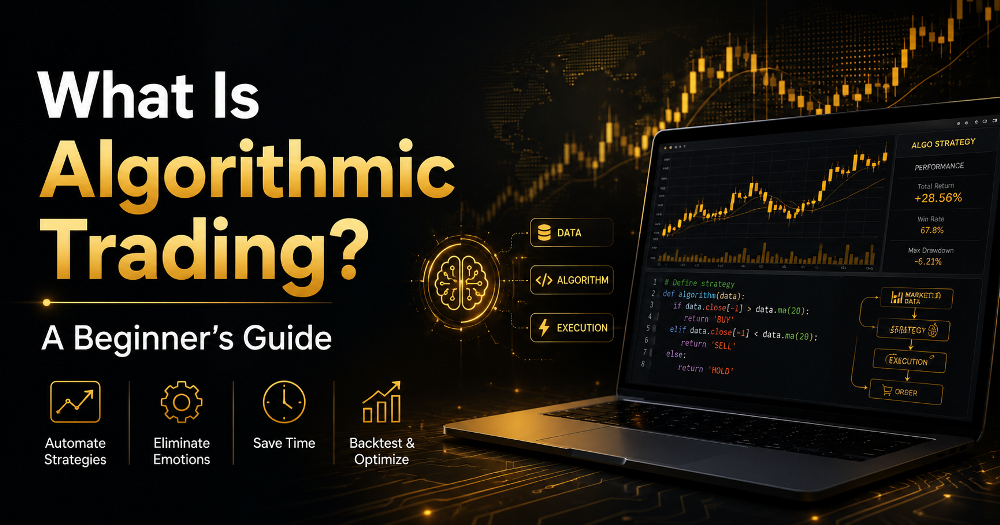
Algorithmic trading for beginners can seem complicated at first, but the basic concept is simple. Instead of manually watching charts, waiting for signals and placing every trade yourself, an automated system can analyze market conditions and execute trades according to predefined rules.
For beginners, however, terms such as algorithmic trading, automated trading, trading bots and Expert Advisors can sound complicated.
The concept is actually quite straightforward.
In this guide, we will explain what algorithmic trading is, how algorithmic trading works, the advantages and risks of automated trading, and how beginners can use trading algorithms in forex, gold and other financial markets.
What Is Algorithmic Trading?
Algorithmic trading is a method of trading financial markets using computer programs that follow predefined rules to identify trading opportunities and execute trades.
These rules may consider factors such as:
- Price movements
- Technical indicators
- Market trends
- Volatility
- Trading volume
- Time of day
- Entry and exit conditions
- Stop-loss levels
- Take-profit targets
- Risk management rules
Once the programmed conditions are satisfied, the trading system can automatically open, manage or close a trade.
This is why algorithmic trading is also commonly called automated trading or algo trading.
Instead of making every decision manually, the trader creates or uses a trading strategy that has been converted into a set of computer instructions.
How Does Algorithmic Trading Work?
An algorithmic trading system normally follows a sequence of rules.
For example, imagine a simple forex trading strategy:
- Identify whether the market is trending upward.
- Wait for a specific technical signal.
- Confirm the trading signal using another indicator.
- Open a BUY position.
- Place a stop loss below a predetermined level.
- Set a profit target.
- Close the trade when the target, stop loss or another exit condition is reached.
A trading algorithm can perform these steps automatically.
More sophisticated algorithms may monitor several indicators and market conditions simultaneously before deciding whether a trade qualifies.
The main difference between manual trading and algorithmic trading is therefore execution.
A manual trader interprets the trading rules and places the trade personally.
An automated trading system performs those same rules through software.
What Is an Automated Trading Bot?
A trading bot is software designed to monitor financial markets and execute trades automatically according to programmed conditions.
Depending on its design, a forex trading bot may perform several functions, including:
- Identifying BUY and SELL signals
- Opening trades
- Setting stop losses
- Setting take-profit targets
- Moving stops to breakeven
- Applying trailing stops
- Managing several positions
- Calculating position sizes
- Limiting maximum trades
- Closing groups or baskets of trades
The important point is that a trading bot does not automatically mean a profitable trading system.
The quality of the result depends heavily on the underlying strategy, programming, market conditions and risk-management rules.
What Is an Expert Advisor in MetaTrader?
For traders using MetaTrader 4 or MetaTrader 5, automated trading programs are commonly called Expert Advisors, or EAs.
An Expert Advisor is a program that operates inside the MetaTrader trading platform.
An EA can monitor charts, calculate indicators, detect trading conditions and execute orders automatically.
This makes MetaTrader automated trading one of the most accessible ways for retail traders to experiment with algorithmic trading.
MT4 Automated Trading
MetaTrader 4 uses programs commonly written in the MQL4 programming language.
MT4 remains widely associated with forex trading and supports automated strategies through Expert Advisors.
MT5 Automated Trading
MetaTrader 5 uses MQL5 and provides additional functionality for developing and testing automated trading systems.
Both MT4 and MT5 can therefore be used for algorithmic forex trading, provided the broker supports the platform and automated trading functionality.
Algorithmic Trading vs Manual Trading
Both approaches have strengths and weaknesses.
Manual Trading
With manual trading, the trader personally:
- Studies the chart
- Identifies the setup
- Makes the trading decision
- Opens the position
- Manages the trade
- Closes the position
Manual trading provides maximum discretion, but emotions and inconsistency can influence decisions.
A trader might hesitate to enter a valid trade after several losses or close a winning trade too early because of fear.
Algorithmic Trading
An automated trading system follows the rules programmed into it.
If a valid trading condition appears, the algorithm reacts according to those instructions.
This can reduce emotional decision-making and make execution more consistent.
However, an algorithm cannot magically determine whether its underlying strategy is profitable.
Automation improves execution of a strategy; it does not automatically improve the strategy itself.
Advantages of Algorithmic Trading
There are several reasons why traders explore automated trading.
1. Consistent Trading Execution
One of the main advantages of algorithmic trading is consistency.
If the strategy requires five conditions before entering a trade, the trading algorithm can require all five every time.
It does not become impatient or randomly change the rules.
2. Reduced Emotional Trading
Fear and greed can strongly affect manual trading.
A trader may:
- Enter too early
- Chase the market
- Increase the trade size after a loss
- Close profitable trades too quickly
- Ignore the original trading plan
An automated trading bot operates according to programmed instructions instead of emotions.
3. Faster Market Monitoring
A computer can continuously monitor market data without becoming tired.
This can be useful when a strategy requires several technical indicators to align before generating a signal.
4. Automated Risk Management
A well-designed algorithm can automatically apply risk controls such as:
- Fixed stop loss
- Trailing stop
- Breakeven protection
- Maximum open trades
- Position sizing
- Daily trading limits
- Maximum loss restrictions
Risk-management automation can help ensure that the same trading rules are applied consistently.
5. Ability to Backtest Strategies
Many algorithmic trading platforms allow traders to test a strategy using historical market data.
This is called backtesting.
Backtesting helps determine how a trading strategy would have performed under previous market conditions.
It can reveal important statistics such as:
- Total number of trades
- Win rate
- Average profit
- Average loss
- Maximum drawdown
- Profit factor
- Consecutive losses
Backtesting cannot guarantee future results, but it can help traders evaluate whether a strategy deserves further testing.
Risks of Algorithmic Trading
Automated trading also involves significant risks.
Beginners should understand these before using a trading bot with real money.
Poor Trading Strategy
A computer can execute a bad strategy extremely efficiently.
If the rules themselves do not provide a statistical advantage, automation will not fix the problem.
Over-Optimization
A trading strategy may be adjusted repeatedly until it performs exceptionally well on historical data.
This is sometimes called overfitting or curve fitting.
The problem is that the strategy may have been optimized specifically for past conditions and may perform poorly when market conditions change.
Market Conditions Change
Financial markets do not behave exactly the same way forever.
A trading strategy that performs well during a strong trend may struggle during sideways or highly volatile conditions.
Technical Failures
Automated trading depends on technology.
Possible problems include:
- Internet connection failures
- VPS interruptions
- Broker connection problems
- Platform crashes
- Incorrect EA settings
- Programming errors
- Unexpected market gaps
- Abnormal spreads or slippage
This is why automated trading systems still require supervision.
Excessive Risk
Perhaps the biggest danger is poor money management.
Even a strategy with a good win rate can suffer significant losses when position sizes are too large.
No trading algorithm eliminates market risk.
Can Beginners Use Algorithmic Trading?
Yes, beginners can learn algorithmic trading, but they should first understand basic trading concepts.
Before using an automated trading bot, a beginner should understand:
- BUY and SELL orders
- Stop loss
- Take profit
- Spread
- Lot size
- Leverage
- Margin
- Drawdown
- Risk-to-reward ratio
- Trading indicators
- Market trends
You do not necessarily need to become a professional programmer immediately.
Many traders begin by using existing Expert Advisors or learning how automated trading strategies operate before attempting to develop their own systems.
Can Algorithmic Trading Be Used for Forex?
Yes.
Algorithmic forex trading is one of the most common applications of automated trading.
A forex trading algorithm can monitor currency pairs such as:
- EUR/USD
- GBP/USD
- USD/JPY
- AUD/USD
- USD/CAD
The same general principles can also be applied to other instruments supported by a broker.
Can Algorithmic Trading Be Used for Gold?
Automated systems can also be designed for gold trading, particularly XAUUSD.
Gold can behave differently from major forex pairs because it may experience strong volatility around economic events, interest-rate expectations and changes in market sentiment.
An algorithm designed specifically for XAUUSD should therefore be tested using gold market data rather than assuming that a strategy developed for another instrument will behave identically.
What Makes a Good Trading Algorithm?
A good trading algorithm is not simply one that produces many profitable trades.
A properly designed automated strategy should have clearly defined rules covering several areas.
Entry Rules
The system should know precisely when a trade may be opened.
Exit Rules
The strategy should define when a position should be closed.
Stop-Loss Protection
Every strategy should address what happens when the market moves against the position.
Position Sizing
The algorithm should determine how much capital is exposed to each trade.
Maximum Risk
There should be limits preventing uncontrolled exposure.
Different Market Conditions
The strategy should be tested across different periods rather than only during ideal market conditions.
Realistic Testing
Testing should consider practical factors such as spreads, commissions and slippage where applicable.
Does Algorithmic Trading Guarantee Profits?
No.
There is no trading strategy, Expert Advisor or automated trading bot that can guarantee profits.
Financial markets involve uncertainty, and losses are part of trading.
Claims of guaranteed profits or virtually risk-free automated trading should therefore be treated cautiously.
A more realistic objective is to develop a trading process with:
- Clearly defined rules
- Controlled risk
- Repeatable execution
- Sufficient testing
- Ongoing monitoring
The goal of algorithmic trading is not to eliminate risk.
The goal is to create a more systematic approach to executing a trading strategy.
Algorithmic Trading for Beginners: Where Should You Start?
If you are completely new to automated trading, a sensible learning process is:
Step 1 — Learn basic trading terminology.
Understand how orders, leverage, position sizing, stop losses and drawdown work.
Step 2 — Learn one trading platform.
MetaTrader 4 and MetaTrader 5 are common starting points for retail traders interested in Expert Advisors.
Step 3 — Understand the strategy before automating it.
Never rely on a trading bot simply because it is automated.
You should understand what causes it to enter and exit trades.
Step 4 — Backtest the strategy.
Study its historical behavior across different market conditions.
Step 5 — Use a demo account.
Forward-test the strategy under live market conditions without immediately risking real capital.
Step 6 — Evaluate risk, not just profit.
Pay attention to maximum drawdown, consecutive losses and trading exposure.
Step 7 — Monitor performance.
Even an automated strategy should be reviewed regularly.
Frequently Asked Questions About Algorithmic Trading
Is algorithmic trading the same as automated trading?
The terms are often used interchangeably. Algorithmic trading uses programmed rules to make trading decisions, while automated trading emphasizes that some or all of the execution process occurs automatically.
Is a forex robot the same as an Expert Advisor?
In MetaTrader terminology, an Expert Advisor is a program capable of analyzing market conditions and potentially executing trades. Forex robot is a broader informal term commonly used for automated forex trading software.
Do I need programming knowledge for algorithmic trading?
Not necessarily at the beginning. Traders can first learn how algorithmic strategies work or use existing software. Programming knowledge becomes more useful when creating, modifying or auditing your own strategies.
Can automated trading lose money?
Yes. Automated trading carries the same underlying market risks as manual trading and can lose money.
Which is better, MT4 or MT5 for automated trading?
Both platforms support Expert Advisors. The appropriate choice depends on the broker, instruments being traded and the EA or strategy you intend to use.
Can trading bots run 24 hours a day?
A trading bot can remain operational while the trading platform and computer or VPS are running and connected. However, whether it should trade continuously depends entirely on its strategy.
Final Thoughts
Algorithmic trading for beginners may initially sound highly technical, but the basic principle is simple: a trading strategy is converted into precise rules that a computer can execute.
Automated trading can provide several advantages, including faster market monitoring, consistent execution and systematic risk management.
However, automation should never be confused with guaranteed profitability.
The most important part of an algorithmic trading system remains the quality of the underlying strategy and its risk management.
Beginners should therefore focus first on learning how markets work, understanding the trading strategy, testing it carefully and evaluating risk before committing real capital.
At Pinoy Pip Hunter, we explore practical approaches to forex trading, gold trading, MetaTrader, Expert Advisors and algorithmic trading, with an emphasis on systematic execution, trading tools and disciplined risk management.
4 Trackbacks / Pingbacks