
Crypto scalping is a short-term trading style that attempts to capture relatively small cryptocurrency price movements through quick entries and exits.
Instead of holding a Bitcoin, Ethereum, or altcoin position for several hours, days, or weeks, a scalper may remain in a trade for only a few seconds or several minutes.
The potential profit from each individual trade can be small.
That is why crypto scalping depends heavily on:
- Accurate entries
- Fast execution
- Tight risk control
- Sufficient liquidity
- Low trading costs
- Consistent position sizing
- A clearly defined strategy
- Discipline over many trades
Scalping can look simple because the trader is only trying to capture a small market move. In practice, however, small profit targets mean that fees, spread, slippage, execution delays, and a few poorly controlled losses can materially affect the strategy.
This guide explains what crypto scalping is, how it works, common crypto scalping strategies, useful indicators and timeframes, important risks, and a practical framework for testing a scalping strategy before risking significant capital.
Important: This article is for educational purposes only and does not constitute financial, investment, or trading advice. Cryptocurrency trading involves substantial risk. Short-term trading can result in rapid losses, particularly when leverage is used.
What Is Crypto Scalping?
Crypto scalping is a trading approach in which a trader attempts to profit from small short-term price movements.
A scalper typically aims to:
- Identify a short-term trading opportunity.
- Enter the market.
- Capture a relatively small price movement.
- Exit quickly.
- Repeat the process only when another valid setup appears.
The objective is generally not to predict where Bitcoin will trade next week or next month.
The focus is much narrower:
Can the trader identify and manage a short-term price movement with an acceptable relationship between potential reward, risk, and trading cost?
For example, imagine BTCUSDT is trading at:
$70,000
A scalper identifies a short-term bullish setup and enters at:
$70,000
The planned Take Profit is:
$70,140
The planned Stop Loss is:
$69,930
Price risk:
$70,000 − $69,930 = $70
Potential price reward:
$70,140 − $70,000 = $140
Before trading costs, the theoretical price relationship is:
Risk $70 to pursue $140
or approximately:
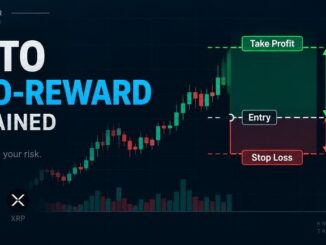
1:2 risk-to-reward
However, that does not mean the trade automatically produces a good result.
The trader still needs to account for:
- Position size
- Entry and exit fees
- Bid-ask spread
- Slippage
- Order execution
- Actual fill prices
These factors become especially important when the target is small.
How Does Crypto Scalping Work?
Scalping generally combines three elements:
Setup → Execution → Risk Management
1. Identify the Setup
The trader first needs a repeatable reason for entering.
Examples might include:
- Trend continuation
- Breakout and retest
- Support bounce
- Resistance rejection
- Moving-average pullback
- Range reversal
- Momentum breakout
- VWAP reaction
The setup should define the market conditions required before the trader considers an entry.
2. Define the Entry and Invalidation
A trader should know:
- Where the trade will be entered
- What would invalidate the setup
- Where the Stop Loss belongs
- Where profits may reasonably be taken
The Stop Loss should not simply be made extremely tight to increase the theoretical risk-to-reward ratio.
Your stop should relate to the trading setup and market structure.
For a deeper discussion, see our Crypto Stop Loss Explained guide.
3. Calculate Position Size
Once the stop distance is known, determine how much of the cryptocurrency should actually be traded.
This is critical.
A 0.2% market movement can still create an excessive account loss if the position is too large.
Position size should therefore be determined from planned account risk rather than from the maximum size an exchange permits.
Our Crypto Position Sizing Explained guide covers this calculation in detail.
4. Execute the Trade
The trader places the appropriate order and monitors execution.
Because scalping targets small movements, poor execution can substantially alter the result.
A strategy that looks profitable on a chart may perform very differently if actual trades repeatedly experience:
- Wider spread
- Slippage
- Delayed execution
- Partial fills
- Higher-than-expected fees
5. Exit According to the Plan
The position may be closed because:
- The Take Profit was reached
- The Stop Loss was triggered
- The technical setup became invalid
- Momentum weakened
- The strategy’s time-based exit condition was reached
The exact rule should be established before the trade whenever possible.
Crypto Scalping vs Day Trading
Scalping and day trading are both short-term trading methods, but they are not identical.
| Feature | Crypto Scalping | Crypto Day Trading |
|---|---|---|
| Typical holding period | Seconds to minutes | Minutes to hours |
| Trade frequency | Potentially high | Usually lower |
| Target movement | Small | Larger intraday moves |
| Chart focus | Very short timeframes | Short to medium intraday timeframes |
| Importance of fees | Extremely high | High |
| Execution sensitivity | Extremely high | High |
| Screen attention | Usually intensive | Usually intensive |
| Overnight holding | Usually avoided | Usually avoided |
A day trader may wait for a larger intraday move.
A scalper usually tries to capture a much smaller segment of that movement.
Neither method is automatically easier or more profitable.
What Timeframes Do Crypto Scalpers Use?
Common scalping charts include:
- 1-minute
- 3-minute
- 5-minute
- 15-minute
The execution chart does not have to be the only timeframe analyzed.
For example, a trader might use:
15-minute chart: determine the broader intraday structure.
5-minute chart: identify the setup.
1-minute chart: refine the entry.
This is called multi-timeframe analysis.
The objective is to avoid making every decision from an extremely noisy 1-minute chart without understanding the larger structure.
Is the 1-Minute Chart Best for Scalping?
Not necessarily.
A 1-minute chart provides more signals, but it also contains more short-term market noise.
A 5-minute chart may produce fewer setups but provide clearer structure.
The appropriate timeframe depends on:
- Strategy
- Cryptocurrency
- Market volatility
- Liquidity
- Execution speed
- Trader experience
The timeframe should be tested rather than selected simply because scalping is supposed to be fast.
What Cryptocurrencies Are Suitable for Scalping?
Liquidity is an important consideration.
Scalpers generally need a market where positions can be entered and exited efficiently.
Highly liquid trading pairs may offer:
- Greater market depth
- More consistent execution
- Smaller bid-ask spreads
- Lower probability of severe slippage under normal conditions
Examples frequently watched by short-term crypto traders include major pairs involving:
- Bitcoin
- Ethereum
- Other heavily traded cryptocurrencies
A thinly traded altcoin may display attractive chart movements but create substantial execution problems.
A trader might see an apparent $50 profit opportunity on the chart but lose much of that theoretical advantage through spread and slippage.
Why Trading Fees Matter So Much in Crypto Scalping
Trading costs are one of the most important parts of a scalping strategy.
Suppose your position value is:
$10,000
Assume, purely as an example, that the combined entry and exit trading fees equal:
0.10% of position value
Approximate round-trip fee:
$10,000 × 0.10%
= $10
Now assume your gross winning scalp produces:
$25
Net result before other costs:
$25 − $10
= $15
The trading fee consumed:
40% of the gross profit
And that still ignores:
- Spread
- Slippage
- Funding where applicable
- Other exchange-specific charges
This is why scalpers should understand the complete cost structure of the platform they use.
Read our Crypto Trading Fees Explained guide for the difference between maker fees, taker fees, spread, funding, slippage, and other costs.
Maker Orders vs Taker Orders for Scalping
Order type can affect both execution and trading cost.
Maker Order
A maker order generally adds liquidity to the order book instead of immediately matching an existing order.
Depending on the exchange, maker fees may be lower than taker fees.
The disadvantage is that your order may not execute.
Taker Order
A taker order immediately consumes available liquidity.
This may provide faster execution, but it can involve:
- Higher trading fees
- Greater sensitivity to slippage
Neither is universally better.
A scalping strategy must balance:
Execution certainty vs execution cost
A lower-fee order that repeatedly fails to fill can be useless for a time-sensitive setup.
Common Crypto Scalping Strategies
There is no single scalping strategy that works in every market.
The following are common frameworks traders may test.
Strategy 1: Trend Pullback Scalping
The idea is to trade in the direction of an established short-term trend after a temporary pullback.
Bullish Example
Suppose BTC shows:
- Higher highs
- Higher lows
- Price holding above an important moving average
Instead of buying after a sudden price surge, the trader waits for price to pull back toward:
- Previous support
- A moving average
- VWAP
- Previous breakout area
The trader then looks for renewed bullish confirmation.
A possible process:
- Confirm an upward short-term trend.
- Wait for a controlled pullback.
- Identify support.
- Wait for bullish rejection or momentum confirmation.
- Enter according to the strategy.
- Place the Stop Loss below the setup’s invalidation point.
- Target a nearby resistance or predefined reward level.
The opposite logic can be applied to a bearish trend.
Strategy 2: Support and Resistance Scalping
Short-term cryptocurrency prices often react around visible support and resistance areas.
Suppose Ethereum repeatedly rejects a price around:
$4,000
A scalper might wait for another test of this resistance.
If the market rejects the level again, a short-term short setup may develop.
However, support and resistance should not be treated as exact mathematical lines.
Price can temporarily move through a level before reversing.
That is why confirmation and risk control remain important.
Strategy 3: Breakout Scalping
Breakout scalping attempts to capture acceleration when price moves beyond an established trading range or technical level.
Imagine BTC trades between:
$69,900 and $70,100
Price repeatedly fails to break above:
$70,100
Eventually, buying pressure increases and price pushes through resistance.
A breakout scalper might look for:
- Strong price expansion
- Increased volume
- Order-flow confirmation
- A close above resistance
- A retest that holds
The danger is a false breakout.
Price can briefly break resistance, attract buyers, and then reverse sharply back into the range.
For this reason, blindly buying every breakout is not a complete strategy.
Strategy 4: Range Scalping
Markets do not always trend.
During a defined range, a scalper may attempt to:
- Buy near support
- Sell near resistance
Suppose BTC trades repeatedly between:
$69,500 support
and
$70,000 resistance
A range strategy might search for bullish confirmation near the lower boundary and bearish confirmation near the upper boundary.
The risk appears when the range finally breaks.
A trader repeatedly buying support can suffer a significant loss when genuine downside momentum begins.
Strategy 5: Moving-Average Scalping
Moving averages can help identify short-term direction and dynamic support or resistance.
A trader may use combinations such as:
- Fast EMA
- Slower EMA
- Price structure
A basic bullish framework could require:
- Fast EMA above slow EMA.
- Price forming higher highs and higher lows.
- Price pulls back toward the moving-average zone.
- Bullish momentum returns.
- Trade is entered with a predefined invalidation point.
The moving-average crossover by itself should not be assumed to predict future movement.
It is better treated as one component of a complete setup.
Strategy 6: VWAP Scalping
VWAP—or volume-weighted average price—is commonly used by short-term traders as a reference for the average traded price weighted by volume.
A strategy may examine whether price is:
- Holding above VWAP
- Holding below VWAP
- Rejecting VWAP
- Reclaiming VWAP
For example, during a strong intraday bullish move, a trader might wait for price to pull back toward VWAP and then look for evidence that buyers are regaining control.
VWAP is not automatically support or resistance.
It is simply a reference that can be incorporated into a tested trading framework.
Useful Indicators for Crypto Scalping
Scalping does not require dozens of indicators.
Too many indicators can produce conflicting signals and slow decision-making.
Common tools include:
Moving Averages
Used to help assess trend direction and dynamic support or resistance.
RSI
The Relative Strength Index measures momentum.
Scalpers may watch:
- Momentum changes
- Divergence
- Overbought/oversold conditions
However, an “overbought” reading does not automatically mean price must fall.
Strong trends can remain overbought for extended periods.
Volume
Volume can help evaluate whether a breakout or price move has meaningful participation.
VWAP
Useful as an intraday reference level.
ATR
Average True Range measures market volatility.
ATR can help a trader understand whether a planned stop is unusually tight relative to recent price movement.
Support and Resistance
Although not technically an indicator, market structure is often more useful than adding another oscillator.
Risk Management for Crypto Scalping
A scalping system cannot be evaluated only by its winning percentage.
Risk management is crucial because one uncontrolled loss can erase multiple small winners.
Our complete Crypto Risk Management for Beginners guide explains the broader framework.
For scalping specifically, pay close attention to the following.
Risk a Defined Amount Per Trade
Suppose your account contains:
$10,000
and your maximum planned risk is:
0.5%
Maximum planned loss:
$10,000 × 0.5%
= $50
That $50 risk limit should determine your position size after the stop distance is known.
It should not be reversed by selecting a large position first and then trying to squeeze the Stop Loss closer.
Keep Losing Trades Controlled
Scalping often produces multiple trades within one session.
Without a daily loss limit, several losing trades can accumulate rapidly.
For example:
Trade 1: −1R
Trade 2: −1R
Trade 3: −1R
Trade 4: −1R
Result:
−4R
A trader should therefore consider limits such as:
- Maximum loss per trade
- Maximum loss per session
- Maximum consecutive losses
- Maximum total daily risk
Understand Risk-to-Reward
Suppose a scalp risks:
$50
to potentially make:
$75
Risk-to-reward:
1:1.5
Whether this is viable depends on the strategy’s actual win rate and trading costs.
A different strategy might target:
1:1
and rely on a higher win rate.
Another might target:
1:2
but win less frequently.
There is no universal ratio that makes a scalping strategy profitable.
Learn how these variables interact in our Crypto Risk-to-Reward Ratio guide.
The Hidden Danger of Leverage in Scalping
Crypto derivatives platforms may make substantial leverage available.
The temptation is obvious:
If the expected price movement is small, increase leverage so that the financial result becomes larger.
But leverage magnifies losses as well as gains.
It does not improve:
- Entry accuracy
- Strategy expectancy
- Win rate
- Market prediction
- Execution quality
For example:
A 0.5% adverse move on a very large leveraged position can produce a significant account loss even though the underlying market movement appears small.
The CFTC’s guidance on virtual-currency trading risk warns that leverage can amplify the underlying risk of virtual-currency derivatives.
Before using leveraged products, review our Crypto Leverage Explained guide and understand how margin and liquidation work.
Slippage Can Destroy a Small Scalping Edge
Suppose your strategy expects:
Average gross winner: $30
Average planned loss: $20
That may appear viable.
But assume your real trading records show average round-trip costs of:
Fees: $6
Spread/slippage: $5
Total average cost:
$11
The expected $30 winner becomes approximately:
$19
The theoretical strategy and the actual strategy are now very different.
This is why a scalping backtest that assumes perfect execution can be misleading.
Example of a Complete Crypto Scalp
Suppose a trader identifies a BTCUSDT bullish pullback.
Account:
$10,000
Maximum planned risk:
0.5%
Risk amount:
$50
Entry:
$70,000
Stop Loss:
$69,900
Stop distance:
$100 per BTC
Step 1: Calculate Position Size
$50 ÷ $100
= 0.50 BTC
Approximate position value:
0.50 × $70,000
= $35,000
This example immediately reveals something important.
The position value is much larger than the account.
That would require leverage or a smaller position.
The trader should therefore consider:
- Required margin
- Available leverage
- Liquidation risk
- Trading fees
- Whether the position exposure is appropriate
Step 2: Determine the Target
Suppose the target is:
$70,200
Potential price reward:
$70,200 − $70,000
= $200 per BTC
At 0.50 BTC:
$200 × 0.50
= $100 theoretical gross profit
The planned relationship is approximately:
Risk: $50
Reward: $100
Risk-to-reward:
1:2
Step 3: Include Costs
If total fees, spread, funding where applicable, and slippage cost:
$15
then the $100 theoretical gross winner becomes approximately:
$85 net
The real strategy should therefore be evaluated using net rather than idealized gross results.
Common Crypto Scalping Mistakes
Trading Every Small Price Movement
More trades do not automatically mean more profit.
A scalper needs a valid setup, not constant market activity.
Ignoring Fees
A system can show many winning trades yet remain unprofitable after costs.
Using Excessive Leverage
Small price targets can tempt traders to create unnecessarily large positions.
Moving the Stop Loss
Turning a small planned loss into a much larger loss can erase several successful scalps.
Revenge Trading
After a loss, a trader may immediately enter another trade without a valid setup.
This can rapidly increase drawdown.
Overtrading
A high-frequency strategy does not require the trader to take every possible signal.
Using Too Many Indicators
Five indicators displaying similar information do not necessarily create stronger confirmation.
Scalping Illiquid Altcoins
Wide spreads and shallow market depth can make chart-based results unrealistic.
Trading Without a Tested Plan
An entry signal is only one part of a system.
A complete plan should include:
- Market
- Timeframe
- Setup
- Entry
- Stop Loss
- Target
- Position-size method
- Maximum risk
- Trading costs
- Session limits
- Exit rules
How to Build and Test a Crypto Scalping Strategy
A structured testing process is more useful than changing strategies after every loss.
Step 1: Define One Setup
Example:
5-minute trend pullback with 1-minute execution
Step 2: Define Exact Entry Conditions
Do not use vague rules such as:
“Buy when the chart looks bullish.”
Define observable criteria.
Step 3: Define the Invalidation Point
Determine what market behavior proves the trade idea wrong.
Step 4: Define Position Sizing
Calculate the position from:
Account Risk ÷ Stop Distance
Step 5: Define the Exit
Specify whether you will use:
- Fixed risk-to-reward
- Previous high or low
- Support or resistance
- Trailing stop
- Momentum-based exit
- Partial profit-taking
Step 6: Include Real Trading Costs
Backtests should include reasonable estimates for:
- Fees
- Spread
- Slippage
- Funding where applicable
Step 7: Record the Results
Track:
- Number of trades
- Win rate
- Average winner
- Average loser
- Average risk-to-reward
- Fees
- Slippage
- Maximum losing streak
- Maximum drawdown
- Net expectancy
Step 8: Test Before Increasing Risk
Paper trading, historical testing, and small live position sizes can help expose weaknesses before significant capital is placed at risk.
Is Crypto Scalping Profitable?
Crypto scalping can produce profitable results for some traders, but the trading style itself does not create profitability.
Profitability depends on whether the complete strategy produces positive expectancy after realistic costs.
A simplified expectancy calculation is:
Expectancy = (Win Rate × Average Win) − (Loss Rate × Average Loss)
Suppose:
Win rate: 60%
Average net winning trade: $40
Loss rate: 40%
Average losing trade: $50
Expected result:
(0.60 × $40) − (0.40 × $50)
= $24 − $20
= +$4 per trade
Theoretical expectancy:
+$4
Now suppose real fees and slippage reduce each average winner by another $8.
Average winner becomes:
$32
New expectancy:
(0.60 × $32) − (0.40 × $50)
= $19.20 − $20
= −$0.80 per trade
A strategy that appeared profitable before costs has become negative.
This demonstrates why trading costs can be decisive in scalping.
Is Crypto Scalping Good for Beginners?
Scalping can be challenging for beginners because it combines:
- Rapid decision-making
- Short-term market noise
- Frequent trading costs
- Execution pressure
- Emotional pressure
- Strict discipline
- Position sizing
- Stop-loss management
A beginner who still struggles with position sizing, Stop Losses, leverage, trading fees, and risk-to-reward may benefit from learning those concepts before attempting rapid-fire trading.
The goal should not be to trade as fast as possible.
The goal should be to make each decision according to a tested process.
Frequently Asked Questions
What is crypto scalping?
Crypto scalping is a short-term trading approach that attempts to capture relatively small cryptocurrency price movements through quick entries and exits.
What is the best timeframe for crypto scalping?
There is no universal best timeframe. Common choices include 1-minute, 3-minute, 5-minute, and 15-minute charts. The appropriate timeframe depends on the strategy, market, volatility, liquidity, and trader.
Can you scalp Bitcoin?
Yes. Bitcoin is frequently used for short-term trading because it generally has substantial market activity and liquidity, although actual execution conditions vary by platform and trading pair.
What indicators are used for crypto scalping?
Common tools include moving averages, RSI, volume, VWAP, ATR, support and resistance, and price action. Indicators should support a defined trading methodology rather than replace one.
Is crypto scalping risky?
Yes. Scalping can involve frequent trading, rapid price changes, execution risk, fees, slippage, emotional pressure, and potentially substantial leverage. Losses can accumulate rapidly if position size and session risk are not controlled.
Do you need leverage for crypto scalping?
No. Scalping and leverage are separate concepts. A trader can scalp an unleveraged spot position. Leverage changes exposure and margin requirements but does not improve the underlying strategy.
How much should a crypto scalper risk per trade?
There is no universal percentage appropriate for every trader. The important principle is to define maximum acceptable account risk before calculating position size and to ensure repeated losses cannot cause disproportionate account damage.
Are high win rates enough to make scalping profitable?
No. A strategy with a high win rate can still lose money if losing trades are much larger than winning trades or if fees and slippage consume too much of the gross profit.
Final Thoughts
Crypto scalping attempts to capture small short-term market movements through precise entries and exits.
But successful scalping is not simply:
Trade faster → Make more money
A more realistic framework is:
Setup → Invalidation → Position Size → Entry → Exit → Costs → Review
Small targets make execution quality and trading costs especially important.
A trader therefore needs to evaluate:
- Market liquidity
- Bid-ask spread
- Fees
- Slippage
- Stop-loss placement
- Position size
- Risk-to-reward
- Win rate
- Leverage
- Maximum daily loss
- Overall expectancy
If you are still developing your trading foundation, start with our Crypto Risk Management for Beginners guide, then review Crypto Position Sizing Explained, Crypto Stop Loss Explained, and Crypto Trading Fees Explained.
Scalping should be treated as a structured trading process—not as a method for generating guaranteed quick profits.
Risk Disclaimer: Cryptocurrency trading involves substantial risk and may result in partial or complete loss of trading capital. Scalping can increase exposure to trading fees, spread, slippage, execution errors, volatility, and emotional decision-making. Leveraged cryptocurrency products can magnify losses and may result in liquidation. No strategy, indicator, or trading method guarantees profitable results.


Be the first to comment