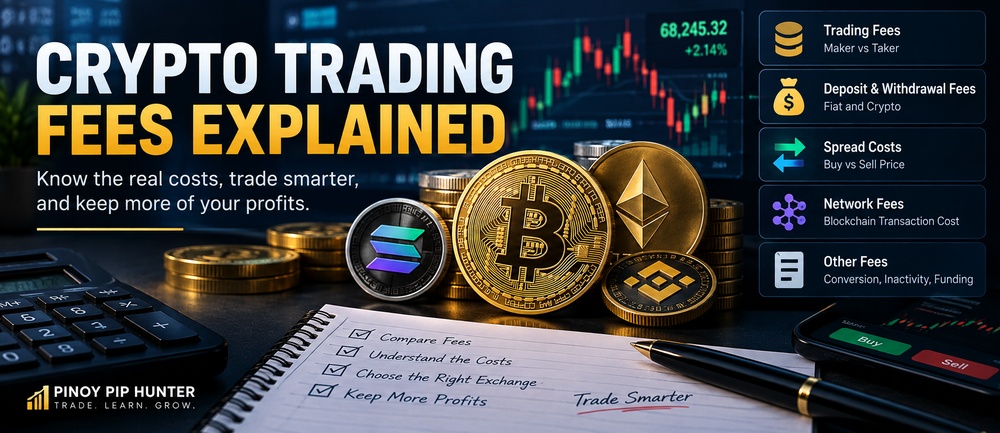
Crypto trading fees can quietly turn a profitable-looking trade into a much smaller gain—or even a loss.
Many beginners focus almost entirely on entry price, exit price, and percentage return. But the actual result of a cryptocurrency trade can also be affected by:
- Maker and taker fees
- Bid-ask spread
- Funding fees
- Withdrawal fees
- Blockchain network fees
- Deposit or payment-method charges
- Conversion fees
- Liquidation fees
- Slippage
This is why understanding crypto trading fees is an important part of risk management.
A trade should not be evaluated only by asking:
How far did the price move?
You should also ask:
How much did the entire trade actually cost?
This guide explains the main types of cryptocurrency trading fees, how maker and taker fees work, how to calculate trading costs, and how fees can affect your real profit and loss.
Important: This article is for educational purposes only and does not constitute financial, investment, or trading advice. Cryptocurrency trading involves substantial risk. Fees, slippage, leverage, funding, liquidity conditions, and rapid price movements can materially affect actual trading results.
What Are Crypto Trading Fees?
Crypto trading fees are charges or transaction costs associated with buying, selling, transferring, converting, borrowing, or holding cryptocurrency positions.
The exact fees depend on:
- Exchange or broker
- Trading product
- Order type
- Trading volume
- Account tier
- Cryptocurrency pair
- Payment method
- Network used
- Position duration
- Whether leverage is involved
For example, a trader buying Bitcoin on a spot exchange may mainly encounter:
- Trading fee
- Spread
- Withdrawal fee
A trader using perpetual futures may instead encounter:
- Entry trading fee
- Exit trading fee
- Funding payments
- Spread
- Slippage
- Possible liquidation fees
Therefore, there is no single universal “crypto trading fee.”
The real cost of a trade is usually the combination of several different charges.
Why Crypto Trading Fees Matter
Suppose you buy Bitcoin and later sell it for a gross profit of:
$50
That does not automatically mean your net profit is $50.
If you paid:
- $8 entry fee
- $8 exit fee
- $4 funding
- $3 slippage
then your total trading cost is:
$8 + $8 + $4 + $3 = $23
Your approximate net profit becomes:
$50 − $23 = $27
That means fees and execution costs consumed:
46% of the gross profit
This is especially important for:
- Scalpers
- Day traders
- High-frequency traders
- Traders using small profit targets
- Leveraged traders
- Traders frequently entering and exiting positions
The smaller your target profit, the more significant trading costs become.
For a broader explanation of how fees affect final trade results, see our How to Calculate Crypto Profit and Loss guide.
The Main Types of Crypto Trading Fees
The most common crypto trading costs can be divided into several categories.
| Cost | When It Usually Applies |
|---|---|
| Maker fee | When your order adds liquidity to an order book |
| Taker fee | When your order immediately removes liquidity |
| Spread | Difference between bid and ask prices |
| Funding fee | Periodic payment on many perpetual futures products |
| Withdrawal fee | When cryptocurrency is transferred off an exchange |
| Network fee | Blockchain transaction cost |
| Deposit/payment fee | May apply depending on deposit method |
| Conversion fee | May apply when converting one asset into another |
| Borrowing/margin fee | Can apply to borrowed funds or margin trading |
| Liquidation fee | May apply when a leveraged position is liquidated |
| Slippage | Execution difference caused by market movement or liquidity |
Not every platform charges every type of fee.
Always check the current fee schedule and product terms before trading.
What Are Maker and Taker Fees?
Many crypto exchanges use a maker-taker fee model.
The basic idea is that orders are treated differently depending on whether they add liquidity to the order book or remove liquidity from it.
Official exchange documentation such as Coinbase Advanced fees and the Kraken fee schedule explain this maker-taker structure.
What Is a Maker Order?
A maker order generally adds liquidity to the order book.
For example, Bitcoin is currently trading around:
$80,000
You place a limit buy order at:
$79,500
Because your order does not execute immediately, it may remain on the order book waiting for a seller.
If it later fills while resting on the book, it may be treated as a maker order.
You are helping “make” the market by providing liquidity.
What Is a Taker Order?
A taker order removes existing liquidity from the order book.
Suppose Bitcoin is trading around:
$80,000
and you place a market buy order.
Your order immediately matches with available sell orders.
You are taking liquidity that was already available.
That normally results in a taker fee.
Maker Fee vs Taker Fee
In many fee structures, maker fees are lower than taker fees.
This is because exchanges often encourage traders to provide liquidity.
A simplified example:
| Order Type | Hypothetical Fee |
|---|---|
| Maker | 0.20% |
| Taker | 0.40% |
These figures are only examples.
Actual fees vary by platform, product, market, account level, trading volume, and time.
Some exchanges also offer extremely low maker fees or even maker rebates on selected markets or higher-volume tiers.
The important lesson is not to memorize one exchange’s fee percentage.
Instead, understand whether your trading style is mainly:
- Adding liquidity
- Removing liquidity
- Using market orders
- Using resting limit orders
That can materially affect transaction costs.
Does a Limit Order Always Pay Maker Fees?
No.
This is a common misunderstanding.
A limit order does not automatically mean you will pay a maker fee.
Suppose Bitcoin is trading at:
$80,000
and the best available sell price is also approximately:
$80,000
If you place a limit buy order at:
$80,100
your order may immediately match against existing sell orders.
Even though you used a limit order, the immediately executed portion may be treated as a taker order.
Coinbase explains that an order can even be partially maker and partially taker if one portion executes immediately while the remaining quantity rests on the order book.
So the correct distinction is:
Maker = adds liquidity
Taker = removes liquidity
—not simply limit order versus market order.
How to Calculate a Crypto Trading Fee
A simple trading-fee formula is:
Trading Fee = Trade Value × Fee Rate
Suppose you buy:
$5,000 worth of Bitcoin
and your applicable trading fee is:
0.30%
Convert the percentage to decimal form:
0.30% = 0.003
Then:
$5,000 × 0.003 = $15
Your trading fee is approximately:
$15
If you later sell the same $5,000 position and pay another 0.30% fee:
$5,000 × 0.003 = $15
Your approximate round-trip trading fees become:
$15 + $15 = $30
This is before considering:
- Spread
- Slippage
- Funding
- Withdrawal fees
- Other platform charges
What Is a Round-Trip Trading Fee?
A round trip means both entering and exiting a position.
Many beginners calculate only the opening fee.
But if you eventually close the trade, the exit may also incur a fee.
Suppose:
- Entry position value: $10,000
- Entry fee: 0.20%
- Exit position value: approximately $10,000
- Exit fee: 0.20%
Entry cost:
$10,000 × 0.002 = $20
Exit cost:
$10,000 × 0.002 = $20
Total approximate trading fees:
$40
A useful planning formula is:
Approximate Round-Trip Fee = Entry Fee + Exit Fee
The actual number may differ because the position value at exit can be different from the position value at entry.
What Is the Bid-Ask Spread?
The spread is the difference between:
- The highest price a buyer is currently willing to pay
- The lowest price a seller is currently willing to accept
Suppose Bitcoin shows:
Bid: $80,000
Ask: $80,040
The spread is:
$80,040 − $80,000 = $40
As a percentage of approximately $80,000:
$40 ÷ $80,000 × 100 ≈ 0.05%
If you buy immediately at the ask and then instantly sell at the bid, you would begin with an approximate spread-related disadvantage even before considering explicit trading fees.
This means the spread is a real trading cost even when it does not appear as a separate fee line.
Why Spreads Become Important in Fast Markets
Crypto spreads are not always fixed.
They can widen when:
- Liquidity is low
- Volatility suddenly increases
- Major news is released
- Large orders hit the market
- Smaller altcoins are traded
- Market makers reduce quoted liquidity
A highly liquid BTC or ETH pair may have a relatively tight spread.
A thinly traded altcoin may have a much wider spread.
For traders using small take-profit targets, a wider spread can significantly reduce the probability that a trade is worthwhile after costs.
What Is Slippage?
Slippage occurs when your order executes at a different price from the price you expected.
Suppose you intend to buy Bitcoin at:
$80,000
but your market order fills at an average price of:
$80,080
The difference is:
$80
On one full BTC of exposure, that difference is significant.
Slippage can be caused by:
- Rapid price movement
- Low liquidity
- Large order size
- Thin order books
- Stop-loss execution during volatility
- Market orders during major news
Slippage is not technically the same thing as an exchange fee, but it is still part of the real cost of trading.
This is also why theoretical risk calculations can differ from actual losses.
When planning position size, include realistic costs instead of assuming perfect execution. Our crypto position-size calculation guide explains how fees and slippage can be incorporated into a risk-based trade plan.
What Are Funding Fees in Crypto Futures?
Many perpetual futures products use a funding mechanism.
Funding payments are exchanged between long and short position holders to help keep the perpetual-contract price aligned with the underlying spot market.
According to Coinbase’s explanation of perpetual funding rates, the basic relationship is:
Funding Fee = Position Notional × Funding Rate
Depending on the funding rate:
- Longs may pay shorts
- Shorts may pay longs
Funding therefore is not always a cost.
It can sometimes be received.
Simple Funding Example
Suppose:
- Position notional: $20,000
- Funding rate for the applicable interval: 0.01%
Convert:
0.01% = 0.0001
Then:
$20,000 × 0.0001 = $2
The funding payment is approximately:
$2
If multiple funding intervals occur while the trade remains open, the total funding impact can accumulate.
Why Funding Matters for Leveraged Traders
Funding is generally based on the position notional rather than simply the cash margin committed.
Suppose:
- Margin: $2,000
- Effective leverage: 10×
- Position value: $20,000
A funding calculation may be based on the:
$20,000 position
not only the:
$2,000 margin
This means relatively small funding percentages can become meaningful when positions are highly leveraged or held for long periods.
For more on the relationship between leverage, margin, position value, and liquidation risk, read:
What Are Crypto Withdrawal Fees?
A withdrawal fee may apply when you transfer cryptocurrency from an exchange to:
- Personal wallet
- Hardware wallet
- Another exchange
- Another blockchain address
Some exchanges charge a fixed withdrawal amount for each supported network.
For example, Kraken’s cryptocurrency withdrawal fee schedule lists asset-specific withdrawal minimums and fees.
Withdrawal fees should not be confused with trading fees.
You can complete a profitable trade and still incur a separate cost when moving the resulting crypto off the platform.
Exchange Withdrawal Fee vs Blockchain Network Fee
These terms are related but not always identical.
Network Fee
A blockchain network fee is paid for processing a transaction on the blockchain.
Examples include:
- Bitcoin miner fees
- Ethereum gas fees
- Solana transaction fees
Exchange Withdrawal Fee
An exchange may charge its own withdrawal fee or pass on network-related transaction costs according to its own fee structure.
The amount displayed by an exchange can therefore differ from the raw blockchain fee you might pay when sending funds directly from a personal wallet.
Always check:
- Asset
- Selected network
- Minimum withdrawal
- Exchange fee
- Destination compatibility
Sending cryptocurrency through the wrong network can result in loss of funds.
What Are Deposit and Payment-Method Fees?
Some exchanges allow users to fund accounts through:
- Bank transfer
- Debit card
- Credit card
- Electronic wallet
- Local payment provider
- Crypto transfer
The cost can vary significantly by payment method.
A bank transfer may be inexpensive or free.
A card purchase may involve:
- Platform fee
- Card-processing charge
- Currency-conversion fee
- Bank fee
Therefore, traders should not compare platforms only by looking at their headline trading fee.
The cheapest-looking exchange may be more expensive after funding and withdrawal costs are included.
What Are Crypto Conversion Fees?
Some platforms allow users to instantly convert:
- BTC to ETH
- ETH to USDC
- USDT to BTC
- One token into another
A conversion may appear simple, but the quoted price can include:
- Spread
- Service fee
- Conversion charge
Always compare the final received amount with the underlying market price.
A “zero commission” conversion does not necessarily mean the transaction has zero economic cost.
The spread may still be built into the quote.
What Are Margin or Borrowing Fees?
Crypto margin trading may involve borrowing assets or funds.
Depending on the product, the trader may pay:
- Interest
- Rollover charges
- Borrowing fees
- Financing charges
These costs can increase with time.
A short-duration leveraged trade may have relatively limited borrowing costs.
A position held for many days or weeks can accumulate much larger charges.
This is another reason a trader should understand the exact product being used instead of assuming all leveraged crypto trading works the same way.
What Are Liquidation Fees?
Some leveraged platforms charge fees when a position is forcibly liquidated.
A liquidation occurs when the position no longer has enough collateral to satisfy the platform’s margin requirements.
Liquidation should not be treated as a normal trade exit.
It can involve:
- Forced position reduction
- Unfavorable execution
- Liquidation fee
- Loss of a significant portion of margin
The CFTC warns that leveraged virtual-currency trading can amplify losses because traders control exposure larger than the amount of capital initially committed. See the CFTC advisory on virtual-currency trading risks.
Using a properly sized position and a planned stop-loss level is generally more disciplined than allowing the exchange’s liquidation system to become your risk-management method.
Example: Complete Crypto Trading Cost Calculation
Suppose a trader opens a leveraged BTC position with:
- Position value: $10,000
- Entry fee: 0.20%
- Exit fee: 0.20%
- Funding paid: $5
- Slippage on entry and exit: $12 total
- Gross trading profit: $120
Step 1: Calculate Entry Fee
$10,000 × 0.002 = $20
Step 2: Calculate Exit Fee
Assume the exit position value is approximately $10,000:
$10,000 × 0.002 = $20
Step 3: Add Funding
$5
Step 4: Add Slippage
$12
Step 5: Calculate Total Cost
$20 + $20 + $5 + $12 = $57
Step 6: Calculate Net Profit
$120 − $57 = $63
The trade produced:
$120 gross profit
but only approximately:
$63 net profit
That means almost half of the gross result disappeared through trading costs.
How Fees Affect Your Break-Even Price
Trading fees increase the amount the market must move in your favor before the trade becomes profitable.
Suppose your combined round-trip cost is approximately:
0.40%
Ignoring other variables, a trade generally needs to move by more than approximately 0.40% in your favor before it produces a positive net result.
If you also face:
- 0.05% spread
- 0.05% slippage
your approximate total cost may become:
0.50%
Therefore, a gross move of:
+0.30%
could still produce a net loss.
This is especially important for scalping strategies.
Why Trading Fees Hurt Small Profit Targets Most
Consider two traders.
Trader A
Target:
0.30%
Total trading cost:
0.20%
Remaining gross edge:
0.10%
Trader B
Target:
5.00%
Total trading cost:
0.20%
Remaining gross edge:
4.80%
The same fee has a much larger proportional impact on Trader A.
This does not mean larger targets are automatically better.
It simply means that trading costs must be evaluated relative to the expected size of the price move.
Trading Fees and Risk-to-Reward Ratio
Fees can also change your true risk-to-reward ratio.
Suppose your planned trade has:
- Potential price loss: $100
- Potential price profit: $200
Before costs:
Risk-to-reward = 1:2
Now suppose estimated total costs are:
$20
If those costs effectively reduce the winning outcome to:
$180
and increase the losing outcome to:
$120
your effective relationship becomes:
$120 risk vs $180 reward
or approximately:
1:1.5
This is why serious trade planning should use net outcomes rather than theoretical chart movement alone.
How Fees Affect Position Sizing
Assume your maximum acceptable loss is:
$100
If your position-sizing formula already uses the full $100 for market-price movement, fees may push the real loss beyond your intended risk.
Suppose:
- Planned price loss: $100
- Entry fee: $10
- Exit fee: $10
- Slippage: $5
Actual approximate loss:
$125
That means you risked:
25% more
than intended.
A more conservative approach is to reserve part of the maximum risk budget for transaction costs.
Our Crypto Position Sizing Explained guide explains the broader framework for determining risk before calculating position size.
How High Trading Frequency Multiplies Fees
Individual fees may look small.
The cumulative cost can be large.
Suppose a trader makes:
100 round-trip trades per month
and pays an average:
$4 total cost per round trip
Monthly cost:
100 × $4 = $400
Annualized:
$400 × 12 = $4,800
Even if each trade cost appears minor, repeated execution can create a major drag on performance.
This is one reason traders should evaluate:
Net expectancy after costs
rather than only:
Gross strategy performance
How to Reduce Crypto Trading Fees
You cannot eliminate all trading costs, but you can manage them more intelligently.
1. Check the Fee Schedule Before Trading
Do not wait until after the trade closes.
Know:
- Maker fee
- Taker fee
- Funding schedule
- Withdrawal fee
- Margin cost
- Liquidation charges
before entering the position.
2. Understand Your Order Type
Market orders prioritize execution.
Resting limit orders may provide better control over price and may qualify for lower maker fees on some platforms.
However, a limit order is not guaranteed to fill.
3. Avoid Unnecessary Trading
Trading more often does not automatically produce more profit.
Every additional trade creates another opportunity to pay:
- Fee
- Spread
- Slippage
4. Compare Total Cost, Not Only Trading Commission
A platform advertising low trading fees may still have relatively high:
- Spreads
- Withdrawal costs
- Conversion charges
- Funding
- Card-purchase fees
5. Choose Liquid Markets Where Appropriate
Higher liquidity can often help reduce:
- Spread
- Slippage
- Execution uncertainty
This is particularly relevant for larger orders.
6. Monitor Funding Before Holding Perpetual Positions
Funding rates can change.
A trade that appears attractive based only on price movement can become less attractive if funding remains unfavorable for several intervals.
7. Include Fees in Backtesting and Journaling
A strategy that looks profitable before costs may be unprofitable after costs.
Record:
- Entry fee
- Exit fee
- Funding
- Spread estimate
- Slippage
- Withdrawal or financing costs where applicable
Are Zero-Fee Crypto Trades Really Free?
Not necessarily.
A platform may advertise:
0% trading fee
but the trader may still experience:
- Spread
- Conversion markup
- Withdrawal fee
- Network fee
- Funding
- Slippage
Therefore:
Zero commission is not always the same as zero trading cost.
Always evaluate the final execution price and total amount received.
Which Is More Important: Low Fees or a Good Exchange?
Low fees matter, but they should not be the only factor used to choose a trading platform.
Also evaluate:
- Regulation and legal availability
- Security
- Custody arrangements
- Liquidity
- Order execution
- Reliability
- Withdrawal policies
- Product transparency
- Customer support
- Risk controls
Investor.gov recommends asking crypto custodians about transaction fees, asset-transfer fees, account charges, and other costs before using a service. See the Investor.gov crypto asset custody bulletin.
Saving a fraction of a percent in trading fees is not worthwhile if the platform itself creates unnecessary operational or counterparty risk.
Frequently Asked Questions
What is a normal crypto trading fee?
There is no single normal fee.
Fees depend on the exchange, product, volume tier, order type, account level, and cryptocurrency pair.
Always check the current fee schedule before trading.
Is maker cheaper than taker?
Often, yes.
Many exchanges charge lower maker fees because maker orders add liquidity.
But this is not universal, and fee structures can change.
Do I pay a fee when buying and selling crypto?
Usually, both sides of a completed trade can incur costs.
You may pay one fee when entering and another when exiting.
Are market orders more expensive?
They often incur taker fees because they remove existing liquidity.
They can also experience more slippage during volatile or illiquid conditions.
Do limit orders avoid fees?
Not automatically.
A limit order can still execute immediately and be classified as a taker order.
What is the difference between trading fee and spread?
A trading fee is an explicit charge applied by the platform.
The spread is the difference between the bid and ask prices.
Both affect your net result.
What is a crypto funding fee?
Funding is a periodic payment between long and short holders of many perpetual futures contracts.
Depending on the funding rate and your position direction, you may pay or receive funding.
Are withdrawal fees part of trading fees?
They are not usually part of the execution fee itself, but they are part of the broader cost of using a crypto platform.
Can fees turn a winning trade into a losing trade?
Yes.
If gross profit is smaller than the combined cost of fees, spread, funding, and slippage, the final result can be negative.
Should I include fees when calculating risk?
Yes.
Fees and expected execution costs should be considered when estimating maximum possible trade loss and position size.
Final Thoughts
Crypto trading fees are more than a small percentage shown on an exchange fee page.
Your real trading cost may include:
- Maker or taker fees
- Spread
- Slippage
- Funding
- Withdrawal costs
- Network fees
- Borrowing charges
- Liquidation fees
The most important calculation is not simply:
Entry Price → Exit Price
A better framework is:
Gross P&L − Trading Fees − Funding − Spread/Slippage − Other Costs = Net P&L
Before entering a trade, know the likely total cost of getting in, staying in, and getting out.
That is especially important when using leverage or trading with small profit targets.
If you are still building your risk framework, continue with our Crypto Risk Management for Beginners and How to Calculate Crypto Position Size guides.
Trading costs cannot be eliminated completely.
But they can be understood, measured, and incorporated into a disciplined trading plan.
Risk Disclaimer: Cryptocurrency markets are volatile and speculative. Fees, spreads, funding, slippage, leverage, liquidation, platform failures, and market gaps can cause actual results to differ materially from theoretical calculations. Only trade products you understand and never risk money you cannot afford to lose.

1 Trackback / Pingback