
Crypto trading and forex trading are two of the most accessible markets for online traders.
Both allow traders to speculate on price movements. Both use charts, technical analysis, stop losses, position sizing, and—in some products—leverage.
But the similarities can be misleading.
The cryptocurrency market and the foreign exchange market operate very differently when it comes to trading hours, volatility, liquidity, regulation, trading costs, market structure, price drivers, leverage, asset ownership, and risk management.
So when traders ask:
Crypto trading vs forex trading—which is better?
There is no universal answer.
The more useful question is:
Which market better matches the way you want to trade, the risks you understand, and the trading environment you can manage consistently?
This guide compares crypto and forex trading in practical terms so beginners can understand the important differences before risking real money.
Important: This article is for educational purposes only and does not constitute financial, investment, legal, or trading advice. Cryptocurrency, forex, CFDs, futures, and other leveraged products involve substantial risk. You can lose part or all of your trading capital.
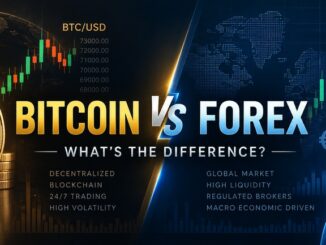
Crypto Trading vs Forex Trading: Quick Comparison
| Feature | Crypto Trading | Forex Trading |
|---|---|---|
| What is traded? | Cryptocurrencies or crypto-linked products | National currencies |
| Examples | BTC/USDT, ETH/USDT, SOL/USDT | EUR/USD, GBP/USD, USD/JPY |
| Trading hours | Commonly 24/7 | Nearly 24 hours per day, Monday-Friday |
| Weekend trading | Generally available | Normally closed |
| Volatility | Often relatively high | Usually lower in major pairs |
| Market size | Large but fragmented across assets and venues | Enormous global market |
| Position measurement | Coins, tokens, dollar value, contracts | Lots and currency units |
| Leverage | Available on some crypto derivatives | Common in retail forex |
| Main costs | Fees, spread, funding, slippage, withdrawal/network costs | Spread, commission, swap/rollover, slippage |
| Main drivers | Crypto sentiment, adoption, regulation, liquidity, token-specific events, macro conditions | Interest rates, central banks, inflation, employment, economic growth, geopolitics |
| Custody risk | Relevant when holding actual crypto | Normally no blockchain custody |
| Regulation | Varies significantly by asset, venue, product, and jurisdiction | More established regulatory structure in many jurisdictions |
Neither market should automatically be considered easy or safe.
They simply expose traders to different types of risk.
What Is Crypto Trading?
Crypto trading involves buying, selling, or speculating on the price of cryptocurrencies such as Bitcoin, Ethereum, Solana, XRP, BNB, and other digital assets.
Crypto can be traded through several different products.
Crypto Spot Trading
In a conventional spot transaction, you exchange one asset for another and normally obtain ownership of the cryptocurrency purchased.
For example:
BTC/USDT
means Bitcoin is being valued against Tether.
If you buy BTC using USDT in the spot market, you receive Bitcoin in your exchange account or wallet.
Our guide to crypto spot trading for beginners explains the process in greater detail.
Crypto Futures and Perpetual Trading
Crypto can also be traded through derivatives.
Instead of owning the underlying cryptocurrency, traders may speculate on its price using futures, perpetual futures, options, CFDs where available, and other derivative contracts.
These products can include leverage and liquidation risk.
For a detailed explanation, see our guide to crypto spot vs futures trading.
What Is Forex Trading?
Forex means foreign exchange.
It involves trading one national currency against another.
Examples include:
- EUR/USD
- GBP/USD
- USD/JPY
- AUD/USD
- USD/CAD
When trading EUR/USD, for example, you are trading the relative value of the euro versus the U.S. dollar.
If EUR/USD rises, the euro is strengthening relative to the dollar.
If EUR/USD falls, the euro is weakening relative to the dollar.
Retail forex positions are commonly expressed in standard lots, mini lots, and micro lots.
If lot sizes are unfamiliar, our guide explaining what lot size means in forex provides a beginner-friendly explanation.
1. Forex Is a Much Larger Global Market
Market size is one of the clearest differences between forex and cryptocurrency.
According to the Bank for International Settlements Triennial Central Bank Survey, global foreign-exchange turnover reached approximately $9.6 trillion per day in April 2025.
The foreign-exchange market includes spot transactions, FX swaps, outright forwards, options, and other FX derivatives.
Crypto is also a major global market, but its liquidity is divided among thousands of cryptocurrencies, centralized exchanges, decentralized exchanges, spot markets, futures markets, perpetual contracts, and broker products.
This makes direct volume comparisons difficult.
The practical lesson is that major forex pairs generally benefit from enormous market depth, while crypto liquidity can vary substantially by coin, exchange, trading pair, time of day, and market conditions.
2. Crypto Trades 24/7 While Forex Normally Stops for the Weekend
One of the biggest lifestyle differences is market availability.
Crypto Trading Hours
Major cryptocurrency markets generally operate 24 hours a day, 7 days a week.
That includes Saturdays, Sundays, and many public holidays.
A crypto position can therefore continue moving while you are sleeping, traveling, spending time with family, or away from your trading screen.
This can create more trading opportunities, but it also means the market never gives traders a natural weekend shutdown.
Forex Trading Hours
Forex normally trades almost continuously during the business week as activity moves through major financial centers:
Sydney → Tokyo → London → New York
Retail forex markets generally close for the weekend.
This gives forex traders a more defined weekly trading schedule.
However, positions left open over the weekend may still face gap risk when trading resumes.
3. Crypto Is Generally More Volatile Than Major Forex Pairs
Volatility describes how much price moves over a given period.
Cryptocurrencies can experience substantial percentage movements over relatively short periods.
Bitcoin may move several percentage points during a volatile session.
Smaller cryptocurrencies can move considerably more.
Major forex pairs such as EUR/USD or USD/JPY normally experience much smaller percentage changes.
However:
Lower underlying volatility does not automatically mean lower trading risk.
Forex traders frequently use leverage.
A relatively small currency movement can still generate a large account gain or loss when the position is oversized.
The CFTC’s virtual currency risk guidance also warns that cryptocurrency volatility and leverage can significantly amplify trading losses.
The correct comparison is therefore not simply:
Which market moves more?
The better risk-management question is:
How much of my trading account is exposed if the market moves against me?
4. Crypto Offers Far More Individual Assets
Forex traders normally concentrate on a relatively limited universe of currencies.
Common major pairs include:
- EUR/USD
- GBP/USD
- USD/JPY
- USD/CHF
- AUD/USD
- USD/CAD
- NZD/USD
Crypto traders can potentially choose from hundreds or thousands of digital assets.
This creates more opportunities—but also more complexity.
Different cryptocurrencies can have very different liquidity, volatility, market capitalization, token supply, technology, use cases, exchange availability, manipulation risk, and project risk.
A major cryptocurrency such as Bitcoin cannot automatically be treated the same way as a small-cap token.
This distinction is one reason our dedicated guide to Bitcoin vs forex trading focuses specifically on Bitcoin, while this article compares the broader cryptocurrency market with forex.
5. Forex and Crypto Have Different Price Drivers
Understanding what moves the market is essential before trading it.
Common Crypto Market Drivers
Cryptocurrency prices may react to:
- Crypto market sentiment
- Regulation
- Institutional adoption
- Exchange developments
- Token listings
- Blockchain upgrades
- Project-specific announcements
- Security breaches
- Stablecoin events
- ETF and institutional flows
- Global liquidity
- Interest-rate expectations
- Risk appetite
- Large-holder activity
Different cryptocurrencies can react to completely different catalysts.
Common Forex Market Drivers
Forex is strongly influenced by macroeconomics.
Currency pairs commonly respond to:
- Central-bank interest rates
- Monetary policy
- Inflation
- Employment data
- GDP growth
- Bond yields
- Trade balances
- Fiscal policy
- Political developments
- Geopolitical events
For example, EUR/USD can react strongly to changes in expectations for the Federal Reserve and European Central Bank because relative interest rates can influence demand for dollars and euros.
The analytical workload is therefore different.
Crypto traders may need to understand both macro conditions and crypto-specific events.
Forex traders usually concentrate more heavily on macroeconomics, central banks, and currency relationships.
6. Crypto and Forex Position Sizes Are Measured Differently
Risk management follows similar principles in both markets, but the units are different.
Forex Position Sizing
Forex commonly uses:
- Lots
- Pips
- Currency units
Typical lot conventions include:
| Forex Lot Size | Currency Units |
|---|---|
| 1.00 lot | 100,000 |
| 0.10 lot | 10,000 |
| 0.01 lot | 1,000 |
The actual pip value depends on the currency pair, lot size, account currency, and exchange rate.
Crypto Position Sizing
Crypto positions may be shown as:
- BTC
- ETH
- Token quantity
- USDT value
- Dollar value
- Futures contracts
- Broker lots
For example, a Bitcoin trader might hold 0.05 BTC, while an ETH trader might hold 2.5 ETH.
A derivatives exchange may instead display a position using contract quantity.
Because contract specifications differ between platforms, traders should never assume identical lot or contract values across brokers or exchanges.
7. Position-Sizing Example: Crypto vs Forex
The underlying risk-management logic can be similar.
Assume a trading account of:
$10,000
Hypothetical planned risk:
1%
Maximum intended monetary loss:
$10,000 × 1% = $100
Crypto Example
Suppose Bitcoin is trading at:
$80,000
Planned stop loss:
$78,000
Risk per Bitcoin:
$80,000 − $78,000 = $2,000
Position size:
$100 ÷ $2,000 = 0.05 BTC
The theoretical price risk would therefore be approximately $100 before fees, spread, slippage, funding, and execution differences.
Forex Example
Suppose you trade EUR/USD with a maximum planned risk of:
$100
Stop-loss distance:
50 pips
Required pip value:
$100 ÷ 50 = $2 per pip
Under simplified conditions where 1.00 EUR/USD lot is approximately $10 per pip for a USD account:
$2 ÷ $10 = 0.20 lot
The underlying principle is the same:
Risk Amount → Stop Distance → Position Size
not:
Maximum Leverage → Maximum Position
For cryptocurrency specifically, our crypto position-sizing guide explains this process in detail.
8. Leverage Can Magnify Losses in Both Markets
Leverage allows a trader to control a position larger than the capital being used as margin.
For example:
Account collateral:
$1,000
Market position:
$10,000
Exposure relative to collateral:
10×
If the position loses 5%:
$10,000 × 5% = $500 loss
Relative to the original $1,000 collateral, that is:
50%
This illustrates why leverage should never be confused with risk management.
Crypto derivatives may offer leverage.
Retail forex commonly operates on margin.
Both markets can therefore produce substantial losses if the trader uses oversized positions.
Our guide to crypto leverage for beginners explains why available leverage should never determine your position size.
9. Crypto and Forex Have Different Trading Costs
Trading costs reduce the amount a trader actually keeps from profitable trades and increase the impact of losing trades.
Common Crypto Trading Costs
Crypto traders may encounter:
- Maker fees
- Taker fees
- Bid-ask spread
- Slippage
- Perpetual funding payments
- Borrowing charges
- Withdrawal fees
- Blockchain network fees
- Conversion charges
- Liquidation-related costs
Common Forex Trading Costs
Forex traders may encounter:
- Bid-ask spread
- Trading commission
- Swap
- Rollover charges
- Financing costs
- Slippage
The actual cost depends on the broker or exchange, account type, trading product, position size, holding period, liquidity, and market conditions.
Frequent traders should pay particular attention to costs because many small fees can significantly reduce net performance.
For a deeper breakdown, see our guide to crypto trading fees.
10. Regulation and Consumer Protection Are Different
Regulation varies substantially across jurisdictions.
Forex has been part of the global financial system for decades and operates under established regulatory frameworks in many countries.
However, regulatory protection still depends on jurisdiction, broker, product, client classification, and account structure.
Crypto regulation is evolving more rapidly.
Different rules can apply to crypto spot trading, crypto derivatives, stablecoins, custody, exchanges, and token issuance.
The UK’s Financial Conduct Authority guidance on crypto investing describes cryptoassets as high-risk and emphasizes that investors should understand the possibility of losing their invested capital.
This does not mean every forex broker is safe or every crypto platform is unsafe.
It means traders should verify the actual regulatory status of the company holding or executing their funds.
11. Crypto Can Introduce Custody and Wallet Risk
A major difference appears when traders buy actual cryptocurrency.
If you purchase crypto in the spot market, your assets may be stored using exchange custody, third-party custody, hot wallets, hardware wallets, or self-custody.
Self-custody means the holder may be responsible for protecting private keys, seed phrases, and wallet credentials.
If those credentials are lost or stolen, access to the cryptocurrency may also be lost.
Forex traders generally do not manage blockchain wallets or private keys.
However, forex traders still face other risks such as broker failure, counterparty exposure, withdrawal problems, operational failures, and fraud.
The type of risk changes rather than disappearing.
12. Forex Usually Offers Deeper Liquidity in Major Pairs
Liquidity refers to the ability to enter or exit a market without causing a significant price change.
The enormous scale of the global foreign-exchange market means major pairs such as EUR/USD often have deep liquidity, tight spreads, and large trading volume.
Crypto liquidity can vary considerably.
Bitcoin and Ethereum may have strong liquidity on large venues.
A smaller token might have a wider spread, thin order books, larger slippage, and sudden price jumps.
This is particularly important when trading larger positions.
A chart may look tradable, but the underlying order book may tell a different story.
13. Crypto Offers Weekend Trading—But That Can Be a Disadvantage Too
Trading 24/7 sounds attractive.
It means crypto traders can respond to market movements at any time.
But there is another side to continuous trading.
A crypto trader can feel pressure to monitor markets constantly.
This can contribute to:
- Overtrading
- Sleep disruption
- Impulsive decisions
- Fear of missing out
- Excessive screen time
Forex’s weekend closure creates a more defined break.
Neither schedule is automatically better.
It depends on whether the trader can maintain a disciplined routine around the market being traded.
14. Technical Analysis Can Be Used in Both Markets
Many technical concepts can be applied to crypto and forex.
Examples include:
- Support and resistance
- Trend analysis
- Breakouts
- Retests
- Candlestick patterns
- Moving averages
- Momentum indicators
- Market structure
- Risk-to-reward analysis
However, the same setup should not automatically be expected to perform identically in both markets.
Crypto may have higher volatility, continuous weekend trading, different liquidity conditions, and token-specific catalysts.
Forex may have session-based behavior, central-bank events, scheduled economic releases, and different liquidity around market opens and closes.
A strategy should therefore be tested separately on each market.
15. Which Market Is Easier for Beginners?
Neither market is automatically easy.
Crypto May Initially Feel Simpler Because
A beginner can potentially:
- Deposit cash or stablecoins.
- Buy a cryptocurrency.
- Hold it.
- Sell it later.
Spot crypto can therefore appear straightforward.
But beginners still need to understand volatility, wallet security, trading fees, liquidity, exchange risk, token risk, and position sizing.
Forex Requires Different Concepts
Forex beginners need to understand:
- Currency pairs
- Pips
- Lots
- Spread
- Swap
- Margin
- Leverage
- Trading sessions
- Economic announcements
- Central banks
The best starting point is therefore not the market that looks easiest.
It is the market whose mechanics and risks you are willing to learn thoroughly before increasing position size.
16. Which Has Greater Profit Potential: Crypto or Forex?
There is no reliable rule stating that crypto or forex is inherently more profitable.
Crypto often provides larger percentage price movements.
That can create larger opportunities.
It can also create larger losses.
Forex major pairs usually move less in percentage terms, but leverage can multiply the financial impact of smaller movements.
Long-term trading performance depends on much more than market volatility.
Important factors include:
- Strategy quality
- Risk management
- Position sizing
- Win rate
- Average gain
- Average loss
- Risk-to-reward ratio
- Trading costs
- Execution quality
- Discipline
- Market conditions
A market that moves more is not automatically easier to trade profitably.
Crypto Trading May Suit Traders Who Prefer
Crypto may better match traders who specifically want:
- 24/7 market access
- Weekend trading
- A large selection of digital assets
- Crypto spot ownership
- Crypto-specific market themes
- Higher-volatility environments
- Exposure to blockchain-related markets
But those characteristics also introduce additional risks.
Forex Trading May Suit Traders Who Prefer
Forex may better match traders who prefer:
- A Monday-Friday trading schedule
- Highly liquid major currency pairs
- Macroeconomic analysis
- Central-bank-driven markets
- Established currency relationships
- Traditional broker-based trading
- Lot and pip-based position sizing
Again, this does not mean forex is automatically safer or easier.
Leverage can turn relatively small currency movements into substantial account losses.
Can You Trade Both Crypto and Forex?
Yes.
Some traders participate in both markets.
But using the same strategy and position size without adjustment can be dangerous.
For example, a position size appropriate for EUR/USD may be completely unsuitable for Bitcoin, Ethereum, Solana, or a small-cap altcoin.
Before transferring a strategy from one market to another, evaluate:
- Volatility
- Liquidity
- Spread
- Trading costs
- Contract specification
- Trading hours
- Historical strategy performance
- Appropriate stop distance
- Position size
- Total account exposure
The market changes.
Your risk parameters should change with it.
Common Mistakes When Comparing Crypto and Forex
Assuming Crypto Is Better Because It Moves More
Greater volatility increases both opportunity and risk.
Assuming Forex Is Safe Because Major Currency Pairs Move Less
Leverage can make small currency moves financially significant.
Using Maximum Available Leverage
Maximum permitted leverage is not a recommended trading size.
Ignoring Trading Costs
Spread, commissions, fees, funding, swap, and slippage reduce trading returns.
Trading Illiquid Crypto Assets Like Bitcoin
Not every cryptocurrency has Bitcoin-level liquidity.
Using the Same Position Size Across Markets
Position size should be calculated from account risk and stop distance.
Choosing a Market Because Someone Promises Easy Profit
No legitimate market provides guaranteed trading profits.
The CFTC virtual currency advisory warns traders against misleading guaranteed-return claims.
Crypto vs Forex Trading: Practical Decision Checklist
Before trading either market, ask:
- What exactly am I trading?
- Do I own the underlying asset?
- Is the product leveraged?
- What is the contract size?
- What trading hours apply?
- How volatile is the instrument?
- How liquid is it?
- What fees apply?
- What spread should I expect?
- What can cause sudden price movement?
- Where is my stop loss?
- How much money am I willing to lose?
- What position size matches that risk?
- Who holds my funds?
- What regulation applies?
- What happens if the broker or exchange fails?
- Can I financially absorb the loss?
If you cannot answer those questions, you probably do not yet understand the instrument well enough to trade it with meaningful size.
Our crypto risk management guide for beginners provides a broader framework for controlling cryptocurrency trading exposure.
Frequently Asked Questions
Is Crypto Trading Better Than Forex Trading?
Neither market is universally better.
Crypto offers 24/7 trading, more individual assets, and generally higher volatility.
Forex offers enormous global liquidity, established major currency pairs, and a more traditional Monday-Friday trading structure.
The appropriate market depends on the product you understand, your strategy, risk tolerance, schedule, and trading process.
Is Crypto More Profitable Than Forex?
Not necessarily.
Higher crypto volatility can create larger percentage movements, but it can also produce larger losses.
Forex generally experiences smaller percentage moves in major pairs, but leverage can magnify both profits and losses.
Is Crypto Riskier Than Forex?
Crypto commonly experiences higher underlying price volatility and can introduce additional risks such as custody, exchange, token, and blockchain-related risks.
Forex also carries substantial risk, particularly when leverage is used.
Neither should be considered risk-free.
Does Crypto Trade 24 Hours a Day?
Major cryptocurrency markets generally operate 24 hours per day and seven days per week, although individual exchanges may occasionally have maintenance periods or product-specific restrictions.
Does Forex Trade 24/7?
No.
Forex normally trades nearly 24 hours per day during the business week but generally closes over the weekend.
Can I Use Forex Strategies for Crypto?
Some technical concepts can be transferred, but the strategy should be retested specifically on cryptocurrency data because volatility, liquidity, trading hours, and market behavior differ.
Which Has More Liquidity: Crypto or Forex?
The global forex market is significantly larger overall.
Major forex pairs usually have very deep liquidity.
Crypto liquidity varies considerably between coins, trading pairs, exchanges, and market conditions.
Do Crypto and Forex Both Use Leverage?
Yes.
Leverage is available in retail forex and in many crypto derivative products.
Available leverage varies by platform, jurisdiction, product, and trader eligibility.
Is Spot Crypto the Same as Forex Trading?
No.
Spot crypto can involve actual ownership of cryptocurrency.
Retail forex usually involves trading the relative value of two national currencies through a broker or dealer.
Should Beginners Trade Crypto or Forex?
Beginners should first understand the instrument, costs, leverage, position sizing, and risks.
Choosing one market because it appears to offer faster profits is not a sound trading approach.
Conclusion
Crypto trading and forex trading share many tools, but they are fundamentally different markets.
Crypto offers:
24/7 trading → more assets → higher volatility → crypto-specific risks
Forex offers:
major currency pairs → enormous liquidity → weekday trading → macroeconomic-driven markets
Neither automatically produces better trading results.
What matters more is whether the trader understands the instrument, market structure, trading costs, volatility, leverage, correct position size, and potential loss.
If you trade cryptocurrency, begin with proper crypto risk management rather than chasing the asset with the largest price movement.
If you trade forex, understand forex lot size and position sizing before increasing exposure.
The market you choose matters.
But controlling how much you can lose matters even more.
Risk Disclaimer: Cryptocurrency, forex, CFDs, futures, and leveraged trading involve substantial risk and may not be appropriate for everyone. Prices can move rapidly, leverage can magnify losses, and brokers, exchanges, or counterparties can fail. This material is provided for educational purposes only and does not constitute financial, investment, legal, or tax advice.


Be the first to comment