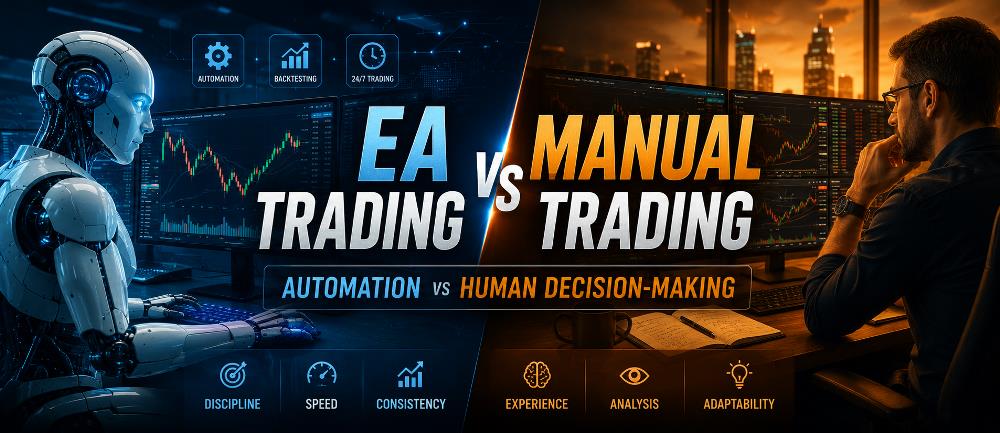
One of the biggest decisions a forex trader can make is whether to trade manually or allow an automated trading system to execute trades.
With manual trading, you analyze the market, decide when to enter and exit, and personally manage each position.
With EA trading, an Expert Advisor follows programmed rules and can automatically analyze market conditions, open trades, manage positions, and close them.
So when comparing EA trading vs manual trading, which one is better?
The answer is not simply automation versus human judgment.
EA trading can provide speed, consistency, continuous monitoring, and rule-based execution. Manual trading provides flexibility, discretion, and the ability to react to market situations that may be difficult to program.
In this guide, we will compare both approaches so you can understand their advantages, disadvantages, risks, and ideal use cases.
Risk Warning: Forex, gold, CFDs, and other leveraged products involve substantial risk. Neither automated trading nor manual trading guarantees profit. Always use appropriate risk management and test a strategy carefully before committing significant capital.
What Is EA Trading?
EA trading means using an Expert Advisor, or EA, to automate part or all of a trading strategy.
An Expert Advisor is a program that operates inside trading platforms such as MetaTrader and follows programmed instructions.
According to the official MetaTrader 5 guide to algorithmic trading, trading robots can analyze financial-market prices and execute trading operations automatically according to programmed algorithms.
Depending on how an EA is programmed, it may automatically:
- Analyze technical indicators
- Identify BUY and SELL conditions
- Open trades
- Calculate lot sizes
- Set Stop Loss levels
- Set Take Profit targets
- Move trades to breakeven
- Apply trailing stops
- Restrict trading sessions
- Control the number of open positions
- Close trades when exit conditions occur
If you are completely new to automated trading, start with our beginner guide on what an Expert Advisor in MetaTrader is.
The important point is that an EA does not independently “think” like a human trader.
It executes the trading logic programmed into it.
What Is Manual Trading?
Manual trading means the trader personally controls the trading process.
A manual trader typically:
- Analyzes the market
- Looks for a trading opportunity
- Determines whether the setup is valid
- Chooses the entry
- Calculates position size
- Places the Stop Loss
- Sets a Take Profit or exit target
- Monitors the position
- Adjusts or closes the trade when necessary
Manual traders may base their decisions on:
- Price action
- Technical indicators
- Support and resistance
- Market structure
- Fundamental analysis
- Economic news
- Market sentiment
- Multiple timeframe analysis
The biggest difference is that the trader makes the final trading decision, rather than allowing a computer algorithm to make it automatically.
EA Trading vs Manual Trading: Quick Comparison
| Factor | EA Trading | Manual Trading |
|---|---|---|
| Trade execution | Automated | Trader executes |
| Emotional influence | Lower during execution | Can be significant |
| Execution speed | Very fast | Depends on trader |
| Market monitoring | Continuous while running | Limited by availability |
| Rule consistency | High | Depends on discipline |
| Flexibility | Limited to programmed logic | High |
| Fatigue | None | Possible |
| Backtesting | Highly suitable | More difficult |
| Human judgment | Limited | Strong |
| Reaction to unusual events | Must be programmed | Trader can adapt |
| Technical dependency | Higher | Lower |
| Position management | Automatic if programmed | Manual |
Neither approach wins every category.
Their strengths solve different trading problems.
Advantage #1: EAs Follow Trading Rules Consistently
One of the strongest advantages of automated trading is consistency.
Imagine a strategy with the following rules:
- BUY only when three specific conditions are satisfied
- Risk no more than 1% per trade
- Use a predefined Stop Loss
- Trade only during certain hours
- Never open more than two positions
A properly programmed EA can check those conditions repeatedly without becoming distracted, impatient, tired, or emotional.
The MetaTrader 5 documentation on algorithmic trading specifically notes that trading robots follow preset algorithms and can respond rapidly to market changes.
A manual trader may understand exactly the same rules but occasionally break them.
For example, a trader might:
- Enter before confirmation
- Increase the lot size
- Chase a missed trade
- Remove the Stop Loss
- Enter because of fear of missing out
- Take an extra trade after reaching the daily limit
An EA can reduce this type of execution inconsistency.
However, there is one important limitation:
An EA will also follow bad rules consistently.
Automation cannot turn a poorly designed strategy into a profitable one.
Advantage #2: EAs Reduce Emotional Trade Execution
Trading psychology is one of the greatest challenges for manual traders.
After several losing trades, a trader may become afraid to take the next valid setup.
After several profitable trades, the trader may become overconfident.
Common emotional mistakes include:
- Revenge trading
- Overtrading
- Fear of missing out
- Increasing lot size impulsively
- Moving the Stop Loss farther away
- Closing profitable trades too early
- Refusing to close losing trades
An EA does not experience fear, greed, frustration, or excitement.
It simply follows its programmed conditions.
This can make automation particularly useful for strategies where strict execution discipline is important.
However, automated trading does not completely eliminate human emotion.
The trader can still interfere by:
- Increasing the EA’s risk
- Changing settings after losses
- Turning the EA off prematurely
- Constantly switching strategies
- Over-optimizing parameters
- Deploying an EA without adequate testing
Automation can remove emotion from individual trade execution, but the trader still controls the overall system and its risk.
Advantage #3: EAs Can Monitor the Market Continuously
Human traders cannot watch charts continuously.
People need to work, sleep, travel, and spend time away from their trading computers.
An EA can continue checking the market as long as MetaTrader remains operational, connected, and authorized to trade.
This is useful when a strategy:
- Trades several sessions
- Monitors multiple instruments
- Waits for rare setups
- Requires quick reaction to signals
- Operates outside the trader’s normal waking hours
MetaTrader specifically supports automated trading systems designed to continuously analyze markets and perform programmed operations.
For traders who need their EA running without relying on a home computer, a VPS can provide a continuously operating MetaTrader environment.
Continuous operation, however, should never be confused with zero supervision.
An automated system can still encounter:
- Internet disruptions
- VPS failures
- Broker connection problems
- Abnormal spreads
- Incorrect settings
- Software errors
- Unexpected market conditions
Advantage #4: EAs Can Execute Trades Faster
Once an EA detects its programmed conditions, it can react almost immediately.
A manual trader must first:
- Notice the signal
- Evaluate the setup
- Open the order window
- Enter the lot size
- Configure the trade
- Click BUY or SELL
That process takes time.
An automated system can send the order as soon as its programmed conditions are satisfied.
This can be particularly useful for:
- Scalping systems
- Short-term strategies
- Fast-moving markets
- Strategies monitoring multiple symbols
However, faster order submission does not guarantee perfect execution.
Actual trades can still be affected by:
- Spread
- Slippage
- Latency
- Liquidity
- Broker execution
- Rapid price movement
Automation improves execution speed.
It does not eliminate execution risk.
Advantage #5: EAs Can Be Backtested Systematically
One of the most important advantages of automated trading is the ability to test a strategy against historical market data.
MetaTrader 5 includes an official Strategy Tester for Expert Advisors, allowing traders to evaluate how an automated strategy would have performed on historical quotes before considering real trading.
Backtesting can help examine:
- Historical profit and loss
- Maximum drawdown
- Number of trades
- Win rate
- Profit factor
- Average winning trade
- Average losing trade
- Consecutive losses
- Trade frequency
- Performance across different market periods
For a complete walkthrough, read our step-by-step guide to backtesting an Expert Advisor in MT5.
If you use the older MetaTrader platform, we also have a separate guide explaining how to backtest an Expert Advisor in MT4.
Backtesting is extremely useful, but historical performance never guarantees future profitability.
Poor data, unrealistic assumptions, parameter over-optimization, and curve fitting can all create impressive historical results that fail under real market conditions.
Advantage #6: EAs Do Not Become Tired
Fatigue affects decision-making.
A manual trader watching charts for several hours may eventually:
- Lose concentration
- Miss a signal
- Misread an indicator
- Enter the wrong lot size
- Place the Stop Loss incorrectly
- Take a poor-quality setup
An automated system does not become physically tired.
It can apply the same programmed logic repeatedly.
This makes automation particularly useful for repetitive strategies.
Where Manual Trading Has an Advantage
EA trading has substantial operational advantages.
But manual traders possess something that can be difficult to reproduce perfectly in code:
human discretion.
Advantage #1: Manual Traders Can Adapt to Unusual Conditions
An EA follows programmed rules.
That is its strength—and also one of its weaknesses.
Consider situations such as:
- Unexpected geopolitical news
- Extreme volatility
- Sudden liquidity shortages
- Abnormally wide spreads
- Broker execution problems
- Unexpected central-bank announcements
- Market behavior completely outside normal conditions
An experienced manual trader may look at the market and simply decide:
Do not trade.
An EA can make that decision only if the relevant condition has already been anticipated and included in its programming.
This makes human discretion valuable when markets behave in ways the automated system was not designed to handle.
Advantage #2: Manual Traders Can Interpret Market Context
Some trading strategies are relatively easy to convert into precise rules.
Others are highly subjective.
A discretionary trader may consider:
- Market structure
- Strength of support and resistance
- Quality of a breakout
- Momentum
- Candle behavior
- News sentiment
- Correlation between markets
- Broader economic conditions
- Whether price action appears clean or erratic
A human trader may combine these observations in ways that are difficult to express mathematically.
If your strategy depends heavily on context and subjective interpretation, completely automated execution may not be practical.
Advantage #3: Manual Traders Have Greater Immediate Control
A manual trader can change a decision instantly.
The trader can:
- Skip a setup
- Close a trade early
- Reduce exposure
- Avoid trading around news
- Stop trading for the day
- Adjust to unexpected circumstances
An EA operates inside the boundaries of its programming.
It cannot spontaneously invent a new rule because something unusual has happened.
This gives manual traders considerably more flexibility.
Advantage #4: Manual Trading Requires Less Automation Infrastructure
An automated trading setup may depend on several components working correctly.
These can include:
- The Expert Advisor
- MetaTrader
- Correct EA inputs
- Correct chart and timeframe
- Broker connectivity
- Internet connection
- VPS
- Supporting indicators
- External libraries
- Licensing systems
- Broker symbol specifications
MetaTrader’s official Expert Advisor settings documentation explains that automated trading must be permitted at platform level before an EA can actually execute trades.
If you are setting up an EA for the first time, follow our step-by-step guide to installing an Expert Advisor in MT5.
For traders who still use MetaTrader 4, see our guide on how to install an Expert Advisor in MT4.
Manual traders still depend on a trading platform and broker connection, but there are fewer automation-specific components to troubleshoot.
The Biggest Weakness of Manual Trading: Human Behavior
Manual trading provides freedom.
Unfortunately, that freedom can become a major weakness.
Imagine a trader with a carefully defined trading plan:
- Risk only 1% per trade
- Take a maximum of two trades per session
- Enter only after confirmation
- Always use a Stop Loss
The trader then loses three trades.
Frustration takes over.
The next setup appears, and instead of risking 1%, the trader risks 5% in an attempt to recover previous losses.
That was not part of the trading strategy.
It was an emotional decision.
Manual trading works effectively only when the trader can maintain discipline.
This is one of the reasons systematic traders use automation: software can enforce rules a trader may otherwise be tempted to break.
The Biggest Weakness of EA Trading: Automation Can Scale Mistakes
Automation works quickly and consistently.
That is excellent when the strategy is functioning correctly.
It becomes dangerous when something is wrong.
Suppose an EA contains:
- Incorrect lot-size calculations
- Faulty entry logic
- Incorrect Stop Loss placement
- Excessive trade stacking
- An unintended martingale rule
- A programming bug
- Incorrect symbol assumptions
The EA may repeatedly execute the same mistake.
A manual trader might notice something unusual after the first trade.
An automated system could potentially repeat the problem across multiple trades before the operator notices.
This is why EAs should be carefully tested before being trusted with meaningful capital.
Can an EA Trade Better Than a Human?
For certain tasks, yes.
An EA can generally:
- Process programmed conditions faster
- Execute rules more consistently
- Monitor markets longer
- Perform calculations immediately
- Follow repetitive procedures without fatigue
But that does not mean every EA is superior to every manual trader.
An experienced discretionary trader may be better at:
- Interpreting changing market conditions
- Avoiding unusual markets
- Evaluating qualitative information
- Recognizing abnormal behavior
- Knowing when not to trade
The real question is therefore not:
Human vs robot — which one wins?
A better question is:
Which execution method is best suited to the trading strategy?
Is EA Trading More Profitable Than Manual Trading?
Not necessarily.
Profitability depends on the quality of the entire trading system.
Important factors include:
- Trading edge
- Entry rules
- Exit rules
- Risk management
- Position sizing
- Spread
- Commission
- Slippage
- Market conditions
- Execution quality
- Trader discipline
A bad strategy will not become profitable simply because it is automated.
Likewise, a potentially profitable manual strategy can fail if the trader repeatedly ignores its rules.
Automation changes how the strategy is executed.
It does not automatically create a profitable trading edge.
EA Trading vs Manual Trading for Beginners
Beginners sometimes assume that installing an EA means they no longer need to understand trading.
That can be a costly mistake.
Even when using an automated system, you should understand:
- What causes the EA to enter
- What causes it to exit
- How much it risks
- How lot size is calculated
- Whether it uses a Stop Loss
- Its potential drawdown
- Maximum simultaneous positions
- Whether it uses grid trading
- Whether it uses martingale
- Which sessions it trades
- What happens during volatile markets
A trader who does not understand how an EA is supposed to behave cannot easily recognize when something is wrong.
After historical testing, another important step is observing the EA under current market conditions. Our guide on how to forward test an Expert Advisor before live trading explains how this process works.
Backtesting vs Forward Testing
Backtesting and forward testing serve different purposes.
Backtesting
Backtesting applies the trading strategy to historical market data.
It answers:
How would this EA have behaved in the past?
MetaTrader’s official Strategy Testing documentation explains how Expert Advisors can be tested and optimized using historical data.
Forward Testing
Forward testing allows the strategy to operate on market data that occurs after the trading rules and settings have already been selected.
It asks:
How is this EA behaving under current market conditions?
A sensible evaluation process may therefore look like:
Backtest → Forward Test → Evaluate → Consider Live Deployment
Neither stage guarantees future profitability.
Together, however, they provide much more information than immediately running an untested EA with real capital.
What Is Semi-Automated Trading?
There is another option between fully automated and fully manual trading:
semi-automated trading.
In this approach, the human trader retains control over certain decisions while software performs repetitive tasks.
For example, a trader may manually choose the entry while an EA automatically:
- Calculates lot size
- Places the Stop Loss
- Sets the Take Profit
- Moves the trade to breakeven
- Applies a trailing stop
- Closes positions under predefined rules
Another system may allow an EA to identify potential signals while requiring the trader to approve the actual trade.
This hybrid approach combines human discretion with automated discipline.
For some traders, this may provide a better balance than choosing either complete automation or complete manual control.
When EA Trading May Be Better
EA trading may be suitable when:
- Your strategy has clearly defined rules
- You want consistent execution
- You cannot watch charts continuously
- Your strategy produces many signals
- You want systematic backtesting
- You struggle with emotional execution
- You trade several markets
- Fast execution matters
- You are comfortable testing and monitoring software
EA trading is particularly effective when the strategy can be translated into objective conditions.
When Manual Trading May Be Better
Manual trading may be more appropriate when:
- Your strategy depends heavily on judgment
- You trade relatively few setups
- You enjoy analyzing the market
- News and economic context affect your decisions
- You want complete control over each position
- Your method is difficult to translate into code
- You can consistently follow your trading plan
The key requirement is discipline.
Manual flexibility becomes dangerous when discretionary decision-making turns into impulsive trading.
Can You Use EA Trading and Manual Trading Together?
Yes.
There is no requirement to choose only one method.
For example, you might:
- Manually trade one strategy
- Run an EA for another strategy
- Use an EA only for position management
- Use automation for alerts
- Automate Stop Loss adjustments
- Automate risk calculations
- Use manual approval for EA-generated signals
The objective should be to automate the parts of your trading process where software provides a genuine advantage while retaining human control where judgment adds value.
EA Trading vs Manual Trading: Which Is Better?
The comparison can be summarized simply.
EA Trading Is Stronger For:
- Consistency
- Speed
- Rule-based execution
- Continuous monitoring
- Repetitive tasks
- Systematic backtesting
- Reducing emotional execution mistakes
- Monitoring multiple markets
Manual Trading Is Stronger For:
- Flexibility
- Human judgment
- Market-context interpretation
- Adapting to unusual situations
- Subjective trading strategies
- Immediate discretionary control
Neither method eliminates risk.
An EA can lose money.
A manual trader can lose money.
A profitable backtest can fail under future market conditions.
An experienced trader can still make emotional mistakes.
The better question is therefore not simply:
“Is EA trading better than manual trading?”
Instead ask:
“Which method allows my trading strategy to be executed most consistently, accurately, and with controlled risk?”
Frequently Asked Questions
Is EA trading better than manual trading?
Not universally. EA trading offers consistency, automation, fast execution, and continuous monitoring. Manual trading provides flexibility and human judgment. The better method depends on your trading strategy and trading style.
Can an Expert Advisor eliminate emotions?
An EA can significantly reduce emotion during automated trade execution because it follows predefined rules. However, the trader can still make emotional decisions when changing settings, increasing risk, or interfering with the EA.
Can an EA trade 24 hours a day?
An EA can monitor the market continuously as long as MetaTrader remains operational, connected to the broker, and authorized to perform automated trading. Whether the strategy should actually trade continuously depends on its programmed rules.
Can an EA guarantee profits?
No.
An Expert Advisor only automates a trading strategy. It cannot guarantee profitable results.
Is manual trading safer than EA trading?
Neither method is automatically safer.
Risk depends on factors including leverage, position size, strategy quality, Stop Loss rules, drawdown, execution, and market conditions.
Should beginners use Expert Advisors?
Beginners can use EAs, but they should first understand how the trading strategy works, how risk is controlled, and how the EA behaves under different market conditions.
A good starting point is our guide explaining what an Expert Advisor is and how it works.
Should I backtest an EA before using it?
Yes.
Historical testing can provide valuable information about how an EA behaved previously. MetaTrader 5 provides a built-in Strategy Tester specifically for this purpose.
You can follow our full tutorial on how to backtest an Expert Advisor in MT5.
Is forward testing necessary after backtesting?
Forward testing is highly useful because it allows you to observe the EA under current market and broker conditions.
Our EA forward-testing guide explains the process in detail.
Can I combine manual and automated trading?
Yes.
Semi-automated trading combines human decision-making with automated functions such as position sizing, order placement, Stop Loss management, breakeven, or trailing stops.
Final Thoughts
The debate over EA trading vs manual trading does not have one universal winner.
Expert Advisors are powerful because they can follow programmed rules rapidly, consistently, and without fatigue.
Manual traders retain an important advantage because humans can interpret context, recognize unusual market behavior, and adapt to situations that may never have been programmed into an automated system.
For strategies with clear and objective rules, automation can be extremely useful.
For strategies requiring substantial judgment and interpretation, manual trading may be more appropriate.
For some traders, the strongest solution may be a combination of both.
Whatever method you choose, focus on the fundamentals:
- Use a clearly defined trading strategy
- Control position size
- Limit risk
- Use appropriate Stop Loss rules
- Understand drawdown
- Backtest automated strategies
- Forward-test before considering significant live capital
- Monitor actual performance
- Never assume automation guarantees profit
The objective is not to prove that a machine is better than a human—or that a human is better than a machine.
The objective is to create a trading process that is disciplined, testable, repeatable, and properly risk-controlled.
If you want to continue learning about automated trading, the logical next step is our guide on how to install an Expert Advisor in MetaTrader 5 and then how to backtest an EA before using it.

Be the first to comment