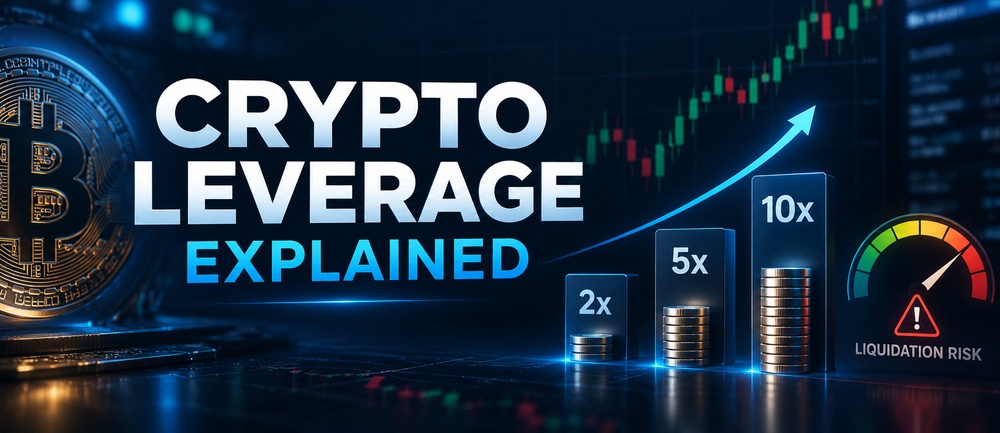
Crypto leverage can make a small trading account control a much larger market position.
That sounds attractive, especially to beginners.
But leverage does not create free buying power. It increases exposure, which means it can magnify both profits and losses. In leveraged crypto trading, even a relatively small price movement can have a much larger effect on your account than it would in an unleveraged trade.
For this reason, beginners should understand leverage before using it.
This guide explains what crypto leverage means, how 2x, 5x, 10x, and higher leverage work, how margin is calculated, why liquidation happens, and how leverage should fit into a proper risk-management process.
Important: This article is for educational purposes only and does not constitute financial, investment, or trading advice. Cryptocurrency trading is highly volatile, and leveraged trading can result in rapid and substantial losses.
What Is Crypto Leverage?
Crypto leverage allows a trader to control a position that is larger than the amount of capital committed as margin.
For example, suppose you have:
- Trading capital: $1,000
- Leverage: 5x
In simplified terms, 5x leverage may allow you to control approximately:
$1,000 × 5 = $5,000
of market exposure.
The important point is that your position is now much larger than the cash amount used as margin.
That larger exposure magnifies the effect of price movements.
The U.S. Commodity Futures Trading Commission warns that leverage in virtual-currency derivatives can amplify underlying market risk because traders fund only a fraction of the position value. CFTC guidance on virtual-currency trading risk
What Does 2x, 5x, 10x, or 20x Leverage Mean?
The leverage number represents the relationship between the position value and the margin used to support it.
A simplified formula is:
Position Value = Margin × Leverage
For example:
| Margin | Leverage | Approximate Position Value |
|---|---|---|
| $1,000 | 1x | $1,000 |
| $1,000 | 2x | $2,000 |
| $1,000 | 5x | $5,000 |
| $1,000 | 10x | $10,000 |
| $1,000 | 20x | $20,000 |
Higher leverage therefore allows the same amount of margin to control a larger position.
But that does not mean higher leverage is automatically better.
It means the account becomes more sensitive to price movement.
Crypto Leverage Example
Suppose you deposit:
$1,000
and open a Bitcoin position worth:
$5,000
Your effective leverage is:
$5,000 ÷ $1,000 = 5x
Now suppose Bitcoin moves:
+2%
A 2% increase in a $5,000 position is:
$5,000 × 2% = $100
Relative to the $1,000 margin:
$100 ÷ $1,000 = 10%
So a 2% favorable market movement produced an approximate 10% gain on the margin before fees and other costs.
But the same mathematics works in reverse.
If Bitcoin falls 2%:
$5,000 × 2% = $100 loss
That is also approximately:
10% of the $1,000 margin
This is the core principle of leverage:
Leverage magnifies the effect of market movement in both directions.
Leverage Does Not Change the Market Move
A common beginner misunderstanding is that leverage somehow makes Bitcoin or another cryptocurrency move more.
It does not.
If Bitcoin rises 1%, it still rises 1%.
What changes is the size of your market exposure relative to the capital you committed.
For example:
Without Leverage
Capital:
$1,000
Position:
$1,000
Bitcoin rises:
2%
Approximate gain:
$20
With 5x Leverage
Margin:
$1,000
Position:
$5,000
Bitcoin rises:
2%
Approximate gain:
$100
The underlying market move remains 2%.
The leveraged position simply creates five times the market exposure.
What Is Margin in Crypto Trading?
Margin is the capital allocated to support a leveraged position.
A simplified formula is:
Initial Margin = Position Value ÷ Leverage
Suppose you want to control a:
$10,000 position
At 2x leverage:
$10,000 ÷ 2 = $5,000 margin
At 5x leverage:
$10,000 ÷ 5 = $2,000 margin
At 10x leverage:
$10,000 ÷ 10 = $1,000 margin
Some exchanges calculate margin using additional position tiers, maintenance-margin requirements, risk limits, contract specifications, fees, and other parameters.
For example, Binance’s current futures documentation explains that margin requirements depend on position notional value, leverage, and the exchange’s applicable margin structure. Binance futures margin calculation documentation
Leverage and Margin Are Not the Same Thing
Although leverage and margin are closely related, they are not identical.
Leverage describes how large the position is relative to the capital supporting it.
Margin is the amount of collateral required to maintain the leveraged position.
For example:
Position value:
$10,000
Margin:
$2,000
Effective leverage:
$10,000 ÷ $2,000 = 5x
This distinction becomes especially important when calculating position size.
Your margin requirement does not automatically tell you how much money you are actually risking.
Position Size vs Leverage
Position size and leverage are two different concepts.
Position size determines:
How much market exposure you have.
Leverage determines:
How much margin may be required to control that exposure.
Suppose your trading plan says your correct position size is:
$2,000
If you trade without leverage, you may need approximately $2,000 of capital.
If you trade at 5x leverage, the platform may require significantly less margin.
But your market exposure is still based on the $2,000 position.
That is why leverage should never be used as a substitute for proper position sizing.
For a detailed explanation of risk-based sizing, read our Crypto Position Sizing Explained guide.
What Is Crypto Liquidation?
Liquidation occurs when a leveraged position no longer has enough margin to satisfy the platform’s maintenance requirements.
When this happens, the exchange may automatically reduce or close the position.
The exact liquidation system varies depending on:
- Exchange
- Product
- Contract type
- Leverage
- Position size
- Margin mode
- Maintenance-margin requirement
- Fees
- Existing account equity
- Other open positions
Coinbase explains that leveraged futures traders must maintain sufficient account balance above maintenance requirements or liquidation can occur. Coinbase explanation of crypto leverage and futures margin
Why Higher Leverage Increases Liquidation Risk
Higher leverage usually leaves less room for adverse price movement before the position reaches dangerous margin levels.
Consider a simplified example.
You have:
$1,000
Trader A Uses 2x Leverage
Position:
$2,000
Trader B Uses 10x Leverage
Position:
$10,000
If the market falls:
5%
Trader A’s approximate price loss:
$2,000 × 5% = $100
Trader B’s approximate price loss:
$10,000 × 5% = $500
Both traders experienced the same 5% market move.
But Trader B suffered a much larger account impact because the position was significantly larger.
This is why extremely high leverage can produce rapid liquidation during volatile market conditions.
Does 10x Leverage Mean You Lose Everything After a 10% Move?
Not necessarily.
A common shortcut says:
10x leverage = approximately 10% move to wipe out the margin
But real liquidation mechanics are more complicated.
Actual liquidation can occur earlier or later depending on:
- Maintenance margin
- Trading fees
- Funding costs
- Mark price
- Position direction
- Cross or isolated margin
- Additional collateral
- Exchange risk tiers
- Contract structure
Therefore, beginners should not assume that:
1 ÷ leverage = exact liquidation distance
It may provide a rough conceptual illustration, but it is not a reliable liquidation-price formula.
Always check the actual liquidation price displayed by the exchange and understand how the platform calculates it.
What Is Maintenance Margin?
Maintenance margin is the minimum level of collateral required to keep a leveraged position open.
Initial margin allows you to open the position.
Maintenance margin helps determine whether the position can remain open.
If account equity falls too close to the maintenance requirement, the platform may:
- Restrict new positions
- Request additional margin
- Reduce exposure
- Liquidate part of the position
- Liquidate the entire position
Exchange maintenance-margin systems can also change over time.
For example, Binance periodically updates leverage and margin tiers for specific futures contracts, which can affect maintenance-margin requirements and liquidation risk.
What Is Isolated Margin?
Isolated margin limits the margin assigned to a specific position.
Suppose you allocate:
$500
to an isolated leveraged position.
If that position deteriorates severely, the loss is generally limited to the margin allocated to that position, subject to the exchange’s rules and market conditions.
The rest of the trading account is not automatically being used to support that position.
This can make isolated margin easier for beginners to understand from a risk-control perspective.
However, isolated margin does not make leverage safe.
A poorly sized isolated position can still be liquidated quickly.
What Is Cross Margin?
Cross margin allows multiple positions to share available margin within the relevant account or margin pool.
If one position moves against you, available funds elsewhere in the margin account may help support it.
This can delay liquidation in some situations.
However, it can also expose a larger portion of the account to the same losing position.
For example:
You might initially believe that only $500 is at risk.
But under cross margin, additional available equity may be used to support the position.
That means one severely losing trade can potentially affect more of the account than expected.
Beginners should therefore understand exactly how their exchange implements cross margin before using it.
Isolated Margin vs Cross Margin
| Feature | Isolated Margin | Cross Margin |
|---|---|---|
| Margin allocation | Assigned to specific position | Shared across eligible positions |
| Account exposure | More contained | Broader |
| Liquidation support | Limited to allocated margin | Can use additional available margin |
| Complexity | Usually easier to understand | More complex |
| Risk to other positions | Lower connection | Positions can affect each other |
Neither mode eliminates risk.
They simply manage collateral differently.
Crypto Spot Trading vs Leveraged Trading
In ordinary spot trading, you typically buy the actual cryptocurrency using available funds.
For example:
You spend:
$1,000
to buy Bitcoin.
If Bitcoin declines 10%, the position becomes worth approximately:
$900
You still own the Bitcoin unless you sell it.
Leveraged derivatives work differently.
You may be trading:
- Perpetual futures
- Dated futures
- Margin products
- Other leveraged contracts
Depending on the product, you may not own the underlying cryptocurrency itself.
Instead, you are trading a contract whose value is linked to the cryptocurrency.
Binance, for example, distinguishes margin trading from futures trading and notes that futures positions involve contracts rather than direct ownership of the underlying asset. Binance comparison of margin and futures trading
What Is a Long Leveraged Crypto Position?
A long position benefits when price rises.
Suppose you open:
Position value:
$5,000
Bitcoin rises:
3%
Approximate gross gain:
$5,000 × 3% = $150
If the position is backed by:
$1,000 margin
then $150 represents:
15% of the margin
before fees and other costs.
But if Bitcoin falls 3%:
Approximate loss:
$150
The same leverage magnifies losses.
What Is a Short Leveraged Crypto Position?
A short position is designed to benefit when price falls.
Suppose you short:
$5,000 worth of Bitcoin exposure
Bitcoin falls:
4%
Approximate gross gain:
$5,000 × 4% = $200
But if Bitcoin rises 4% instead:
Approximate loss:
$200
Short positions can therefore be liquidated when the underlying cryptocurrency rises sharply against the trader.
Is Higher Leverage More Profitable?
Higher leverage can increase potential return on the margin used.
But it does not improve the quality of the trade.
Leverage does not increase:
- Win rate
- Accuracy
- Trading skill
- Market prediction
- Strategy quality
It only changes the relationship between account capital and market exposure.
A poor trading setup at 1x leverage remains a poor setup at 20x leverage.
At higher leverage, the consequences may simply arrive faster.
A 5x vs 10x Leverage Example
Suppose two traders each have:
$1,000
Trader A
Leverage:
5x
Position:
$5,000
Trader B
Leverage:
10x
Position:
$10,000
The market drops:
3%
Trader A approximate loss:
$5,000 × 3% = $150
Trader B approximate loss:
$10,000 × 3% = $300
As a percentage of the original $1,000:
Trader A:
15%
Trader B:
30%
This illustrates why increasing leverage without reducing position exposure can dramatically increase account risk.
The Biggest Beginner Mistake: Using Maximum Available Leverage
Crypto platforms may display leverage choices such as:
- 5x
- 10x
- 20x
- 50x
- 100x
- Or higher
Beginners sometimes assume that because the exchange allows a certain leverage level, that leverage is appropriate.
That is incorrect.
Maximum platform leverage represents:
What the exchange permits
not:
What your account should use
A trader should determine acceptable risk first.
The exchange’s maximum leverage should not determine position size.
How Leverage Should Fit Into Position Sizing
A more disciplined sequence is:
1. Determine account equity
Example:
$10,000
2. Decide the maximum planned risk
Example:
1%
Risk amount:
$100
3. Determine the logical stop-loss level
Suppose the stop is:
5% away from entry
4. Calculate the position size
$100 ÷ 5%
= $2,000
5. Decide whether leverage is required
If you already have enough available capital to support the $2,000 position, you may not need substantial leverage.
If leverage is used, it should facilitate the already-calculated position.
It should not be used to enlarge the position beyond the planned risk.
Example: Same Position Size, Different Leverage
Suppose your calculated position size is:
$5,000
1x Leverage
Approximate margin:
$5,000
Position exposure:
$5,000
5x Leverage
Approximate margin:
$1,000
Position exposure:
$5,000
10x Leverage
Approximate margin:
$500
Position exposure:
$5,000
Notice something important.
The market exposure remains:
$5,000
Changing leverage mainly changes how much margin is required.
This is why choosing 10x instead of 5x does not automatically mean you must double the position.
The risk problem usually begins when traders use higher leverage to increase market exposure.
Why Stop Losses Matter More With Leverage
A stop loss is an order intended to exit the position if price reaches a predefined level.
In leveraged trading, a stop can be particularly important because losses can accelerate quickly.
However, a stop loss does not guarantee an exact exit price.
Actual execution can differ because of:
- Slippage
- Fast price movement
- Thin liquidity
- Exchange outages
- Market gaps
- Stop-trigger mechanics
- Liquidation occurring before the intended stop
Therefore, leverage should never be sized on the assumption that a stop loss makes the position risk-free.
Can You Lose More Than Your Margin?
Depending on the product, exchange, legal jurisdiction, account structure, market conditions, and platform rules, losses may not always be limited to the amount initially committed as margin.
The CFTC specifically warns that losses on leveraged virtual-currency derivatives can exceed the trader’s initial investment in some circumstances. CFTC leverage risk advisory
This is one reason traders should understand:
- Negative-balance policies
- Liquidation procedures
- Insurance funds
- Auto-deleveraging
- Margin calls
- Contract specifications
before entering leveraged positions.
Funding Fees and Leveraged Crypto Positions
Many crypto perpetual futures contracts use funding payments.
Funding helps keep the perpetual contract price aligned with the underlying market.
Depending on the funding rate and your position direction, you may:
- Pay funding
- Receive funding
These payments can affect the real cost of holding a leveraged position.
A trade that remains open for a long period may therefore have costs beyond:
- Entry fee
- Exit fee
- Spread
Leverage can magnify the importance of these costs because the position value may be large relative to the trader’s margin.
Trading Fees Matter More With High Leverage
Suppose your account contains:
$1,000
but your leveraged position is:
$20,000
Trading fees are usually based on the transaction or contract value rather than your original cash deposit.
That means the cost of opening and closing a large leveraged position can represent a significant percentage of your account.
Beginners should calculate:
- Entry fee
- Exit fee
- Funding
- Expected slippage
before assuming that a small price move will be profitable.
Leverage and Maximum Drawdown
Higher leverage can accelerate account drawdown.
Suppose a strategy experiences several consecutive losing trades.
Even if each trade appears manageable individually, large leveraged exposure can cause losses to accumulate rapidly.
This is why traders should evaluate leverage together with drawdown, not in isolation.
Our guide to Maximum Drawdown Explained shows why large account declines become increasingly difficult to recover from.
For example:
A 10% loss requires approximately an 11.1% gain to recover.
A 50% loss requires a 100% gain to recover.
Preventing severe losses is therefore more important than maximizing leverage.
Common Crypto Leverage Mistakes
1. Using the Highest Available Leverage
The platform maximum is not a risk recommendation.
2. Confusing Margin With Maximum Loss
A small margin requirement does not mean the trade has small market exposure.
3. Ignoring Liquidation Price
Every leveraged trader should understand how close the position is to liquidation.
4. Increasing Leverage After a Loss
Trying to recover quickly by increasing leverage can compound losses.
5. Opening Several Correlated Positions
Multiple leveraged long positions in BTC, ETH, and altcoins may behave like one large directional exposure during a market selloff.
6. Ignoring Fees and Funding
Large leveraged positions can accumulate substantial trading and funding costs.
7. Treating a Stop Loss as a Guarantee
Stops can slip or execute differently from the intended price.
8. Using Leverage Before Learning Position Sizing
Position size should be determined from account risk and stop distance first.
Is 2x Leverage Safe for Beginners?
No leverage level is automatically safe.
Even 2x leverage can produce significant losses if:
- Position size is excessive
- No stop-loss plan exists
- The cryptocurrency is highly volatile
- Multiple positions are open
- The trader adds to losing trades
- The account is undercapitalized
Lower leverage generally creates more room before liquidation compared with extremely high leverage, but proper position sizing remains essential.
Is 5x Leverage Too Much?
It depends on the position size, strategy, volatility, and account risk.
A carefully sized 5x position may expose less account capital than a badly managed 2x position.
For example:
Trader A uses 5x leverage but risks only $50.
Trader B uses 2x leverage but structures the trade to risk $500.
Trader B may have much greater account risk despite using lower leverage.
This is why leverage alone cannot measure trade risk.
Is 10x Leverage Good for Beginners?
Beginners should be extremely cautious with 10x leverage.
At that level, relatively modest market movements can have large effects on the margin supporting the position.
Crypto markets can also move rapidly during:
- Liquidation cascades
- Major economic announcements
- Exchange events
- Weekend volatility
- Thin-liquidity periods
- Sudden market news
A position that appears comfortable during calm conditions can become dangerous quickly.
What Is a Good Crypto Leverage Ratio?
There is no universal leverage ratio that is appropriate for every trader.
The correct question is not:
What leverage should I always use?
A better question is:
What position size keeps my planned loss within an acceptable account-risk limit?
Once the position size is known, leverage can be selected based on:
- Available margin
- Exchange requirements
- Strategy structure
- Risk tolerance
- Liquidation distance
- Total portfolio exposure
Frequently Asked Questions
What does leverage mean in crypto?
Leverage allows a trader to control a larger cryptocurrency position using a smaller amount of margin.
For example, $1,000 at 5x leverage can control approximately $5,000 of market exposure.
What does 10x leverage mean?
10x leverage means the position can be approximately ten times the margin supporting it.
For example:
$500 margin × 10 = $5,000 position.
Does leverage multiply profit?
Leverage magnifies the impact of market movement on the margin used.
It can increase potential gains, but it also increases potential losses.
Can leverage cause liquidation?
Yes.
If a leveraged position moves sufficiently against the trader and margin falls below required levels, the exchange may liquidate the position.
Is leverage the same as borrowing money?
In some margin products, leverage involves borrowed funds.
In derivatives such as futures, leverage may instead come from the contract and margin structure rather than a conventional loan.
Does using 20x leverage mean I should trade a 20x larger position?
No.
Your position size should be determined from your acceptable risk.
Maximum available leverage should not determine your trade size.
What is better, isolated or cross margin?
Neither is universally better.
Isolated margin confines collateral to a specific position, while cross margin can share available account equity across positions.
The better choice depends on the trader’s strategy and risk-management approach.
Can a stop loss prevent liquidation?
A stop loss can help exit a position before liquidation, but it cannot guarantee the exact execution price.
Fast market conditions and slippage can still produce larger-than-expected losses.
Final Thoughts
Crypto leverage is a tool for controlling a larger market position with a smaller amount of margin.
The fundamental relationship is simple:
Position Value = Margin × Leverage
But the consequences are significant.
Higher leverage can increase potential profit on the capital committed, but it also magnifies losses and generally reduces the distance between your position and serious margin pressure.
Beginners should therefore avoid thinking:
“How much leverage can I use?”
A better approach is:
Account Equity → Acceptable Risk → Stop Distance → Position Size → Required Leverage
Risk should determine position size first.
Leverage should come afterward.
If you have not yet established a position-sizing framework, continue with our Crypto Position Sizing Explained guide before increasing leveraged exposure.
The goal of leverage is not to make a small account behave like a large account at any cost.
The goal is to use capital efficiently without allowing one adverse market move to cause disproportionate damage.
Risk Disclaimer: Cryptocurrency and leveraged derivatives involve substantial risk. Liquidation, slippage, fees, funding costs, volatility, platform failure, and market gaps can cause actual losses to exceed theoretical calculations. Only trade products you understand and never assume that leverage guarantees higher returns.


8 Trackbacks / Pingbacks