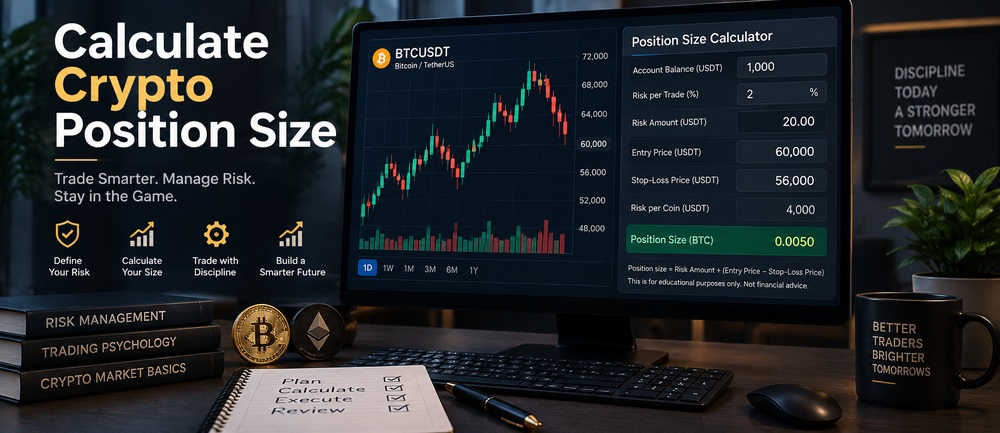
Knowing how to calculate crypto position size is one of the most practical risk-management skills a cryptocurrency trader can learn.
A trading setup may look attractive, but that does not tell you how much Bitcoin, Ethereum, or another cryptocurrency you should actually buy or sell.
Your position size should be determined by your:
- Trading account balance
- Maximum risk per trade
- Entry price
- Stop-loss price
- Stop-loss distance
The basic idea is simple:
Decide how much money you are prepared to lose first, then calculate the position size that keeps the trade within that limit.
This guide explains the crypto position-sizing formula step by step, with examples for Bitcoin, Ethereum, percentage-based stops, long trades, short trades, and leveraged positions.
Important: This article is for educational purposes only and does not constitute financial, investment, or trading advice. Cryptocurrency trading involves substantial risk, and losses can exceed expectations because of volatility, slippage, leverage, liquidity conditions, and other market factors.
What Is Crypto Position Size?
Crypto position size is the amount of cryptocurrency you buy or sell in a particular trade.
For example, a trader might open a position of:
- 0.01 BTC
- 0.25 ETH
- 500 XRP
- $2,000 worth of cryptocurrency
However, the amount invested in the position is not necessarily the same as the amount being risked.
Suppose you open a Bitcoin position worth:
$5,000
and your stop loss is positioned 2% away from your entry.
Ignoring fees and slippage for the moment, your theoretical loss if that stop is reached would be approximately:
$5,000 × 2% = $100
Therefore:
Position Value = $5,000
but:
Money at Risk = $100
Understanding this distinction is critical when calculating cryptocurrency position size.
The Basic Crypto Position Size Formula
A useful risk-based formula is:
Position Size in Coins = Maximum Money at Risk ÷ Price Risk per Coin
Where:
Maximum Money at Risk = Account Balance × Risk Percentage
and:
Price Risk per Coin = |Entry Price − Stop-Loss Price|
The absolute value symbol means that you use the positive distance between the entry and stop whether the trade is long or short.
Putting everything together:
Position Size = (Account Balance × Risk %) ÷ |Entry Price − Stop-Loss Price|
This formula tells you approximately how many coins or tokens you can trade while keeping the planned loss within your chosen risk amount.
Step 1: Determine Your Trading Account Balance
Start with the capital you are actually allocating to the trading strategy.
Suppose your crypto trading account contains:
$10,000
That does not automatically mean you should place a $10,000 trade.
Account size is simply the starting point for calculating how much money you are willing to expose to one trading idea.
Step 2: Choose Your Maximum Risk Per Trade
Next, decide the percentage of the account you are prepared to lose if the trade reaches its stop loss.
For example:
- Account balance: $10,000
- Selected risk: 1%
Calculate the monetary risk:
$10,000 × 0.01 = $100
Your maximum planned risk is therefore:
$100
This does not guarantee that the trade can lose no more than $100. Fast price movements, slippage, gaps, fees, liquidity conditions, or liquidation can result in a different final loss.
Cryptocurrency markets can be highly volatile and speculative. Investor.gov warns that the risk of loss involving crypto assets can be significant and that investors should consider how much of their overall portfolio, if any, should be allocated to speculative investments. Investor.gov — Crypto Asset Risk Guidance
Step 3: Determine Your Entry Price
Assume you plan to buy Bitcoin at:
$60,000
Your proposed entry price is therefore:
$60,000 per BTC
The next step is to identify where the trade becomes invalid.
Step 4: Set the Stop-Loss Price
Suppose your analysis indicates that the trade should be exited if Bitcoin falls to:
$58,800
Your entry is:
$60,000
Your stop loss is:
$58,800
Calculate the price distance:
$60,000 − $58,800 = $1,200
Your risk per Bitcoin is therefore:
$1,200
A full 1 BTC position would theoretically lose approximately $1,200 if price moved from $60,000 to $58,800, excluding fees and slippage.
But your predetermined maximum account risk is only:
$100
Therefore, you need a much smaller BTC position.
Step 5: Calculate the Position Size
Use the formula:
Position Size = Maximum Money at Risk ÷ Price Risk per Coin
Using our example:
$100 ÷ $1,200 = 0.08333 BTC
Your calculated position size is therefore approximately:
0.0833 BTC
At a $60,000 entry price:
0.08333 × $60,000 ≈ $5,000
Your position has a market value of approximately:
$5,000
Yet the theoretical planned loss at the stop remains approximately:
$100
This is why position value and money at risk are not the same thing.
Crypto Position Size Example: Complete Calculation
Here is the entire calculation in one table:
| Item | Value |
|---|---|
| Account Balance | $10,000 |
| Risk Per Trade | 1% |
| Maximum Money at Risk | $100 |
| BTC Entry Price | $60,000 |
| Stop-Loss Price | $58,800 |
| Stop Distance | $1,200 |
| Calculated Position | 0.0833 BTC |
| Approximate Position Value | $5,000 |
| Theoretical Planned Loss at Stop | $100 |
The calculation is:
Risk Amount
$10,000 × 1% = $100
Risk Per BTC
$60,000 − $58,800 = $1,200
Position Size
$100 ÷ $1,200 = 0.0833 BTC
Calculating Crypto Position Size Using Stop-Loss Percentage
You can also calculate the position directly when you know the stop-loss distance as a percentage.
Use:
Position Value = Maximum Money at Risk ÷ Stop-Loss Percentage
For example:
- Account balance: $10,000
- Risk per trade: 1%
- Maximum risk: $100
- Stop distance: 2%
Calculation:
$100 ÷ 0.02 = $5,000
Your position value would therefore be approximately:
$5,000
If Bitcoin is trading at $60,000:
$5,000 ÷ $60,000 = 0.08333 BTC
This produces the same answer as the price-distance method.
Crypto Position Size Formula Using Percentage Risk
The simplified percentage formula is:
Position Value = (Account Balance × Risk %) ÷ Stop-Loss %
For example:
Account Balance: $5,000
Risk: 1%
Stop Distance: 4%
First calculate your risk amount:
$5,000 × 0.01 = $50
Then calculate the position:
$50 ÷ 0.04 = $1,250
Your approximate position value is:
$1,250
If the cryptocurrency falls 4% to the planned stop level:
$1,250 × 4% = $50
which corresponds to your planned 1% account risk.
Bitcoin Position Size Example
Suppose:
- Account balance: $20,000
- Maximum risk: 0.5%
- Bitcoin entry: $70,000
- Stop loss: $68,600
Step 1: Calculate Monetary Risk
$20,000 × 0.005 = $100
Maximum planned risk:
$100
Step 2: Calculate Risk Per BTC
$70,000 − $68,600 = $1,400
Step 3: Calculate BTC Position
$100 ÷ $1,400 = 0.07143 BTC
Therefore, the calculated position is approximately:
0.0714 BTC
Position value:
0.07143 × $70,000 ≈ $5,000
Again, the position value is approximately $5,000 while the planned risk is approximately $100.
Ethereum Position Size Example
The same formula works with Ethereum.
Suppose:
- Account balance: $4,000
- Risk per trade: 1%
- ETH entry: $3,000
- Stop loss: $2,910
Risk Amount
$4,000 × 1% = $40
ETH Price Risk
$3,000 − $2,910 = $90
Position Size
$40 ÷ $90 = 0.4444 ETH
Therefore, the calculated position is approximately:
0.444 ETH
Position value:
0.4444 × $3,000 ≈ $1,333
If ETH reaches $2,910 under the simplified assumptions:
0.4444 × $90 ≈ $40
which matches the planned risk.
How to Calculate Position Size for a Crypto Short Trade
The same principle applies to short positions.
The main difference is that the stop loss normally sits above the entry price.
Suppose:
- Account balance: $8,000
- Risk per trade: 1%
- ETH short entry: $3,200
- Stop loss: $3,296
Step 1: Monetary Risk
$8,000 × 1% = $80
Step 2: Stop Distance
$3,296 − $3,200 = $96
Step 3: Position Size
$80 ÷ $96 = 0.8333 ETH
Your calculated short position is therefore approximately:
0.833 ETH
The direction changes, but the position-sizing logic does not:
Position Size = Risk Amount ÷ Absolute Difference Between Entry and Stop
Does Leverage Change Crypto Position Size?
This is an area where many beginners become confused.
Leverage should not be the starting point for determining your acceptable trade risk.
Position size should first be calculated from:
- Account balance
- Acceptable risk
- Entry price
- Stop-loss distance
Leverage then determines how much margin may be required to hold the position.
Kraken’s educational material on leveraged cryptocurrency position sizing similarly distinguishes trade risk from leverage: position size should be based on risk tolerance, while leverage changes the amount of margin required to control the position. Kraken — Position Sizing With Leverage
Example: Position Size With 5× Leverage
Return to our Bitcoin example:
- Calculated position value: $5,000
- Leverage: 5×
Approximate initial margin required:
$5,000 ÷ 5 = $1,000
The position controlled is still:
$5,000
The margin committed might be approximately:
$1,000
But this does not mean your position size has become $1,000.
It also does not mean leverage has made the trade safer.
The U.S. Commodity Futures Trading Commission warns that leveraged virtual-currency trading can amplify risk because traders fund only a fraction of the underlying exposure while remaining exposed to larger market movements. CFTC — Understand the Risks of Virtual Currency Trading
Position Size vs. Margin: Do Not Confuse Them
These three figures are different:
Position Size
The total market exposure controlled by the trade.
Margin
The capital the exchange requires to support a leveraged position.
Risk Amount
The amount you intend to lose if the trade reaches your predetermined stop, subject to execution conditions.
Example:
- Position size: $5,000
- 5× leverage
- Approximate margin: $1,000
- Planned stop-loss risk: $100
These numbers describe different aspects of the same trade.
What Happens When the Stop Loss Is Wider?
For the same account risk:
Wider stop = Smaller position
Suppose your account is $10,000 and your maximum risk is $100.
Trade A
Stop distance:
2%
Position:
$100 ÷ 0.02 = $5,000
Trade B
Stop distance:
5%
Position:
$100 ÷ 0.05 = $2,000
| Stop Distance | Risk Amount | Position Value |
|---|---|---|
| 1% | $100 | $10,000 |
| 2% | $100 | $5,000 |
| 4% | $100 | $2,500 |
| 5% | $100 | $2,000 |
| 10% | $100 | $1,000 |
The wider stop requires a smaller position if the same monetary risk is maintained.
What Happens When the Stop Loss Is Tighter?
The opposite also occurs:
Tighter stop = Larger calculated position
For example:
Risk amount:
$100
Stop distance:
1%
Position:
$100 ÷ 0.01 = $10,000
A tighter stop does not automatically mean the trade is safer.
If you artificially tighten the stop simply to obtain a larger position, normal market volatility may trigger the stop more frequently.
The stop-loss level should ideally be based on the point where your trading idea becomes invalid.
Set the stop first. Calculate the position second.
Do not manipulate the stop just to obtain the position size you want.
Account Balance vs. Account Equity
Another calculation decision is whether to use account balance or account equity.
Account Balance
Generally reflects closed trading results.
Account Equity
Generally includes the current value of open positions.
If you already have open cryptocurrency trades, your equity can be lower or higher than your balance.
For example:
- Balance: $10,000
- Floating loss: $700
- Equity: $9,300
If you continue calculating new trades from the original $10,000 balance while several open positions are losing, your effective exposure may become larger than intended.
Some traders therefore calculate risk from available equity rather than static balance when multiple positions are open.
The important point is consistency:
Know which account value your position-sizing process uses.
Include Trading Fees in Real-World Position Sizing
The simple formula assumes that the only loss comes from price movement between entry and stop.
Real trading can also involve:
- Entry fees
- Exit fees
- Funding fees
- Spread
- Slippage
- Borrowing costs
- Other exchange charges
Investor.gov specifically recommends checking transaction fees and other charges associated with crypto-asset services because fees reduce the amount you ultimately retain. Investor.gov — Crypto Asset Custody and Fees
Suppose your maximum acceptable loss is:
$100
but your expected entry and exit costs total:
$8
You could conservatively allocate only:
$92
to the price-risk component of the trade.
This gives additional room for transaction costs.
Account for Slippage
A stop-loss order identifies the level at which an exit should be triggered, but the actual execution price may differ.
For example:
Planned stop:
$58,800
Actual average exit:
$58,730
The difference is slippage.
If you calculated the trade assuming a perfect $58,800 exit, the final monetary loss may exceed your planned amount.
Slippage can become particularly important when trading:
- Small-cap cryptocurrencies
- Thinly traded tokens
- Highly volatile markets
- News events
- Large positions relative to available liquidity
Position-sizing calculations are therefore estimates rather than guarantees.
Consider Total Open Risk Across Multiple Crypto Trades
Calculating each trade individually is not enough if several positions are open simultaneously.
Suppose you have:
- BTC trade risk: 1%
- ETH trade risk: 1%
- SOL trade risk: 1%
- XRP trade risk: 1%
Your total planned open risk could become approximately:
4%
And because cryptocurrency assets often move together during broad market moves, the trades may not represent four completely independent risks.
This is why position sizing should be evaluated at both:
Trade level
and:
Portfolio level
The same principle applies to trading drawdown generally. Our Maximum Drawdown Explained guide explains why position size, simultaneous exposure, leverage, and losing streaks can interact to produce much larger account declines.
Crypto Position Size Calculation Checklist
Before entering a cryptocurrency trade, work through this sequence:
1. Identify your current account value
Example:
$10,000
2. Decide your maximum percentage risk
Example:
1%
3. Convert percentage risk into money
$10,000 × 1% = $100
4. Determine your entry price
Example:
$60,000
5. Determine your stop-loss price
Example:
$58,800
6. Calculate price risk per coin
$60,000 − $58,800 = $1,200
7. Calculate coin quantity
$100 ÷ $1,200 = 0.0833 BTC
8. Calculate position value
0.0833 × $60,000 ≈ $5,000
9. Check trading costs and slippage
Reduce the position if necessary.
10. Check leverage and liquidation risk
Make sure the exchange’s margin and liquidation mechanics do not conflict with your planned stop-loss structure.
11. Check total account exposure
Include all other open positions rather than evaluating the new trade in isolation.
Common Crypto Position Sizing Mistakes
Mistake 1: Using the Same Dollar Position on Every Trade
A fixed $5,000 position does not create the same risk when stop-loss distances are different.
A 1% stop and a 10% stop produce dramatically different monetary exposure.
Mistake 2: Choosing Position Size Before the Stop Loss
Some traders first decide:
“I want to trade 0.5 BTC.”
Then they try to build the stop around the chosen position.
A more disciplined sequence is:
Trading Setup → Stop-Loss Level → Risk Amount → Position Size
Mistake 3: Using Maximum Exchange Leverage
An exchange may allow 10×, 20×, 50×, or greater leverage on certain products.
That does not mean the maximum permitted leverage represents an appropriate risk level.
Allowed leverage and responsible position sizing are separate decisions.
Mistake 4: Confusing Margin With Risk
Depositing $500 of margin into a leveraged position does not automatically mean your maximum possible loss is $500 or that you should treat $500 as your calculated trade risk.
Understand the exchange’s liquidation rules, contract design, margin requirements, and stop execution before trading leveraged crypto products.
Mistake 5: Ignoring Fees
If your position-sizing calculation uses your entire risk budget for market movement, transaction costs can push your actual loss above that amount.
Mistake 6: Ignoring Slippage
Stops do not guarantee a specific execution price in rapidly moving markets.
Mistake 7: Increasing Size After a Loss
Increasing position size simply to recover a previous loss can rapidly increase account exposure.
The next trade should normally be calculated using the same predefined risk framework rather than emotional recovery targets.
Mistake 8: Ignoring Existing Open Trades
Several individually reasonable trades can collectively create excessive exposure.
Always calculate total open account risk.
Crypto Position Size Formula Cheat Sheet
Step 1 — Calculate Risk Amount
Risk Amount = Account Balance × Risk Percentage
Step 2 — Calculate Price Risk Per Coin
Risk Per Coin = |Entry Price − Stop-Loss Price|
Step 3 — Calculate Crypto Quantity
Coin Quantity = Risk Amount ÷ Risk Per Coin
Step 4 — Calculate Position Value
Position Value = Coin Quantity × Entry Price
Or, when using stop-loss percentage:
Position Value = Risk Amount ÷ Stop-Loss Percentage
Step 5 — Calculate Approximate Margin When Leveraged
Margin ≈ Position Value ÷ Leverage
Remember:
Margin is not the same as position size, and neither is automatically the same as monetary risk.
Frequently Asked Questions
How do I calculate crypto position size?
First calculate your maximum monetary risk:
Account Balance × Risk Percentage
Then determine the distance between your entry and stop-loss price.
Finally:
Position Size = Risk Amount ÷ Price Difference Between Entry and Stop
The result gives the approximate number of coins or tokens you can trade.
What is the formula for crypto position sizing?
For a coin-based calculation:
Position Size = (Account Balance × Risk %) ÷ |Entry Price − Stop-Loss Price|
For a percentage-based stop:
Position Value = (Account Balance × Risk %) ÷ Stop-Loss %
How do I calculate Bitcoin position size?
Suppose you have:
- $10,000 account
- 1% maximum risk
- BTC entry at $60,000
- Stop at $58,800
Your risk amount is:
$100
Your risk per BTC is:
$1,200
Therefore:
$100 ÷ $1,200 = 0.0833 BTC
Does leverage increase my correct position size?
Leverage increases the amount of market exposure that can be controlled with a given amount of margin.
It does not automatically justify increasing your risk.
Calculate position size from account risk and stop-loss distance first, then evaluate leverage and required margin separately.
Do I calculate position size before or after setting my stop loss?
Generally, determine the stop-loss level first.
The stop should reflect where the trading idea becomes invalid.
Then calculate the position size required to keep the monetary loss within your predetermined risk limit.
Is position size the same as the amount I can lose?
No.
A $5,000 position might have only $100 of planned price risk if the stop is 2% away.
Position value and monetary risk are different measurements.
Should I include fees when calculating crypto position size?
Yes, especially when trading frequently or when transaction costs are significant.
Fees, spreads, funding charges, and slippage can make your actual loss larger than the simple theoretical calculation.
Does a stop loss guarantee my calculated maximum loss?
No.
The calculated risk is an estimate based on the assumed exit price.
Slippage, gaps, liquidity problems, liquidation, exchange outages, and extreme volatility can cause the actual loss to differ.
Final Thoughts
Learning how to calculate crypto position size changes trading from:
“How much crypto should I buy?”
to the more useful question:
“How much can I trade while keeping the loss within my predetermined risk limit?”
The calculation follows a logical order:
Account Size → Risk Percentage → Monetary Risk → Entry → Stop Loss → Position Size
Remember the central formula:
Position Size = Maximum Money at Risk ÷ Risk Per Coin
and when your stop is expressed as a percentage:
Position Value = Maximum Money at Risk ÷ Stop-Loss Percentage
The important principle is not to maximize the amount you can trade.
It is to calculate an exposure that fits your trading plan.
Position sizing cannot eliminate cryptocurrency risk, and no formula can guarantee that a stop will execute at the expected price. However, using a consistent calculation gives you a structured way to define your exposure before entering a trade rather than discovering your risk after the market moves against you.
For the broader concept of controlling account deterioration, continue with the Pinoy Pip Hunter guide on Maximum Drawdown Explained.
And if you trade automated strategies as well as cryptocurrency, our How to Choose an EA Lot Size guide explains how the same risk-first principle applies when determining Forex EA trade size.
1 Trackback / Pingback