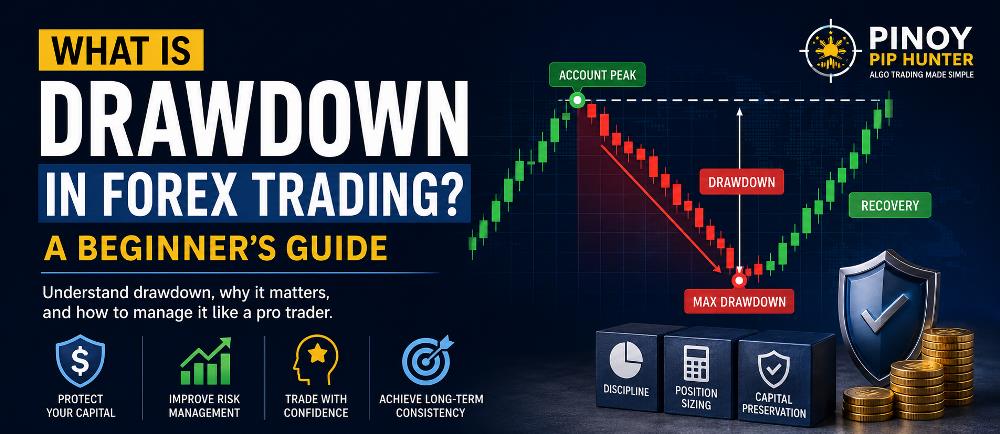
If you are new to Forex trading, one of the most important risk terms you need to understand is drawdown.
Many beginners focus almost entirely on profits, win rate, or how much an Expert Advisor can earn. However, a trading system can look profitable while still exposing the account to serious risk.
That is where drawdown becomes important.
In this guide, we will explain what is drawdown in Forex trading, how it is calculated, the different types of drawdown, why it matters when using Expert Advisors, and how traders can manage it more effectively.
If you are still learning how automated trading works, you may want to first read our Algorithmic Trading for Beginners: A Complete Beginner’s Guide.
What Is Drawdown in Forex Trading?
Drawdown in Forex trading is the decline in your trading account from a previous high point to a later low point before the account recovers.
In simple terms, drawdown shows how much your account has fallen from its peak.
For example:
- Your account starts at $10,000
- It grows to $12,000
- It then falls to $10,800
- Later, it recovers and reaches a new high
The decline from $12,000 to $10,800 is the drawdown.
The dollar drawdown is:
$12,000 − $10,800 = $1,200
The percentage drawdown is:
$1,200 ÷ $12,000 × 100 = 10%
So the account experienced a 10% drawdown.
A drawdown does not automatically mean that a trading strategy is bad. Every trading strategy experiences losing periods.
The important questions are:
- How large is the drawdown?
- How long does it last?
- How quickly can the account recover?
- Is the drawdown within the expected risk of the strategy?
Understanding what is drawdown in Forex trading helps you judge whether a strategy is truly sustainable rather than simply profitable on paper.
Why Is Drawdown Important in Forex Trading?
Drawdown helps traders understand the real level of risk behind a trading strategy.
Suppose you compare two Expert Advisors:
| Trading System | Annual Return | Maximum Drawdown |
|---|---|---|
| EA A | 35% | 10% |
| EA B | 50% | 45% |
At first glance, EA B looks better because it produced a higher return.
However, a 45% drawdown means the account experienced an extremely large decline along the way.
A trader may not be comfortable watching almost half of the account value disappear, even if the system eventually recovers.
This is why you should never evaluate a trading strategy using profit alone.
A more complete evaluation considers:
- Net profit
- Maximum drawdown
- Profit factor
- Win rate
- Average win and average loss
- Consecutive losses
- Recovery factor
- Total market exposure
What Is Maximum Drawdown?
Maximum drawdown is the largest decline from a previous account peak to a subsequent low during a specific period.
Consider this simplified account history:
$10,000 → $11,500 → $10,900 → $13,000 → $9,750 → $14,000
The largest decline occurs from:
$13,000 to $9,750
The monetary decline is:
$13,000 − $9,750 = $3,250
The percentage drawdown is:
$3,250 ÷ $13,000 × 100 = 25%
Therefore, the maximum drawdown is 25%.
Maximum drawdown is particularly useful when comparing Expert Advisors because it shows the worst historical decline experienced during the testing period.
Balance Drawdown vs Equity Drawdown
When trading or backtesting in MetaTrader, you may encounter both balance drawdown and equity drawdown.
They are not the same.
Balance Drawdown
Balance drawdown is mainly based on closed trades.
Your account balance changes when a trade is closed and its profit or loss is recorded.
If losing positions remain open, they may not immediately affect the account balance.
Equity Drawdown
Equity drawdown includes:
- Closed trade results
- Floating profits
- Floating losses from open positions
This makes equity drawdown especially important when evaluating automated trading systems.
An EA may show a healthy balance while holding large losing positions.
For example:
- Account Balance: $10,000
- Floating Loss: -$2,500
- Account Equity: $7,500
The balance still shows $10,000, but the real account value at that moment is only $7,500.
This is why traders should monitor equity, not just account balance.
Why Equity Drawdown Matters for Expert Advisors
Equity drawdown can reveal risks that may not be obvious from the balance curve.
This is particularly important when analyzing trading systems that use:
- Grid trading
- Martingale techniques
- Basket trading
- Averaging strategies
- Recovery systems
- Multiple simultaneous positions
Some strategies can generate many small closed profits while holding large floating losses.
The account balance may continue rising while account equity falls significantly.
This can create the illusion that the strategy is safer than it actually is.
Absolute Drawdown, Maximum Drawdown, and Relative Drawdown
You may also encounter different drawdown measurements in MetaTrader reports.
Absolute Drawdown
Absolute drawdown measures how far the trading account falls below its original starting deposit.
For example:
Starting balance: $10,000
Lowest balance: $9,400
Absolute drawdown:
$600
Maximum Drawdown
Maximum drawdown measures the largest monetary decline from a previous account peak to a later low.
Relative Drawdown
Relative drawdown expresses drawdown as a percentage.
For example:
Peak equity: $12,000
Lowest equity: $10,200
Drawdown:
$1,800
Relative drawdown:
15%
Percentage drawdown is useful when comparing trading strategies with different account sizes.
Is a 10% Drawdown Good?
There is no universal drawdown percentage that is suitable for every trader.
Risk tolerance depends on factors such as:
- Trading strategy
- Account size
- Leverage
- Position size
- Trading frequency
- Number of simultaneous positions
- Personal risk tolerance
As a general reference:
- Below 10% — relatively conservative
- 10% to 20% — moderate
- 20% to 30% — aggressive
- Above 30% — high risk
- Above 50% — extremely difficult to recover from
These are not fixed rules.
A strategy with a 15% drawdown may still be risky if it depends heavily on averaging into losing positions.
Similarly, a strategy with slightly higher drawdown may be acceptable if the risk is well controlled and diversified.
Why Large Drawdowns Are Dangerous
One of the biggest problems with large drawdowns is that the recovery becomes increasingly difficult.
Consider this:
| Account Loss | Gain Needed to Recover |
|---|---|
| 10% | 11.1% |
| 20% | 25% |
| 30% | 42.9% |
| 40% | 66.7% |
| 50% | 100% |
If your account loses 50%, you do not need a 50% profit to recover.
You need a 100% return on the remaining capital.
For example:
You start with:
$10,000
After a 50% loss:
$5,000
To return to $10,000:
$5,000 → $10,000
That requires a 100% gain.
This is why capital preservation is one of the most important principles in Forex risk management.
What Causes Drawdown in Forex Trading?
Drawdown can be caused by several factors.
1. Normal Losing Trades
No trading strategy wins every trade.
Even profitable systems experience losing streaks.
A few losses do not necessarily mean the strategy has stopped working.
2. Changing Market Conditions
A strategy designed for trending markets may struggle when the market becomes sideways.
Likewise, a range-trading system may perform poorly during strong trends.
3. Excessive Position Size
Trading with overly large lot sizes magnifies both profits and losses.
Even a reasonable strategy can experience dangerous drawdowns when position size is too aggressive.
4. High Leverage
Leverage allows traders to control larger positions with less capital.
However, higher leverage also increases exposure and can accelerate losses.
5. Too Many Simultaneous Trades
Several small trades can combine into a very large market exposure.
Traders should always consider total account exposure.
6. Correlated Positions
Opening several trades that depend on the same market direction can increase risk.
For example, multiple USD-related positions may effectively represent one large exposure to the US dollar.
7. Grid Trading
Grid trading strategies often open additional positions as the market moves against the original trade.
This can produce large floating drawdowns.
8. Martingale Strategies
Martingale systems usually increase position size after a loss.
While this may help recover previous losses, it can also cause drawdown to increase very quickly during extended losing periods.
Drawdown and Expert Advisors
Drawdown is one of the most important statistics to examine when evaluating an Expert Advisor.
Automated trading can execute trades consistently according to programmed rules, but automation does not remove risk.
In fact, a poorly configured EA can increase risk very quickly.
Before using an Expert Advisor on a live account, review:
- Maximum drawdown
- Equity drawdown
- Lot-sizing method
- Stop-loss settings
- Maximum open trades
- Margin usage
- Basket exposure
- Consecutive losses
- Recovery time
- Trading frequency
A profitable backtest does not automatically mean that an EA is safe.
Drawdown and Backtesting
Drawdown should always be evaluated when backtesting an Expert Advisor.
When you run a backtest in MetaTrader 5 Strategy Tester, do not focus only on the final profit.
Study the entire equity curve.
Ask:
- What was the maximum drawdown?
- How long did the drawdown last?
- How long did the account take to recover?
- Did the EA experience long losing streaks?
- Were large floating losses present?
- Did lot sizes increase after losses?
- Did the EA approach dangerous margin levels?
For a step-by-step explanation, read our How to Backtest an Expert Advisor in MetaTrader 5 guide.
Important: Insert the live URL of Article #4 into the anchor text above. I could not verify its indexed URL from search yet, so I am not going to invent the slug.
For more technical information about how MetaTrader 5 tests automated strategies on historical market data, see the official MQL5 documentation on testing trading strategies.
The MetaTrader 5 Strategy Tester supports historical testing of Expert Advisors and can also test multi-currency strategies.
Backtesting and drawdown analysis should always be used together.
Drawdown vs Losing Streak
Drawdown and losing streak are related, but they measure different things.
A losing streak refers to a number of consecutive losing trades.
A drawdown measures the decline in the account value.
For example:
Five consecutive losses of $20 each may create only a relatively small drawdown.
However, one single $1,000 loss could cause a much larger drawdown.
That is why both statistics should be reviewed when evaluating a trading system.
A High Win Rate Does Not Mean Low Drawdown
Many beginners look for Expert Advisors with extremely high win rates.
A high win rate can look impressive, but it does not automatically mean the strategy is safe.
For example, an EA may:
- Win 90% of trades
- Make $10 on each winning trade
- Lose $500 on occasional losing trades
The win rate looks excellent, but one large loss could erase dozens of previous winning trades.
This problem is common in strategies that:
- Hold losing trades too long
- Average into losing positions
- Use grid systems
- Use Martingale position sizing
- Take very small profits but allow large losses
Always analyze risk and reward, not just win rate.
How Can Traders Reduce Drawdown?
Drawdown cannot be completely eliminated.
However, there are several ways traders can reduce it.
Use Smaller Lot Sizes
Reducing position size is one of the simplest ways to reduce account volatility.
Control Risk Per Trade
Avoid risking a large percentage of the account on one position.
Use Stop Losses Properly
A well-designed stop-loss system can prevent individual trades from causing excessive losses.
Limit Maximum Open Trades
Allowing too many positions to remain open at the same time can create excessive exposure.
Reduce Leverage
High leverage can magnify normal market movements into large account losses.
Monitor Total Exposure
Do not evaluate each position separately.
Several trades moving in the same direction may collectively represent one large risk.
Backtest Across Different Market Conditions
Avoid testing an EA only during favorable periods.
Include:
- Trending markets
- Sideways markets
- High volatility
- Low volatility
- Major news periods
Forward Test Before Going Live
Run the strategy on a demo account first.
This allows you to observe how the EA behaves under current market conditions.
Understanding what is drawdown in Forex trading becomes much more useful when you combine it with proper backtesting, realistic position sizing, and disciplined risk limits.
Should You Stop an EA During Drawdown?
Not necessarily.
Every trading strategy goes through losing periods.
Stopping an EA immediately after a few losses can sometimes mean disabling the system just before normal recovery begins.
However, you should consider stopping or reducing exposure if:
- Drawdown exceeds your predefined risk limit
- Live behavior differs significantly from backtest results
- Position sizes are incorrect
- Market conditions have changed dramatically
- Execution problems occur
- The EA begins behaving unexpectedly
The important principle is to establish your risk limits before the drawdown happens.
Decisions made emotionally during a losing period are often inconsistent.
How Much Drawdown Can You Handle?
Drawdown is not only mathematical.
It is also psychological.
Suppose you deposit:
$10,000
Your account falls to:
$7,500
That is a 25% drawdown.
Would you continue trading?
Would you reduce your position size?
Would you stop the EA completely?
Would you panic and close everything?
A strategy can look acceptable during a backtest but feel very different when real money is involved.
Your trading risk should therefore match both your financial capacity and your psychological tolerance.
Example of Evaluating an Expert Advisor
Suppose an EA produces these backtest results:
- Starting Deposit: $10,000
- Final Balance: $14,000
- Net Profit: 40%
- Maximum Equity Drawdown: 16%
- Profit Factor: 1.65
The 40% profit looks attractive.
But you should not immediately conclude that the EA is suitable.
You should also ask:
- Are you comfortable with a 16% historical drawdown?
- Could live drawdown become higher?
- Was the test period long enough?
- Did the EA trade through different market conditions?
- Were realistic spreads and commissions used?
- Was the strategy over-optimized?
Historical results can help evaluate a system, but they cannot guarantee future performance.
Frequently Asked Questions
What is drawdown in Forex trading?
Drawdown is the decline in a trading account from a previous high point to a subsequent low point before the account recovers.
What is maximum drawdown in Forex?
Maximum drawdown is the largest peak-to-trough decline experienced during a particular trading period or backtest.
Is 10% drawdown good?
A 10% drawdown is often considered relatively moderate, but whether it is acceptable depends on the strategy, leverage, account size, and trader’s personal risk tolerance.
Is equity drawdown important?
Yes. Equity drawdown includes floating profits and losses, making it particularly useful when analyzing Expert Advisors and automated trading strategies.
Can a profitable strategy still have a large drawdown?
Yes. A strategy can be profitable overall while experiencing substantial losses along the way.
Does high win rate mean low risk?
No. A strategy may have a high win rate while still exposing the account to very large occasional losses.
Can backtesting predict future drawdown?
No. Backtesting only shows how a strategy behaved using historical data. Live trading conditions can produce larger or different drawdowns.
Final Thoughts
Understanding what is drawdown in Forex trading is essential for anyone using manual or automated trading strategies.
Profit tells you how much money a strategy made.
Drawdown tells you how much risk the strategy had to endure to make that profit.
When evaluating an Expert Advisor, do not focus only on:
- High profits
- High win rates
- Attractive equity curves
Also examine:
- Maximum drawdown
- Equity drawdown
- Position sizing
- Consecutive losses
- Margin usage
- Recovery time
- Total account exposure
A sustainable trading system is not simply one that can make money.
It is one that can survive unfavorable market conditions without exposing the trading account to unacceptable risk.
1 Trackback / Pingback