
Opening a single trade is relatively simple.
You enter the market, determine your position size, set your Stop Loss and Take Profit, and manage that individual position.
But many automated trading strategies operate differently.
Instead of treating every position independently, they may open multiple trades and manage them collectively as one group.
That group of positions is commonly called a basket.
Basket trading is frequently used by Expert Advisors (EAs), grid systems, averaging strategies, recovery systems, and other automated trading strategies that manage several positions simultaneously.
Understanding basket trading is important because looking only at individual winning and losing trades can give a misleading picture of what the overall strategy is actually doing.
In this guide, you will learn what basket trading is, how basket profit targets work, how basket Stop Loss and trailing systems operate, how basket trading differs from grid and martingale strategies, and the major risks traders should understand before using a basket-based system.
Important: This article is for educational purposes only and should not be considered financial or investment advice. Forex, gold, CFDs, and other leveraged products involve substantial risk.
What Is Basket Trading?
Basket trading is a trading method where several open positions are managed collectively instead of being treated entirely as separate trades.
A trading basket may contain:
- Multiple BUY positions
- Multiple SELL positions
- Positions entered at different prices
- Positions with different lot sizes
- Positions on one instrument
- Positions across several instruments
The important characteristic is that the trading system evaluates the combined performance of the group.
For example, imagine an Expert Advisor has opened five XAUUSD BUY trades:
| Trade | Floating Result |
|---|---|
| BUY 1 | -$20 |
| BUY 2 | -$10 |
| BUY 3 | +$5 |
| BUY 4 | +$15 |
| BUY 5 | +$30 |
The combined basket result is:
-$20 – $10 + $5 + $15 + $30 = +$20
Even though two positions are losing money, the basket as a whole is profitable.
If the EA has a basket profit target of $20, it could close all five positions together.
This is the fundamental concept behind basket trade management.
How Does Basket Trading Work?
A basket trading system continuously monitors the combined status of several positions.
Depending on the strategy, it may track:
- Number of open trades
- Individual lot sizes
- Total lot exposure
- Entry prices
- Average entry price
- Floating profit
- Floating loss
- Combined basket profit
- Basket drawdown
- Margin usage
- Basket Take Profit
- Basket Stop Loss
- Basket trailing profit
Instead of asking:
“Should Trade #1 close?”
the system may ask:
“Has the combined basket reached our target?”
This makes basket management particularly suitable for automated trading systems because an EA can continuously calculate the combined result of numerous positions.
If you are still learning automated trading, our guide to Algorithmic Trading for Beginners explains how Expert Advisors and automated strategies operate.
Simple Basket Trading Example
Suppose an EA opens three XAUUSD BUY positions:
| Trade | Lot Size | Floating P/L |
|---|---|---|
| BUY 1 | 0.01 | -$15 |
| BUY 2 | 0.01 | +$5 |
| BUY 3 | 0.01 | +$25 |
The total basket result is:
-$15 + $5 + $25 = +$15
Suppose the EA’s basket profit target is:
+$15
The EA could close all three trades simultaneously.
Notice something important.
The first trade never became profitable.
Its loss was simply offset by the combined profits generated by the other positions.
This is one of the fundamental differences between individual trade management and basket management.
What Is a Basket Profit Target?
A basket profit target is a predefined combined profit at which the trading system closes all positions belonging to a particular basket.
For example:
Basket Profit Target = $100
The EA currently has:
- Trade A: +$40
- Trade B: -$25
- Trade C: +$60
- Trade D: +$25
Combined result:
$40 – $25 + $60 + $25 = $100
Once the basket reaches its $100 combined profit target, the EA can close the complete group.
This means every individual position does not necessarily require its own Take Profit.
Instead, the automated system can monitor the combined financial result.
Basket Profit vs Individual Take Profit
Basket Take Profit and individual Take Profit should not be confused.
Individual Take Profit
An individual Take Profit closes a specific position.
For example:
Trade 1 reaches +$30 → Trade 1 closes.
Trades 2 and 3 remain open.
Basket Take Profit
A basket system may instead calculate:
Trade 1 = +$30
Trade 2 = -$10
Trade 3 = +$50
Total:
+$70
If the basket profit target is $70, the system closes all three positions together.
Neither approach is automatically better.
They simply represent different trade-management methods.
What Is a Basket Stop Loss?
Basket systems can also use a basket Stop Loss.
Instead of limiting the loss of one individual position, a basket Stop Loss limits the combined loss of the entire group.
For example:
Maximum Basket Loss = -$300
Current positions:
- Trade 1: -$80
- Trade 2: -$60
- Trade 3: -$90
- Trade 4: -$70
Combined basket result:
-$300
The EA closes the entire basket.
A basket Stop Loss can prevent a group of trades from continuing to accumulate losses indefinitely.
However, the protection is only as effective as the risk settings chosen by the trader.
What Is Basket Trailing Profit?
Some Expert Advisors use a more advanced feature called basket trailing profit.
It works somewhat like a traditional trailing stop, but instead of tracking one position, the system tracks the combined profit of the entire basket.
Consider this simplified example:
Basket Trailing Activation: +$200
Trailing Distance: $50
The basket reaches:
+$200
The trailing system activates.
The basket then increases to:
+$250
Then:
+$300
Rather than immediately closing the basket at $200, the EA allows the profitable movement to continue.
If the combined basket profit subsequently falls by the configured trailing distance, the EA can close the group and protect part of the accumulated profit.
This type of management is commonly used in automated trading systems where several positions are intended to work together.
Why Do Traders Use Basket Trading?
There are several reasons basket management is used in automated trading.
1. Multiple Trades Can Be Managed as One Strategy
Instead of manually managing many positions separately, an EA can evaluate the entire group.
This can simplify management when a strategy intentionally enters the market multiple times.
2. Winning Trades Can Offset Losing Trades
A basket does not necessarily require every position to become profitable.
One trade may remain negative while other positions generate enough combined profit for the basket to reach its target.
This is one reason basket management is frequently associated with averaging and grid-style strategies.
3. Basket Management Can Be Automated
An Expert Advisor can continuously monitor:
- Floating profit
- Floating loss
- Total exposure
- Number of trades
- Average entry price
- Basket profit
- Drawdown
- Margin
These calculations can be performed automatically every time market prices change.
Basket Trading and Grid Trading
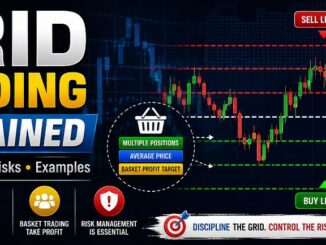
Basket trading and grid trading are commonly used together, but they are not the same thing.
A grid strategy primarily determines how and where multiple trades are opened.
Basket management determines how a group of positions is managed or closed.
For example:
An EA might open additional BUY positions whenever XAUUSD moves a predefined distance.
That is grid-style entry logic.
The EA might then close every BUY position when their combined profit reaches $100.
That is basket-management logic.
In simple terms:
Grid Trading = How positions are built
Basket Trading = How positions are managed collectively
A strategy can therefore use basket management without necessarily using a grid.
Likewise, not every grid trading strategy must use a basket exit.
Basket Trading vs Martingale
Basket trading is also frequently confused with martingale trading.
They are not the same thing.
Basket trading refers to managing several positions together.
Martingale generally involves increasing position size after losses or adverse price movements according to some predefined progression.
For example, a basket could contain:
0.01 lot
0.01 lot
0.01 lot
0.01 lot
The position sizes remain constant.
Another strategy could contain:
0.01 lot
0.02 lot
0.04 lot
0.08 lot
The rapidly increasing lot sizes could represent martingale-style money management.
Therefore:
Basket trading does not automatically mean martingale.
A basket is simply a collection of positions being managed together.
The actual risk depends on:
- Lot sizes
- Position spacing
- Maximum trades
- Entry rules
- Leverage
- Stop-loss rules
- Basket limits
- Account size
Average Entry Price in Basket Trading
When several positions are opened in the same direction, the average entry price becomes important.
Consider three equally sized BUY positions:
BUY 1 = 2,500
BUY 2 = 2,490
BUY 3 = 2,480
Their approximate average entry price is:
2,490
This means price does not necessarily need to return to the original 2,500 entry for the combined positions to approach break-even.
This principle is commonly used in averaging strategies.
However, improving the average entry price does not automatically reduce account risk.
Every additional trade also increases total market exposure.
If price continues moving against the basket, floating losses can increase significantly.
Lot Size Becomes More Important as the Basket Grows
Imagine opening one:
0.01-lot position
The exposure appears relatively small.
But suppose the strategy eventually opens ten separate:
0.01-lot positions
Combined exposure becomes:
0.10 lot
Therefore, traders should not evaluate basket risk based only on the size of an individual trade.
They need to monitor the combined lot exposure of the entire basket.
This is particularly important when trading volatile instruments such as gold.
Our XAUUSD Risk Management Guide explains how position sizing, leverage, Stop Loss, account size, and total exposure affect trading risk.
Basket Trading and Drawdown
Drawdown is one of the most important risks associated with basket trading.
Some basket systems intentionally allow earlier positions to move into floating loss while additional trades are opened.
Consider this example:
Account Balance: $10,000
Open Basket Floating Loss: -$2,000
Current account equity is therefore approximately:
$8,000
Even though the account balance still shows $10,000, the account has already experienced significant equity drawdown.
This distinction is extremely important when evaluating an Expert Advisor.
A trading system can show many profitable closed baskets while simultaneously experiencing very large floating losses before those baskets eventually recover.
Therefore, traders should evaluate:
- Balance drawdown
- Equity drawdown
- Maximum drawdown
- Floating loss
- Margin level
- Maximum basket size
—not simply the number of winning baskets.
The Biggest Risk of Basket Trading
A dangerous misconception is believing that opening several positions somehow reduces risk automatically.
It does not.
Imagine an automated strategy repeatedly buying as the market continues falling.
The EA opens:
BUY 1
BUY 2
BUY 3
BUY 4
BUY 5
BUY 6
BUY 7
BUY 8
Each additional trade may improve the average entry price.
However, each trade also increases total market exposure.
If the market eventually reverses, the basket may recover quickly.
But what happens if price continues falling?
Floating loss can continue increasing while margin is consumed by additional positions.
This becomes especially dangerous when basket trading is combined with:
- Large starting lot sizes
- Martingale multipliers
- Very small grid spacing
- Unlimited entries
- High leverage
- No Basket Stop Loss
- No equity protection
- Insufficient account capital
The U.S. Commodity Futures Trading Commission’s forex risk advisory specifically warns that leverage magnifies both gains and losses and that traders using margin can potentially lose all of their margin and more.
Basket traders should therefore consider maximum potential exposure, not simply expected basket profit.
Margin Risk in Basket Trading
Every open position normally requires margin.
As the basket grows, the amount of used margin can also increase.
Suppose an EA keeps opening positions while the market continues moving against the original direction.
The account now faces two simultaneous problems:
1. Floating loss is increasing.
2. Available margin is decreasing.
Eventually, the account may reach a point where there is insufficient free margin to continue supporting the positions.
Depending on the broker’s rules and account conditions, this can eventually result in forced position liquidation.
This is why traders should understand their broker’s:
- Margin requirement
- Stop-out level
- Contract size
- Leverage
- Lot specifications
before operating a multi-position strategy.
When trading gold specifically, our What Is XAUUSD? Beginner’s Guide explains the basic contract concepts new gold traders should understand.
Basket Trading on MetaTrader 5
Basket-management behavior can also depend on the type of MetaTrader 5 account being used.
MetaTrader 5 supports two position-accounting systems:
Hedging
and
Netting
According to the official MetaTrader 5 position-accounting documentation, the accounting system is determined by the trading account and broker.
Understanding the difference is important for basket EAs.
Basket Trading on a Hedging Account
Under MetaTrader 5’s hedging system, multiple separate positions can exist on the same symbol.
For example:
XAUUSD BUY 0.01
XAUUSD BUY 0.01
XAUUSD BUY 0.02
XAUUSD SELL 0.01
These can exist as separate positions.
This structure is particularly suitable for many basket and grid-based EAs because the program can individually identify each position while still calculating their combined basket result.
Official MetaTrader documentation confirms that a hedging account can maintain multiple positions on the same symbol, including positions in opposite directions.
Basket Trading on a Netting Account
Netting accounts behave differently.
Under MetaTrader 5’s netting system, there can generally be only one common position for a symbol.
For example:
BUY 0.50 EURUSD
followed by another:
BUY 0.50 EURUSD
does not result in two independent BUY positions.
Instead, the existing position volume becomes:
BUY 1.00
An opposite transaction can reduce, close, or reverse the existing position.
Therefore, an EA designed around multiple independent positions must correctly account for whether the trading account is using a hedging or netting system.
This should always be checked before running a basket-management EA.
Separate BUY and SELL Baskets
Advanced Expert Advisors may manage BUY and SELL trades independently.
Consider this example.
BUY Basket
BUY 1 = +$30
BUY 2 = +$40
BUY 3 = -$10
Combined BUY Basket:
+$60
SELL Basket
SELL 1 = -$20
SELL 2 = +$5
Combined SELL Basket:
-$15
A sophisticated basket-management EA could close the profitable BUY basket while allowing the SELL basket to continue operating.
This provides considerably more flexibility than combining every open position into one global basket.
However, it also introduces additional complexity because the account could simultaneously carry exposure in both directions.
Basket Trading and XAUUSD
Basket trading can become particularly risky when applied to XAUUSD because gold can experience significant short-term volatility.
XAUUSD can react sharply to:
- U.S. inflation data
- Federal Reserve decisions
- U.S. employment reports
- Interest-rate expectations
- U.S. dollar movements
- Geopolitical developments
- Changes in global risk sentiment
The timing of gold trading can also affect volatility.
Our guide to XAUUSD Trading Sessions explains how trading activity differs during the Asian, London, and New York sessions.
A basket system that performs comfortably during quiet market conditions may behave very differently during a major economic announcement.
Spread Also Matters in Basket Trading
Spread should not be ignored when running several positions.
Every entry carries a transaction cost.
If an EA opens many trades, those trading costs can accumulate.
Spread can also widen significantly during:
- Major news
- Market rollover
- Low liquidity
- Highly volatile conditions
For basket and grid systems that open trades relatively close together, unusually high spreads may materially affect strategy performance.
Our complete guide to XAUUSD Spread Explained covers how spread works and why automated traders should consider spread filters.
Basket Trading Does Not Guarantee Recovery
One particularly dangerous assumption surrounding averaging and basket strategies is:
“The market will eventually come back.”
It might.
But it does not have to return before the trading account reaches its risk or margin limits.
Financial markets can trend much farther and for much longer than expected.
Gold, currencies, indices, and other markets can experience extended directional movements caused by major fundamental changes.
A strategy that depends completely on eventual market reversal may therefore accumulate substantial exposure before recovery occurs.
The CFTC warns that forex trading can involve substantial risk and that traders should not commit funds they cannot afford to lose. Read the CFTC’s foreign currency risk guidance
A basket system should therefore have clearly defined risk controls rather than relying solely on the assumption that price will eventually reverse.
Important Basket Trading Risk Controls
Anyone evaluating a basket strategy should understand the following risk controls.
Maximum Number of Trades
This limits how many positions the strategy is allowed to open.
For example:
Maximum Trades = 5
After the fifth position opens, the EA cannot add another trade until existing positions are closed.
Maximum Total Lot Size
Instead of limiting only the number of positions, the strategy can also limit total exposure.
For example:
Maximum Basket Exposure = 0.10 lot
This prevents the basket from continuously increasing position volume.
Basket Stop Loss
A basket Stop Loss limits the maximum permitted combined loss.
Example:
Maximum Basket Loss = -$200
When the combined floating result reaches the limit, all positions belonging to the basket are closed.
Equity Protection
Equity protection monitors the entire trading account rather than one basket.
For example, an EA could stop trading or close positions if account equity falls below a predefined threshold.
This can provide an additional account-level safety mechanism.
Maximum Drawdown
A trader should determine the maximum level of account decline considered acceptable.
This is particularly important when evaluating basket EAs because floating losses may be significantly larger than the closed-trade history suggests.
Grid or Entry Spacing
If a basket strategy adds trades as the market moves, the distance between entries can dramatically affect how quickly exposure accumulates.
Smaller spacing normally causes new trades to be added faster.
Maximum Spread Filter
An EA may prevent new trades from opening when the current spread exceeds a predetermined threshold.
This can be particularly important during volatile trading conditions.
How to Evaluate a Basket Trading EA
Before using a basket-based Expert Advisor, do not focus only on profit.
Ask the following questions:
- How does the EA decide when to open another trade?
- What is the maximum number of open positions?
- Does the lot size remain constant or increase?
- Does the strategy use martingale?
- How far apart are additional entries?
- Is there a Basket Stop Loss?
- Does the EA have equity protection?
- What is the historical maximum drawdown?
- What happens during a strong one-directional trend?
- Can BUY and SELL baskets operate simultaneously?
- What is the maximum possible combined lot size?
- How much margin could the maximum basket consume?
- Does the EA require a hedging account?
- How does the EA behave when spreads increase?
These questions reveal far more about the true risk of a basket strategy than simply looking at win rate.
Do Not Judge a Basket EA Only by Win Rate
Basket systems can sometimes produce unusually high percentages of winning baskets.
That can look impressive.
For example:
95 profitable baskets
5 losing baskets
The apparent win rate is:
95%
But imagine that most winning baskets produce:
+$20
while one losing basket produces:
-$2,000
The high win rate suddenly becomes much less impressive.
This demonstrates why traders should evaluate:
- Average profit
- Average loss
- Maximum drawdown
- Equity curve
- Risk-to-reward
- Maximum exposure
- Recovery time
- Margin usage
A high percentage of profitable baskets does not automatically mean a trading system has low risk.
Basket Trading vs Single-Trade Trading
Neither approach is automatically better.
A traditional single-trade strategy normally has relatively straightforward risk.
For example:
One entry
One lot size
One Stop Loss
One Take Profit
One defined risk amount
A basket strategy may dynamically change exposure as additional trades are opened.
That provides greater flexibility, but it also creates greater complexity.
For example:
One trade becomes three.
Three trades become six.
0.01 lot becomes 0.06 total lots.
Floating loss changes continuously.
Average entry changes.
Margin usage increases.
Therefore, the trader must understand the maximum possible basket, not simply the risk of the first trade.
Is Basket Trading Suitable for Beginners?
Beginners can certainly learn the concept of basket trading.
However, operating basket strategies with real money requires a solid understanding of risk.
Before using one, traders should understand:
- Lot size
- Leverage
- Margin
- Stop Loss
- Take Profit
- Floating profit and loss
- Account balance
- Account equity
- Drawdown
- Maximum drawdown
- Spread
- Automated trading
- Expert Advisors
Beginners who are still learning the fundamentals of gold trading should begin with our How to Trade XAUUSD for Beginners before experimenting with more complicated multi-position strategies.
Advantages of Basket Trading
Potential advantages include:
- Multiple trades can be managed collectively.
- Winning positions can offset losing positions.
- Automated systems can manage complex groups of trades.
- Strategies can target combined profit instead of requiring every trade to win.
- BUY and SELL baskets can potentially be managed independently.
- Basket trailing can protect accumulated group profit.
- Average entry price can be managed dynamically.
- Basket logic works well with certain multi-entry automated strategies.
Disadvantages of Basket Trading
Potential disadvantages include:
- Floating drawdown can become very large.
- Total market exposure may be underestimated.
- Multiple small positions can become one large combined exposure.
- Margin usage increases as positions accumulate.
- Aggressive averaging can increase risk rapidly.
- Martingale lot progression can magnify losses.
- Extended trends can severely affect recovery strategies.
- Basket systems may appear safer than they actually are because losing positions remain open.
- High win rates can disguise unfavorable risk-to-reward characteristics.
- Complex basket logic can be difficult for beginners to evaluate.
Frequently Asked Questions About Basket Trading
What does basket mean in forex trading?
A basket is a collection of positions that a trader or automated trading system treats as one group.
The combined profit or loss of the positions can be used to determine when the entire group should be closed.
What is basket profit?
Basket profit is the combined profit or loss of all trades belonging to a specific basket.
For example:
+$50
-$20
+$40
Total Basket Profit:
+$70
What is a basket Take Profit?
A basket Take Profit closes multiple positions when their combined profit reaches a predetermined target.
It differs from a normal Take Profit, which generally applies to an individual position.
What is a basket Stop Loss?
A basket Stop Loss closes a group of trades when their combined loss reaches a predetermined maximum.
It can help prevent a losing basket from growing indefinitely.
Is basket trading the same as grid trading?
No.
Grid trading generally refers to the method used to open multiple positions at predetermined price intervals.
Basket trading refers to managing a group of positions collectively.
A strategy can use both simultaneously.
Is basket trading martingale?
Not necessarily.
A basket can contain several trades using identical lot sizes.
Martingale generally involves increasing position size following losses or adverse price movement.
A basket strategy may use martingale, but basket trading itself is not martingale.
Can basket trading lose money?
Yes.
Basket trading does not eliminate trading risk.
If the market continues moving against accumulated positions, floating losses and margin usage can increase substantially.
Can basket trading be automated?
Yes.
Basket management is frequently implemented through Expert Advisors because an EA can continuously monitor several positions and calculate their combined profit, loss, exposure, drawdown, and exit conditions.
Does MT5 support multiple trades on the same symbol?
It depends on the account’s position-accounting system.
MetaTrader 5’s official documentation states that hedging accounts can maintain multiple separate positions on the same symbol, while netting accounts maintain one common position per symbol.
Traders using basket EAs should therefore verify the account type required by their automated system.
Final Thoughts
Basket trading is a method of managing several trading positions collectively rather than evaluating every trade entirely on its own.
A basket can contain winning and losing positions simultaneously.
What matters to a basket-management system is the combined result of those positions.
This makes features possible such as:
- Basket Take Profit
- Basket Stop Loss
- Basket trailing profit
- Average entry management
- Separate BUY and SELL baskets
- Multi-position recovery logic
- Automated equity management
However, basket trading should never be judged solely by how frequently baskets close in profit.
The more important questions are:
How much total exposure is being accumulated?
How large can floating drawdown become?
What is the maximum basket size?
How much margin can the strategy consume?
What happens if the market continues trending instead of reversing?
A trading system that repeatedly generates small basket profits while occasionally carrying extremely large floating losses may be far riskier than its closed-trade history suggests.
That is why basket trading should always be evaluated together with position sizing, maximum drawdown, margin usage, leverage, equity protection, entry spacing, and total account exposure.
Understanding the complete risk structure—not simply the basket profit target—is what allows traders to properly evaluate a basket trading strategy.
Continue Learning
Build on this topic with these Pinoy Pip Hunter guides:
Risk Management:
XAUUSD Risk Management Guide
Gold Trading Fundamentals:
What Is XAUUSD? A Beginner’s Guide to Trading Gold
Beginner Trading Guide:
How to Trade XAUUSD for Beginners
Trading Sessions:
XAUUSD Trading Sessions Explained
Spread and Trading Costs:
XAUUSD Spread Explained
Automated Trading:
Algorithmic Trading for Beginners
External References
For further technical and risk information:
MetaTrader 5 — Position Accounting: Netting and Hedging
Be the first to comment